
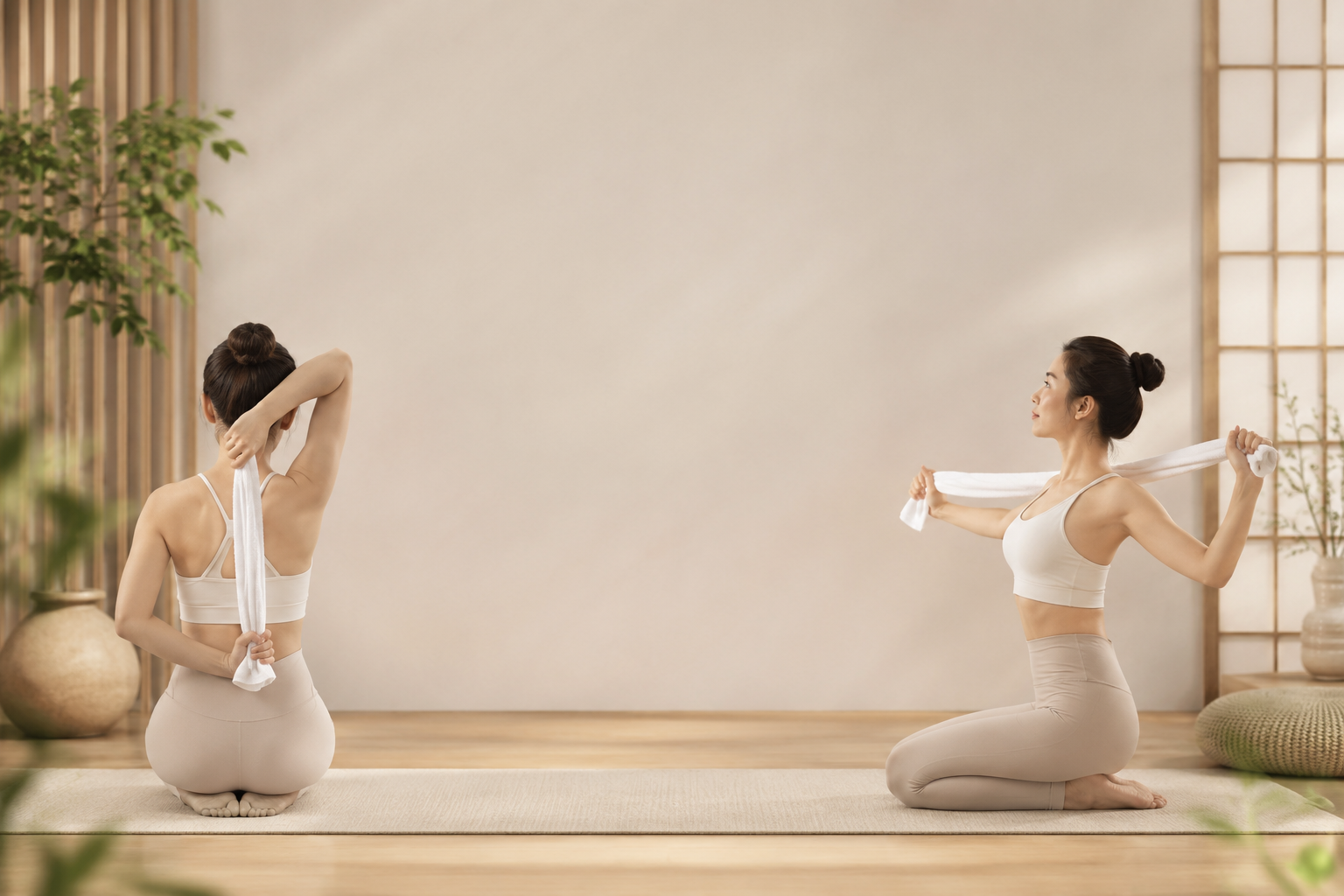
Japanese towel exercise is a 5-minute posture correction technique created by Japanese reflexology specialist Dr. Toshiki Fukutsudzi. It involves lying flat on your back with a rolled-up towel placed under your lower back (behind the navel), keeping your feet shoulder-width apart with the big toes touching, and stretching your arms overhead with palms down and pinky fingers touching. You hold the position for about 5 minutes a day. The exercise does not directly burn belly fat, but it can improve pelvic alignment, ease lower back tension, activate deep core muscles, and make your midsection appear flatter by correcting posture. Most people report subtle waistline changes after 2 to 4 weeks of daily practice combined with a proper diet and movement. It is a helpful add-on for posture and core activation, but not a stand-alone weight loss method.
What the Japanese Towel Exercise Actually Is
Also known as the Fukutsudzi method or towel technique, this exercise was developed by Dr. Toshiki Fukutsudzi, a Japanese reflexology and posture specialist. He originally introduced it to help his patients with chronic back pain and poor posture. After years of clinical observation, he noticed that many of them also saw slimmer waistlines and better core alignment as a side effect.
His theory was simple: a big part of belly bulge is not fat, it is a misaligned pelvis. When the pelvis tilts forward (called anterior pelvic tilt, which is extremely common from too much sitting), the lower abdomen pushes out and the spine curves unnaturally. Correcting that tilt, he argued, could make the stomach look flatter without touching diet or exercise.
The exercise itself is embarrassingly simple. No equipment beyond a rolled bath towel. No gym membership. No sweating.
How to Do the Japanese Towel Exercise (Step by Step)
You need a firm surface (yoga mat or hard floor), a bath towel, and 5 quiet minutes.
Step 1: Roll a bath towel tightly into a cylinder about 4 inches thick and 15 inches long. Secure it with string or a rubber band so it holds its shape.
Step 2: Sit on the floor and place the rolled towel just behind your belly button, lined up horizontally under your lower back.
Step 3: Lie back slowly so the towel sits directly under your navel line, supporting your lumbar spine.
Step 4: Stretch your legs out, keeping them about shoulder-width apart. Turn your feet inward so the big toes touch each other while your heels stay roughly 8 inches apart. This creates a triangle shape with your feet.
Step 5: Extend both arms straight over your head. Rotate them so your palms face down and your pinky fingers touch. Your arms should form an inverted V above your head.
Step 6: Hold the position for 5 minutes. Breathe slowly and deeply. That is one full session.
Do this once daily. Start with 2 to 3 minutes if 5 feels too intense, especially in the first week.
Does the Japanese Towel Exercise Actually Work?
Let us be honest. This is where the marketing and the science part ways.
What it does: It stretches the spine, encourages proper pelvic alignment, activates the deep transverse abdominis muscle (the “corset” muscle), and helps counteract hours of sitting. Improving posture alone can make your belly look 1 to 2 inches smaller almost immediately, because you stop slouching and your lower abdomen no longer pushes forward.
What it does not do: Burn calories, target fat, or directly reduce visceral or subcutaneous fat. You cannot lie on a rolled towel for 5 minutes a day and expect to lose actual body fat. The reality of fat loss is that it always requires a calorie deficit, and no static stretch changes that. If you have been wondering can you target fat loss in a specific area, the research is clear that spot reduction is a myth regardless of the method.
So the exercise is not fake. It is just often oversold. Think of it as a posture reset, not a fat burner.
The Real Benefits of Doing It Daily
Even if it will not melt fat, the Japanese towel exercise has some legitimate benefits worth knowing about:
Improved posture: Correcting anterior pelvic tilt makes you look taller, leaner, and more upright.
Reduced lower back pain: Many desk workers report that the gentle spinal stretch takes pressure off the lumbar spine and reduces daily tension.
Better core activation: The awkward arm and leg position forces the deep abdominal muscles to work isometrically, which strengthens them subtly over time.
Slimmer-looking waistline: Not from fat loss, but from realigning your pelvis and reducing the lower belly pooch caused by poor posture.
Lower stress and better breathing: Five minutes of stillness with focused breathing works like a mini meditation. This matters because stress and elevated cortisol are directly linked to stubborn belly weight through cortisol belly patterns.
Zero equipment, zero cost: You can do it in your bedroom before bed. There is no barrier to entry, which is why the trend keeps circling back on TikTok.
What About the Side Effects?
For most people, the exercise is safe. But there are a few things to watch for.
Lower back discomfort: If you have existing lumbar spine issues, herniated discs, or spinal stenosis, this position can aggravate them. Speak to a doctor first.
Rib and shoulder tightness: The arm position feels awkward for people with tight shoulders, and forcing it can strain the rotator cuff.
Numbness or tingling: If your feet, hands, or lower back go numb, come out of the position immediately. Numbness means you are compressing something you should not be.
Post-surgery recovery: Anyone recovering from abdominal surgery, back surgery, or pregnancy should not attempt this without medical clearance.
If the position causes pain rather than a gentle stretch, stop. This is a mild restorative exercise, not a challenge.
Realistic Results: What to Expect in 2 to 4 Weeks
Most people who commit to daily practice see:
- Better posture within 1 to 2 weeks
- Less lower back tension by week 2
- A slight visual reduction in belly appearance by week 3 to 4
- A more toned lower abdomen feel from core engagement over 1 to 2 months
What you will not see is actual fat loss unless you also address diet, movement, and sleep. If your goal is to lose belly fat, you need to know how to lose belly fat naturally through a real strategy, not a stretch alone.
What Actually Works for Real Belly Fat Loss
If you want the towel exercise to actually give you results, pair it with the things that genuinely drive fat loss:
A calorie deficit: Nothing works without this. A moderate calorie deficit diet of 300 to 500 calories below maintenance is the foundation.
Enough protein: A high protein diet for weight loss keeps you full, protects muscle, and controls cravings.
Consistent movement: The best cardio for weight loss is whatever you will actually do daily, whether that is walking, swimming, or cycling.
Strength training: Strength training for weight loss is what builds the tight, defined core the towel exercise cannot on its own.
Complementary practices: If you enjoy the low-impact style of the towel method, you might also benefit from pilates or yoga, which offer deeper core and flexibility work.
Stack these on top of the towel exercise and you actually get somewhere. Use the towel alone and you get better posture but the same waistline.
When Diet and Simple Exercises Are Not Enough
For a lot of people, especially those carrying significant weight or dealing with hormonal issues, gentle exercises and self-directed diets simply do not touch the problem. That is not a personal failure. It is biology working against you.
If you have been trying every method under the sun (towel exercises, walking, calorie counting, fastest weight loss methods you have read about online) and the scale still will not budge, medical support is a legitimate next step. A structured medical weight loss clinic can identify the underlying cause. A GLP-1 weight loss program can address appetite regulation. For those with higher BMI or metabolic conditions, bariatric surgery offers a lasting solution.
The Honest Verdict
The Japanese towel exercise is a genuinely useful posture and core activation tool. It is not the belly fat miracle TikTok makes it out to be, but it is a low-effort habit that costs nothing and delivers real posture, back pain, and core engagement benefits. Combine it with sustainable healthy habits for losing weight and you have something worth doing.
If stubborn belly fat has followed you for years despite everything you have tried, the team at BodEvolve Bariatric works with patients across Dallas, Arlington, Richardson and Texarkana to build medically supported plans that address the real biological drivers instead of another 5-minute trick.
Frequently Asked Questions
Does the Japanese towel method really work?
It works for posture correction, mild back pain relief, and making your midsection appear flatter by fixing pelvic tilt. It does not directly burn belly fat. Combined with a calorie deficit and movement, it can support a slimmer appearance, but on its own it will not cause fat loss.
How long should you do the Japanese towel method?
Start with 2 to 3 minutes daily if you are new, then work up to 5 minutes once a day. Most people see posture and back tension benefits within 2 to 4 weeks of consistent daily practice. Doing more than 5 minutes offers no extra benefit.
Is the towel method really effective?
Yes for posture, spinal alignment, and core activation. No for actual fat loss. Its effectiveness is often overstated online, but it is a legitimate mild restorative exercise that offers real benefits when expectations are realistic.
What are the benefits of towel exercise?
The main benefits include better pelvic alignment, reduced lower back tension, activation of the deep transverse abdominis muscle, improved posture, subtle waist appearance reduction, and a calming 5-minute mindfulness effect. It is a low-impact habit that fits into any routine.
Can the Japanese towel exercise flatten your stomach in 10 days?
It can visually flatten your stomach through better posture, but not through actual fat loss. In 10 days, most people notice they stand taller and their lower belly pooch looks reduced, though the fat itself has not changed.
Are there any risks to doing this exercise daily?
For most people, no. Those with lower back issues, herniated discs, or recent abdominal surgery should consult a doctor first. Stop immediately if you feel sharp pain, numbness, or tingling.
