
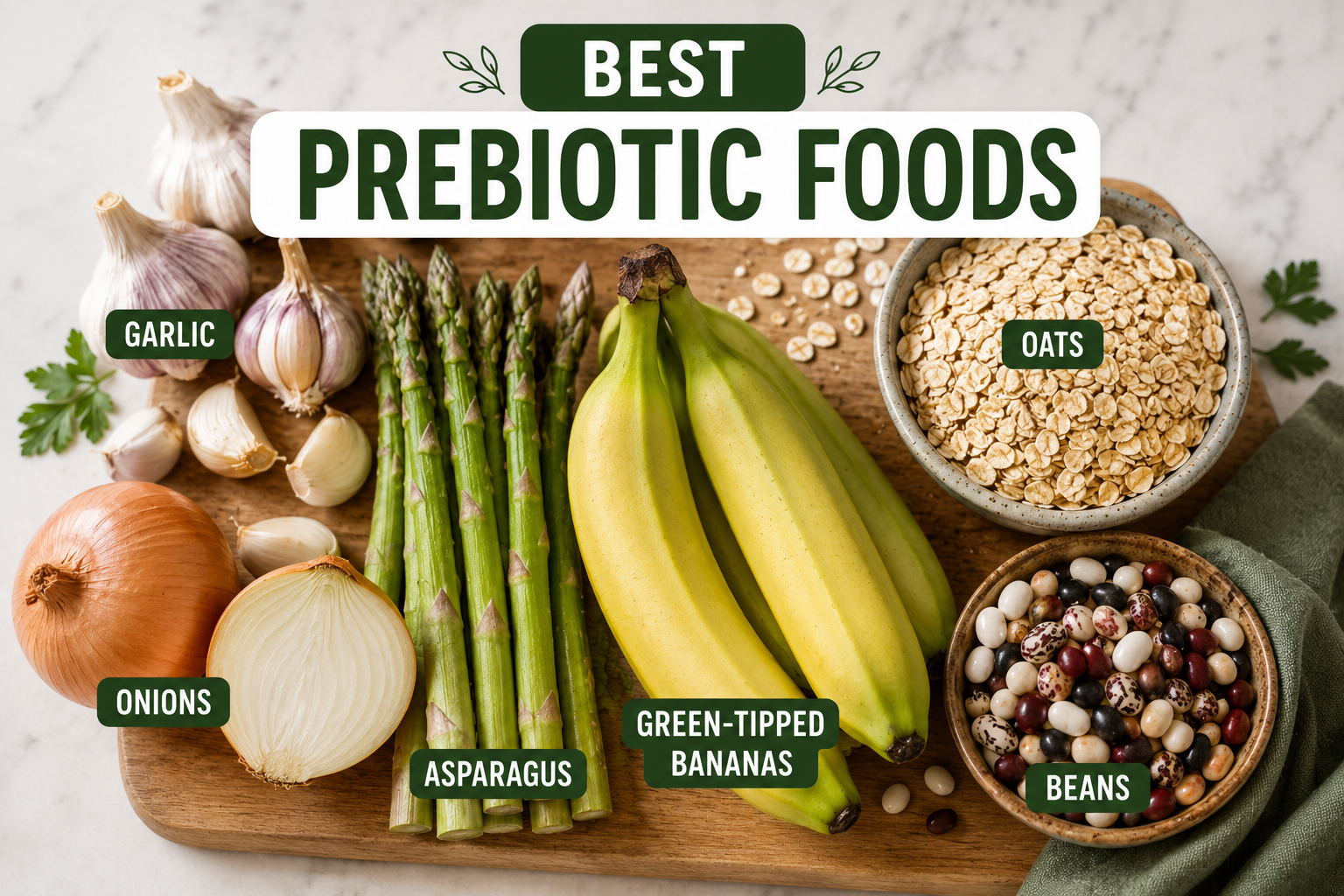
When people ask about the best prebiotic foods they are usually surprised by the answer. It is not something you find in a supplement aisle. Rather in a grocery list. Prebiotic foods are the fibers that feed the beneficial bacteria already living in your gut. The effective sources of prebiotics are not capsules but rather ordinary foods that most people already have in their kitchen and do not eat enough of.
We talked about the difference between prebiotics vs probiotics for weight loss in our guide. This guide is about which foods actually deliver fiber, how much you need and the part that nobody warns you about, which is the bloating especially if you have had bariatric surgery.
At BodEvolve Bariatric Surgery Center in Texas, Dr. Frenzel and our team spend a lot of time on gut health. This is because for our patients gut health directly affects digestion, nutrient absorption and how comfortable recovery feels. Here is the honest food-first breakdown.
What Makes a Food a Prebiotic?
A prebiotic food contains a kind of fiber that your body cannot digest. Of being absorbed it passes through to your colon, where your gut bacteria ferment it for fuel. That fermentation produces short-chain fatty acids, which are linked to fullness reduced inflammation and better metabolic health.
The fibers that do this are mostly inulin, fructooligosaccharides, galactooligosaccharides and resistant starch. You do not need to remember the names of these fibers. You just need to know which foods are richest in them.
Best Prebiotic Foods for Gut Health
These are the foods with the prebiotic fiber content, the ones that are genuinely worth prioritizing.
1. Chicory root is the most concentrated natural source of inulin. It is where most supplement inulin actually comes from. You will rarely eat it whole. It is why chicory-root fiber shows up in so many products.
2. Garlic is rich in both inulin and fructooligosaccharides. It feeds beneficial bacteria. A little goes a way and it is easy to add to almost anything.
3. Onions and leeks are staples that deliver inulin and fructooligosaccharides in amounts. Because you cook with them constantly they are one of the realistic ways to raise your prebiotic intake without trying.
4. Asparagus is an inulin source that also brings antioxidants and other nutrients that no supplement replicates.
5. Slightly under-ripe bananas are high in starch. As a banana ripens and sweetens that starch converts to sugar so the greener banana is the better prebiotic.
6. Oats contain beta-glucan and resistant starch feeding gut bacteria while also supporting cholesterol. They are one of the prebiotic foods to eat daily.
Best Natural Prebiotic Foods You Already Eat
Beyond the hitters a lot of everyday foods quietly contribute prebiotic fiber. Building meals around these is more sustainable than chasing a single “superfood.”
A) Legumes, such as beans, lentils and chickpeas are loaded with starch and fiber. They are among the powerful prebiotic foods and also the most likely to cause gas if you ramp up too fast.
B) Apples contain pectin, a fiber that feeds bacteria and supports short-chain fatty acid production.
C) Cooled cooked potatoes and rice are a trick: cooking then cooling starchy foods like potatoes or rice increases their resistant starch. A cold potato salad or cooled rice has prebiotic value than the same food served hot.
D) Barley and whole grains are beta-glucan- grains that feed gut bacteria and support fullness.
E) Flaxseeds add fiber plus the bonus of omega-3s.
A varied diet of vegetables, whole grains, legumes and fruit delivers fiber from many angles, which is exactly what a healthy microbiome thrives on.
Best Prebiotic and Probiotic Foods Together
Prebiotics feed bacteria; probiotics are bacteria. Eat them together. They reinforce each other. This pairing is the food version of a “synbiotic,” without the supplement price tag.
Pair prebiotic foods with probiotic ones: yogurt or kefir with sliced banana and oats; a stir-fry of garlic, onion and asparagus alongside a side of kimchi; or lentils with a spoon of fermented vegetables.
For the full picture on the probiotic half of that equation, including which strains have the best weight-loss evidence, see our guide to the best probiotics for weight loss.
Prebiotic Foods for Weight Loss
This is the question behind prebiotic searches so here is the honest answer: prebiotic foods support weight loss but they do not cause it.
The mechanism is real. Prebiotic fiber slows digestion increases fullness and feeds the bacteria that produce appetite-regulating compounds. People who eat prebiotic fiber tend to feel satisfied on fewer calories, which makes a calorie-aware eating plan easier to stick to. That is genuinely useful.
What it is not is a fat-burner. No food melts fat and the difference between “supports your plan” and “does the work for you” is where supplement marketing oversells. Prebiotic foods are a tool that makes eating well easier. They are a supporting player, not the lead. For patients needing weight loss our medical weight management program and surgical options do the heavy lifting, with gut-supporting foods rounding out the plan.
Prebiotics and Bloating: Start Low Go Slow
This is the part that best prebiotic foods” lists skip entirely and it is the most important practical advice in this guide.
Prebiotic fiber ferments in your colon and fermentation produces gas. So when you suddenly load up on garlic, onions, beans and inulin the predictable result is bloating, cramping and excess gas. Most people read that discomfort as a sign that these foods “do not agree with them” and back off when the real fix is simply adding foods gradually over two to three weeks so your gut bacteria adapt.
Start with portions increase slowly drink plenty of water and spread fiber across the day rather than front-loading it. Given a couple of weeks the bloating typically. The benefits remain.
Prebiotic Foods After Bariatric Surgery
For our patients the bloating issue is not a footnote. It is a consideration that changes the plan.
After a gastric sleeve or gastric bypass, your altered anatomy and changed gut environment make you noticeably more sensitive to fermentable fiber. The same beans or raw onions that barely register for someone else can cause discomfort for a post-op patient particularly in the early months. High-prebiotic foods are not off-limits. They need to be introduced carefully in small amounts and at the right stage of recovery.
The importance is all the greater in relation to such highly intricate operations as the duodenal switch or SADI-S, as well as bariatric revision surgery, in which the digestive system is disrupted significantly. If you’ve had surgery, we’d rather guide you on which prebiotic foods to add and when, as part of your overall post-bariatric diet, than have you guess and end up uncomfortable.
Gut Microbiome and Weight Loss: The Bigger Picture
Your gut holds 100 trillion bacteria and their balance influences how many calories you extract from food how full you feel and how your body stores fat. Feeding that ecosystem well with a range of foods is one of the simplest cheapest things you can do for your gut and it pays off in digestion and comfort regardless of what the scale does.
It is worth keeping perspective. A healthy microbiome supports a weight-loss plan; it does not replace one. The patients who succeed term are the ones who treat gut-friendly eating as part of a structured approach not as the whole strategy.
Expert Bariatric and Weight Loss Care Across Texas
BodEvolve serves patients, throughout the Dallas-Fort Worth metroplex from four locations:
1. Arlington- serving Tarrant County
2. Richardson- our primary facility
3. Dallas- serving central Dallas County
4. Texarkana- Serving East Texas and Southwest Arkansas
Good gut health starts on your plate. It is one piece of a bigger picture. If you are working toward weight loss and want a real plan talk to our bariatric surgeon Dr. Frenzel and the BodEvolve team. We will help you build an approach that fits your body and your goals.
Book Your Consultation
