
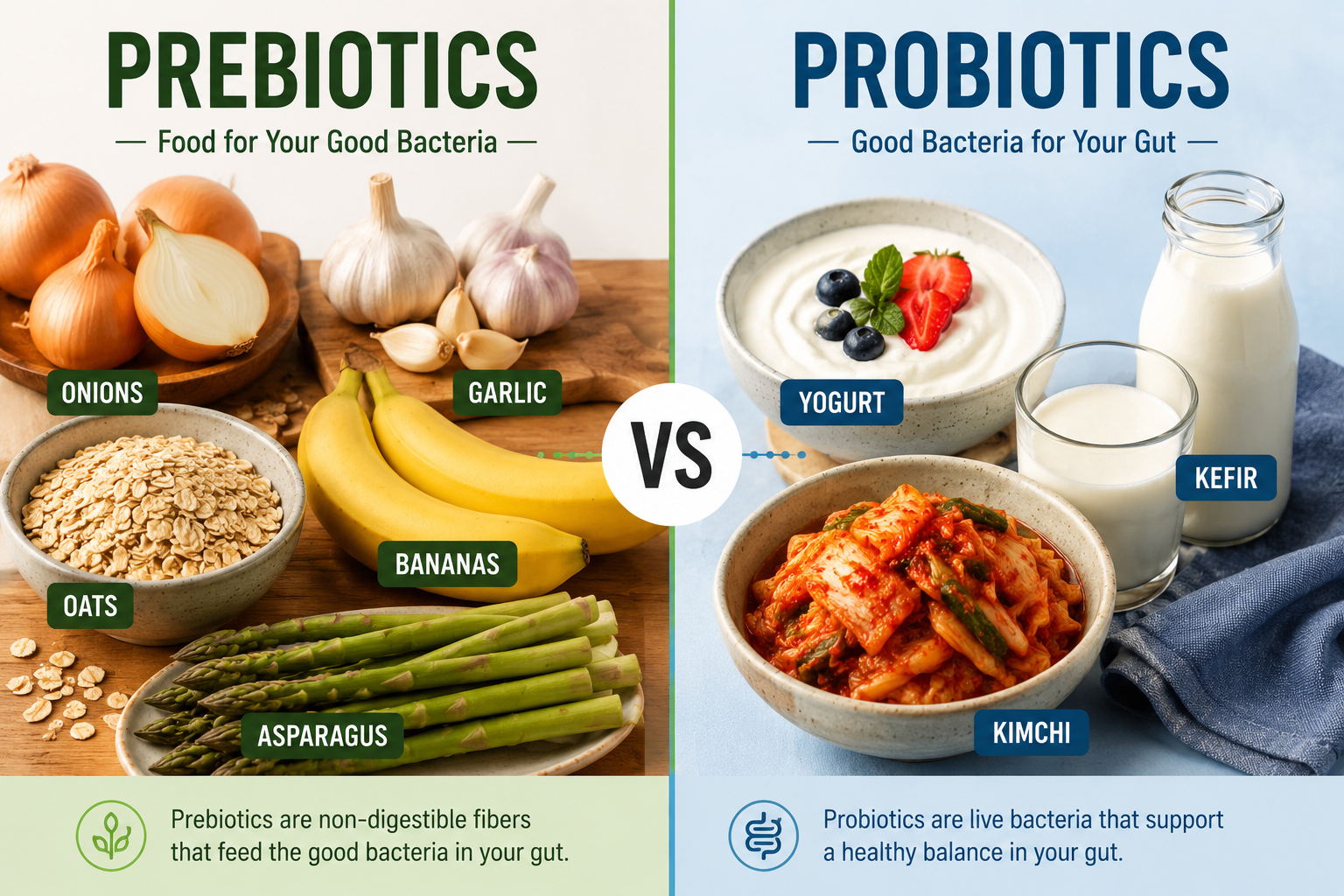
When patients ask us about probiotic vs prebiotic for weight loss and how it relates to weight loss always stems from the same misconception. While everybody hears about probiotics, the helpful bacteria in yoghurt, almost no one knows what prebiotics are. Moreover, they might not even guess that picking one out over the other can be important if one needs to lose some weight. What makes consumers confused? There must be a reason behind it because this ignorance helps sell products, making people buy something they don’t entirely understand. The answer lies in the name itself- one is bacteria, while the other one is its food.
Everyday we hear the question: “Should I use prebiotics, probiotics, or both to lose weight?” This is quite reasonable, and there is a truthful answer that cannot be found on the majority of product’s labels. Probiotics are bacteria themselves while prebiotics feed them with fibers. Besides, only one of these groups of substances deserves attention due to evidence-based research.
At BodEvolve Bariatric Surgery Center in Texas, Dr. Frenzel and our team work with patients every day whose gut health shapes how they lose weight absorb nutrients and recover from surgery. Here’s the straight comparison, what the research supports and where the marketing has run ahead of the science.
What is the difference between prebiotics and probiotics?
The way to think about it: probiotics are the live bacteria the probiotics are the live bacteria and prebiotics are the food that feeds them the prebiotics are the food that feeds them.
Probiotics are microorganisms the probiotics are live microorganisms. Strains like Lactobacillus and Bifidobacterium that you add to your gut through fermented foods or supplements. We covered these in depth in our guide to the best probiotics for weight loss.
Prebiotics are types of fiber your body can’t digest the prebiotics are types of dietary fiber your body can’t digest. They pass through to your colon, where the bacteria already living there ferment them for fuel. Common prebiotics include inulin, fructooligosaccharides and resistant starch found in foods like onions, garlic, oats, bananas and asparagus.
Here’s why the distinction matters for weight: a probiotic adds bacteria the probiotic adds bacteria but if you don’t feed them they don’t thrive. A prebiotic feeds the bacteria you already have the prebiotic feeds the beneficial bacteria you already have helping them multiply and produce the compounds linked to appetite and fat regulation. They work best together. They are not interchangeable and a lot of “prebiotic” weight-loss marketing borrows credibility from probiotic research that doesn’t actually apply to it the probiotic research.
Do prebiotics and probiotics help with weight loss?
Both can play a supporting role the prebiotics and probiotics can play a supporting role. Neither is a weight-loss treatment on its own the prebiotics and probiotics are not a weight-loss treatment on its own. That’s the framing and its worth sitting with before you spend money on either the prebiotics or probiotics.
The mechanism both share runs through your gut microbiome the gut microbiome. Your gut holds 100 trillion bacteria and the balance of those bacteria influences how many calories you extract from food how full you feel and how your body stores fat. Prebiotics and probiotics both nudge that balance in a direction through three pathways:
1. Short-chain fatty acid production- When gut bacteria ferment prebiotic fiber they produce compounds that signal fullness and help regulate fat storage. This is actually where prebiotics have an edge because the fiber is the raw material for that fermentation the prebiotics have a direct edge.
2. GLP-1 stimulation- Certain bacteria increase your body’s natural GLP-1 secretion, the same hormone targeted by wegovy vs ozempic for weight loss pharmacologically, though to a far smaller degree.
3. Reduced inflammation- A healthier gut lining lowers the inflammation tied to insulin resistance and weight gain.
The effect size for both is modest the effect size for both prebiotics and probiotics is modest. Studies on fiber and probiotic strains tend to show a few pounds over 8 to 12 weeks and only alongside dietary change the prebiotic fiber and probiotic strains. If you’re hoping a supplement does the work for you neither will deliver the prebiotics and probiotics will not deliver.
Can prebiotics help with weight loss on their own?
Prebiotics have one useful well-supported effect on weight: appetite control the prebiotics have one genuinely useful effect on weight. Soluble prebiotic fibers like slow digestion and trigger the gut hormones that tell your brain you’re full. Several trials have shown people taking inulin or oligofructose eat fewer calories and report less hunger.
That’s real. It’s more mechanistically direct than most probiotic claims, the probiotic claims. But it’s still support, not fat-burning the prebiotics are still appetite support. The patients who see something from fiber are the ones using it as a tool inside a calorie-aware eating plan not as a substitute for one, the prebiotic fiber. Used that way prebiotic fiber is genuinely helpful the prebiotic fiber is genuinely helpful. Sold as a fat-loss product its overhyped the prebiotic fiber is overhyped.
Fiber and weight loss: where inulin fits
Inulin is the prebiotic you’ll see most often in weight-loss products and its worth understanding because it shows up everywhere from “prebiotic sodas” to fiber powders.
Inulin is a fiber found naturally in chicory root, onions, garlic and asparagus the inulin is a soluble fiber. It feeds gut bacteria adds bulk that promotes fullness and ferments into the short-chain fatty acids discussed above. Most research uses doses of 5 to 10 grams per day and the honest catch is that ramping up fast causes significant gas and bloating which is the number-one reason people quit. Start low increase slowly and take it with water. It’s an appetite-support tool the inulin is a reasonable appetite-support tool. It is not a metabolism booster, whatever the label implies the inulin is not a metabolism booster.
Best prebiotic and probiotic for weight loss: Do you take both?
For people the answer is that food beats a stack of supplements and the two work better together than either alone the prebiotics and probiotics work better together.
If you’re choosing a supplement the logic is straightforward the logic is straightforward. A probiotic adds researched strains the probiotic adds specific researched strains. A prebiotic feeds them the prebiotic feeds them. Products combining both are called “synbiotics,”. In principle they make sense.
But here’s what we tell patients: before buying a stack eat the prebiotic foods first the prebiotic foods. A diet rich in onions, garlic, oats, beans and under-ripe bananas delivers prebiotic fiber alongside nutrients no capsule contains. Pair that with foods like yogurt and kefir for natural probiotics and you’ve replicated most of what an expensive synbiotic does for the price of groceries. Reserve supplements for when diet alone’s n’t getting you enough fiber the prebiotic fiber.
Prebiotics and bloating: The part nobody warns you about!
This is the underexplained issue in the entire prebiotic conversation and it matters enormously for our patients.
Prebiotic fiber ferments in your colon the fiber ferments. Fermentation produces gas the fermentation produces gas. So when you suddenly add a prebiotic dose, especially inulin the predictable result is bloating, cramping and excess gas for the first week or two. Most people misread this as the supplement “not agreeing with them” and quit, when the real fix is simply starting with a dose and building up over two to three weeks as your gut adapts.
For anyone who has had surgery this is even more important, the bariatric surgery. After a gastric sleeve or gastric bypass, your altered anatomy and changed gut environment make you far more sensitive to fermentable fiber. Dose prebiotic supplements can cause real discomfort for post-op patients, which is exactly why we’d rather guide you toward gentle food-based prebiotics introduced gradually. If you’ve had surgery talk to your team before adding a supplement, the prebiotic supplement. The right approach is individual the right approach is individual.
Prebiotics, probiotics and the gut microbiome after bariatric surgery
Bariatric surgery fundamentally changes the gut microbiome. That’s where this whole topic stops being a supplement-aisle curiosity and becomes genuinely clinical.
After a sleeve or bypass patients commonly experience shifts in populations from changes in stomach acid and digestion reduced acid levels that let different bacteria grow altered bile acid turnover and in some cases small intestinal bacterial overgrowth. A thoughtful prebiotic-and-probiotic approach can support digestion reduce gas and improve the nutrient absorption that matters much when you’re already absorbing less than before.
For more complex procedures like the duodenal switch or SADI-S, and for patients undergoing bariatric revision surgery, microbiome changes are more pronounced and the approach needs to be tailored. This is a conversation we have with -operative patients directly because the right balance of fiber and bacteria depends on which procedure you’ve had and how your body is recovering.
Prebiotics vs probiotics vs weight loss treatment
Here’s the comparison the supplement industry would rather you didn’t see laid out plainly.
If your goal is to lose 20 pounds or more neither prebiotics nor probiotics will get you there the prebiotics and probiotics will not get you there. The math simply doesn’t work the math simply doesn’t work. Both produce, at most a pounds over several months and only as a supporting player to diet, the prebiotics and probiotics.
For patients not at a surgical stage , medical weight management combines clinical supervision and nutrition coaching with GLP-1 medications like semaglutide vs tirzepatide, which produce 15 to 20% body-weight loss. That’s an universe from anything a fiber supplement achieves the fiber supplement.. For patients with severe obesity or obesity-related conditions surgery remains the most effective long-term treatment by a wide margin. Prebiotics and probiotics earn their place as gut-health support after the real work is done, not as a replacement for it the prebiotics and probiotics.
Expert bariatric and weight loss care across Texas
BodEvolve serves patients throughout the Dallas-Fort Worth metroplex from four locations:
1. Arlington- serving Tarrant County
2. Richardson- our primary facility
3. Dallas- serving central Dallas County
4. Texarkana- Serving East Texas and Southwest Arkansas
Gut health is one piece of a larger picture, the gut health. If you’re carrying weight and want a real plan rather, than another supplement talk to our bariatric surgeon Dr. Frenzel and the BodEvolve team. Prebiotics and probiotics can support your gut, the prebiotics and probiotics. We’ll help you build the plan that actually moves the scale the plan that actually moves the scale.
Book Your Consultation
