
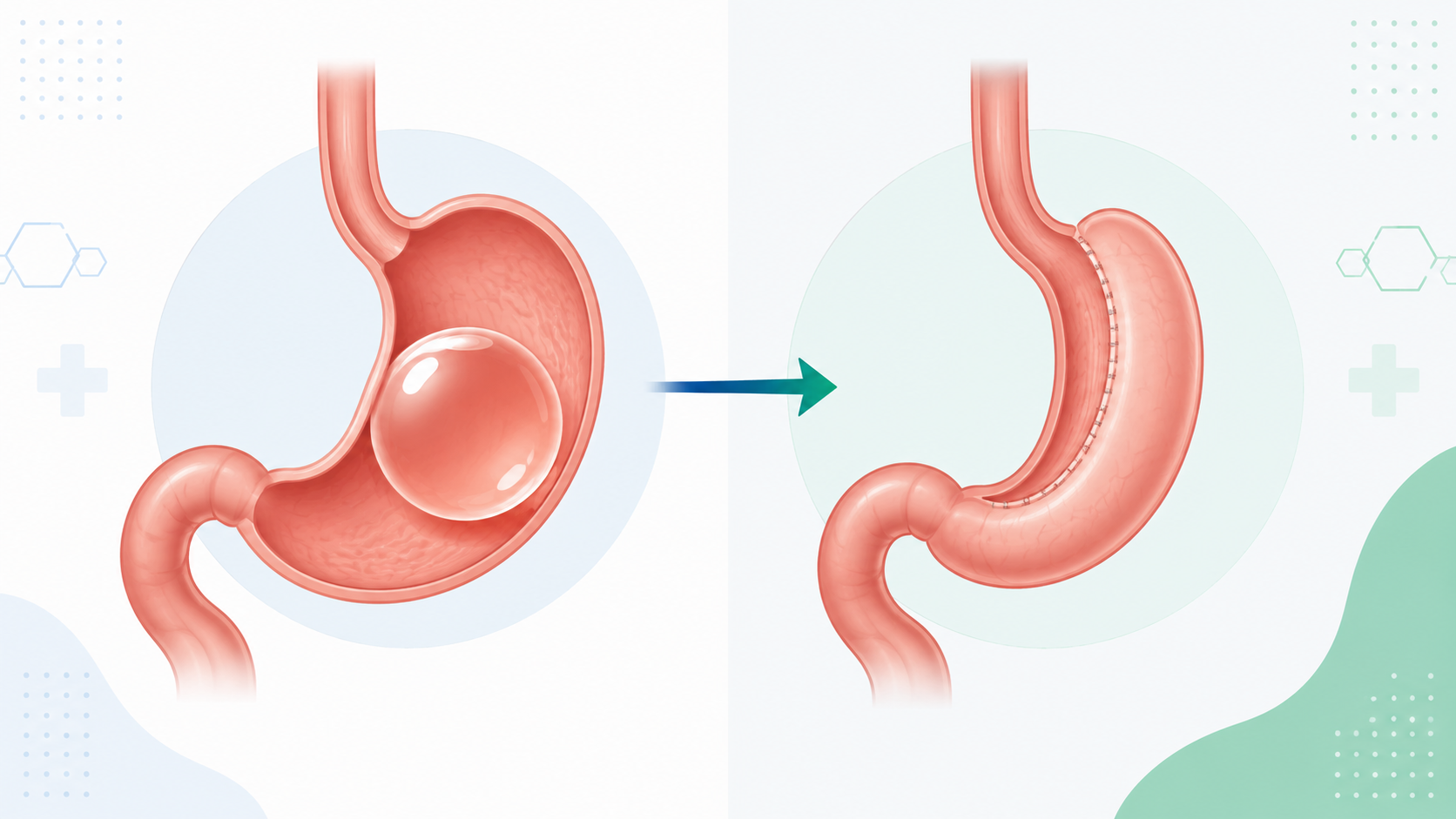
If you’re researching Orbera balloon treatment, it is probably because you’ve seen how effective this approach seems to be with no invasive surgery required. However, there is one thing that you need to know about Orbera which is rarely disclosed by balloon centers- Orbera gives temporary weight loss results and the patient can expect to gain the lost pounds within 12-24 months after balloon removal. In Texas, Dr. Frenzel and BodEvolve Bariatric Surgery Center analyze thousands of potential candidates for Orbera and bariatric surgeries in Dallas-Forth Worth area and the numbers speak for themselves. In this guide, we will give you all the information about what the Orbera balloon can do and cannot do and why gastric sleeve or gastric bypass would be a much better choice.
What Is the Orbera Balloon? (And Why Surgery Often Wins)
The orbera gastric balloon is a non-invasive weight loss tool, which is inserted into the patient’s stomach via endoscopy. The balloon will be inflated to a grapefruit-like size using a saline solution and kept in your stomach for 6 months before being removed.
orbera intragastric balloon system has received FDA approval in 2015. Here is the overview of its key features:
1. Time frame: 6 months within stomach, followed by mandatory removal
2. Procedure: Endoscopy, under conscious sedation
3. Average weight loss: 10-15% of the body weight during the balloon period
4. BMI: 30-40
5. Permanent changes to body/anatomy: None
And here arises the question: what after the balloon removal?
Here lies in the main disadvantage of Orbera procedure. Since no permanent changes to your physiology will be made, any other weight loss procedure will result in the following outcome:
Time After Removal of Balloon Average Weight Gain 6 months 25-40% of lost weight 12 months 30-50% of lost weight 18 months 40-60% of lost weight 24 months Most of patients return to the initial weight
While with the surgical procedures such as gastric sleeve/bypass, 60-80% of weight loss will be kept even 10 years after the procedure. For more information about gastric balloons compare to surgery, check our gastric balloon vs. surgery cost comparison page.
| Timeframe Post-Removal | Average Weight Regained |
|---|---|
| 6 months | 25–40% of lost weight |
| 12 months | 30–50% of lost weight |
| 18 months | 40–60% of lost weight |
| 24 months | Most patients near starting weight |
Compare this to surgical procedures like gastric sleeve or gastric bypass, where 60-80% of excess weight loss is sustained at 10+ years.
For broader context on all gastric balloon options vs surgery, see our breakdown on gastric balloon cost.
Orbera Balloon Cost- And Why Surgery Often Costs Less Long-Term
The orbera balloon cost can vary. On average it costs between $6,000 and $8,500. In Texas the cost is usually between $6,500 and $8,500.
When you pay for the Orbera balloon you are usually paying for the following things:
- The cost of the Orbera balloon device itself, which can range from $2,500 to $4,500.
- The cost of the procedure to place the balloon.
- The cost of medication used to help you relax during the procedure.
- The cost of the facility where the procedure is performed.
- The cost of removing the balloon after 6 months.
- The cost of 12 months of support and follow-up care.
When patients ask how much does orbera balloon cost, how much does the orbera balloon cost, how much is orbera balloon, or how much is the orbera balloon, the headline price typically includes:
a. The Orbera balloon implant itself ($2,500-$4,500 wholesale)
b. Placing the balloon endoscopically
c. Anesthesia/sedation
d. Hospital fees
e. Balloon removal after six months
f. One year nutritional counseling
Additional hidden costs not included in the above list:
a) Testing pre-operation laboratory values: $200-$500
b) Anti-emetic medication first two weeks: $50-$150
c) Fee for early balloon removal in case patient cannot tolerate it: $1,500-$3,000
d) Lost income for the first 1-2 weeks (no one is able to work after the procedure)
e) Cost of vitamins and other supplements required after Orbera: $300-$600
f) Maintenance program post-removal: $1,500-$3,500
Realistic total cost: $7,500-$11,000
The cost comparison most clinics don’t show you
When you compare Orbera to insurance-covered bariatric surgery, the financial argument falls apart:
| Path | 5-Year Total Cost | Net Weight Loss at 5 Years |
|---|---|---|
| Two Orbera balloons (regain → repeat) | $18,500 | 5–15 lbs |
| Self-pay gastric sleeve | $15,500–$19,000 | 60–70% sustained |
| Insurance-covered bariatric surgery | $4,000–$9,000 | 60–80% sustained |
Insurance-covered surgery is the cheapest long-term path AND produces 4-6x more weight loss than the balloon.
For pricing details, see gastric sleeve cost without insurance and bariatric surgery cost without insurance.
Orbera Balloon Cost Texas- Dallas-Fort Worth, Plano
For patients from Texas researching orbera gastric balloon dallas-fw, orbera gastric balloon plano, orbera gastric balloon dallas, orbera gastric balloon fort worth tx, orbera balloon near me, or orbera balloon cost near me, 2026 Dallas-Fort Worth pricing:
| Texas Metro Area | Typical Orbera Balloon Price |
|---|---|
| Dallas | $6,500–$8,500 |
| Fort Worth | $6,500–$8,000 |
| Plano | $7,000–$8,500 |
| Frisco/McKinney | $7,000–$8,500 |
| Texarkana | $5,500–$7,500 |
We don’t do any orbera placements here. Our practice is entirely surgery-based, which provides superior long-term results that cannot be replicated by orbera balloon. Most people considering orbera wind up opting for surgery once they understand the difference.
Is Orbera Balloon Covered by Insurance? (Surgeries Are Usually)
A short answer to does insurance cover orbera balloon, is orbera balloon covered by insurance, is the orbera balloon covered by insurance, or orbera balloon covered by insurance is no. As far as we know, no major US insurance company (Aetna, BlueCross BlueShield, Cigna, United Healthcare, Medicare, or Medicaid) will cover Orbera.
Why? Because insurance carriers have looked at the long-term data and made the same conclusion: Orbera doesn’t deliver lasting outcomes worth covering. Specifically:
1. FDA approval is temporary (6 months only)
2. Outcomes are poor after 12-24 months – most people will regain 30-50% of lost weight
3. Insured consider it investigational and lifestyle, rather than medically necessary procedure
4. Lack of data on reduced mortality rates compared to bariatric surgery
This is consistent across orbera balloon insurance and orbera gastric balloon covered by insurance policies industry-wide.
Bariatric surgery, on the other hand, is routinely covered
Most major insurance plans cover gastric sleeve, gastric bypass, duodenal switch, and SADI-S when medical necessity is documented:
1. Aetna, BlueCross BlueShield, Cigna, UnitedHealthcare, Humana, Tricare, Medicare
2. BMI 35 or greater and comorbidity present OR BMI 40 or greater and no comorbidity present
3. Obesity-related health problems documentation
If you qualify for insurance-covered bariatric surgery, you’d be paying $7,500-$11,000 out-of-pocket for Orbera while you could pay $1,500-$5,000 for a procedure with 4-6x better outcomes. Learn more about your insurance options at how to get insurance to pay for weight loss surgery.
Orbera Balloon Financing Or Surgery Financing That Is Cheaper
Insurance does not cover the Orbera, hence orbera balloon financing options have emerged:
CareCredit
Popular option for Orbera financing. Interest-free financing available for 6, 12 and 24 months. Normal APR after promotional period: 27-29%. Credit score required for approval: above 620.
Prosper Healthcare Lending
Medical loan with fixed interest rate. Terms can be from 6 to 84 months. Annual percentage rate from 6-30%. Credit score required for approval: above 660.
In-House Financing of Clinics
Clinics provide 6-12 month installment plans that do not involve any interest when paid upfront.
The reality of financing
If we finance a $7,500 procedure via Orbera on a 24 month term on the CareCredit at 27% APR post-promotional period, then your payments will amount to approximately $10,500 overall, for a procedure that helps people achieve the same weight loss result that most patients gain in 24 months.
Same options apply to bariatric surgery but with insurance covering it, you will only finance $1,500-$5,000 in total costs of which Orbera procedure is a part. Check out bariatric surgery financing and self-pay bariatric surgery options.
Orbera Balloon Procedure – The Truth About It
The Orbera balloon procedure is carried out in 3 stages:
Phase 1 – Placement (20-30 min)
The endoscopic Orbera balloon is inserted orally to the patient’s stomach by an endoscope under sedation. The balloon is filled with saline (400-700 ml). Discharge on the same day.
Phase 2 – 6 Months of Balloon Wear
After 6 months in the stomach, the balloon is removed. Patients tend to lose their weight fast during the initial 8-12 weeks and afterwards plateau.
Phase 3 – Mandatory Balloon Removal
After 6 months, mandatory balloon removal surgery takes place. Once your balloon is removed, there will be no other surgical procedures performed to aid in weight maintenance. And most patients are losing their hard-earned weight in this stage.
Compare this to a gastric sleeve, which is one-time surgery for a permanent stomach reduction with no obligatory surgical procedures for the following 60-70% of excess weight loss after 5+ years.
Orbera Balloon Weight Loss – The Honest Facts
The facts about orbera balloon weight loss and orbera weight loss balloon :
What you’ll lose (in 6 months)
1. Weight loss during placement: Lose 10-15% of body weight on average
2. Weight loss amount: Lose 20-50 lbs for most people
3. Peak weight loss: Most of your weight loss will occur within the first three months
4. Plateau: Your weight loss will stop by around months 4-5
How much do you compare with surgical weight loss?
| Outcome Measure | Orbera Balloon | Gastric Sleeve | Gastric Bypass |
|---|---|---|---|
| Average weight loss during placement | 10–15% TBWL | N/A (permanent) | N/A (permanent) |
| Weight loss at 12 months | 25–50 lbs | 60–90 lbs | 90–130 lbs |
| Weight loss at 24 months | 15–35 lbs (after regain) | 70–100 lbs sustained | 100–145 lbs sustained |
| Weight loss at 5 years | 5–20 lbs (regained) | 60–70% sustained | 60–70% sustained |
| Diabetes remission rate | Minimal | 60–65% | 75–85% |
| Sleep apnea resolution | Minimal | High | High |
Orbera is 4-6 times less effective in producing sustainable weight loss results compared to surgical procedures. Learn more about gastric sleeve before and after, as well as gastric bypass before and after results.
Why does surgery win durability-wise?
Orbera works by taking up space in the stomach and forcing you to control portions temporarily. It won’t change your hormones in the long run. After its removal:
1. Ghrelin levels return to pre-implantation levels
2. Stomach expands to regular capacity
3. Hormones signaling hunger come back to their pre-procedure level
4. Habits from before the procedure are back
Surgeries- specifically the Gastric Sleeve- remove the part of the stomach responsible for ghrelin production. They rewrite your body’s hunger and satiety system in the long run, while Orbera doesn’t.
Orbera Balloon Side Effects (And Some Hard Truths Your Clinic Probably Isn’t Telling You About)
The orbera balloon side effects and side effects of orbera balloon are very real and definitely something to consider before committing. Typical orbera side effects are:
1-2 Weeks After Procedure (Acute Period)
1. Severe nausea and vomiting- occurs in 90%+ of patients
2. Abdominal cramps and pain
3. Acid reflux/indigestion
4. Vomiting even when drinking water — in some cases, patient will need IV fluids
5. Anti-emetic needed during this period (first 7-14 days)
Side effects throughout 6-month period
1. Nausea lasting for a month or more in 20-30% of patients
2. Bloating/gas
3. Limited exercise tolerance
4. Trouble sleeping during first few weeks
Occurrence of serious side effects
A) Deflation of the balloon- rare but if it happens, is characterized by unexplained weight gain
B) Migration of balloon- rare but potentially dangerous
C) Intestinal blockage- rare medical emergency
D) Ulcerations in stomach- caused by excessive pressure
E) Worsening acid reflux- occurs often and often requires medications
Around 5-10% of patients experience such adverse reactions that balloon must be removed ahead of time, at the cost of another $1,500-$3,000.
Now compare this to bariatric surgery: most patients feel uncomfortable for 1-2 days after operation, take regular painkillers and go back to working from their desks two weeks later.
Is Orbera Balloon Safe? (And Is Bariatric Surgery Safer?)
For patients who wonder about “is orbera balloon safe,” the truth is that “yes, when performed properly, but not without danger.”
Orbera was approved by the FDA in 2015. By 2025, less than 15 deaths have occurred in the US in relation to hundreds of thousands of implants done worldwide.
Comparing statistics of death from Orbera implants with those from bariatric surgeries done at accredited hospitals means both:
| Procedure | Major Complication Rate | Mortality Rate |
|---|---|---|
| Orbera Balloon | 5–10% require early removal | Under 0.005% (very rare) |
| Gastric Sleeve | 1–3% | Under 0.1% |
| Gastric Bypass | 2–4% | Under 0.2% |
Are safer statistically than gall bladder surgery or knee replacement. Are safe operations when performed at accredited hospitals.
Difference: Bariatric surgery provides long-term benefits, while Orbera only works temporarily and must be removed at 6 months.
Orbera Balloon Reviews- Patient Feedback Long Term
When reviewing orbera balloon reviews, reviews about orbera balloon, orbera weight loss balloon reviews, orbera gastric balloon reviews, or before and after orbera balloon reviews, the truth is revealed in patient comments long-term:
Positive points that come out (in short term)
1. Weight loss is proven for 6 months period (10-15% body weight)
2. Non-surgical approach
3. Anatomically, no irreversible change is caused
4. 50% “Worth It” according to RealSelf reviews
For BodEvolve patients pursuing surgical alternatives like bariatric surgery for severe obesity, the long-term satisfaction rate is dramatically higher. Patient reviews routinely mention sustained outcomes 5-10 years post-surgery.
Orbera Gastric Balloon & Orbera Balloon Diet- What to Eat (and Why It Fails)
In orbera balloon diet and orbera gastric balloon diet, meals are divided into three stages:
Stage I: Fluids only (1st week)
Clear fluids, protein drinks, broth.
Stage II: Soft food (2nd week- 3rd week)
Yogurt, smooth soup, cottage cheese.
Stage III: Regular food modified (after 4th week)
Lean proteins, vegetables, complex carbohydrates. Not allowed at any time:
1. Fizzy drinks
2. Hard meats
3. Lots of bread, rice, pasta
4. Sticky foods
5. Alcohol
6. Spicy foods
It is a lifelong post-bariatric surgery type of diet, but minus the anatomical aspect that makes people stick to it after the procedure. That is the exact reason why people gain weight after the treatment, nothing to prevent them from breaking down.
Patients who had bariatric surgeries continue to eat similar food since their physical structure depends on it. With gastric sleeve, the small stomach capacity ensures limited consumption of food. Orbera patients’ normal stomach will make them return to old habits.
For more details on pre-operative preparation, visit our see our pre bariatric surgery diet protocol.
Results of Orbera Balloon Before and After Photos
While considering results from orbera balloon before and after, consider the following:
1. Most patients shed 25 to 50 pounds over the 6 months period of implantation.
2. Most visible results appear at about 3-4 months due to rapid weight loss.
3. Most photos labeled as ‘after’ will be those taken during the peak of weight loss (month 4-5).
4. Rarely do you see pictures past 18+ months post removal as regain usually occurs.
See real BodEvolve surgical transformations at gastric sleeve before and after and gastric bypass before and after.
The real before and after data
For an average Orbera patient, here are some weight loss milestones:
1st Month: 8-15 Pounds Lost
3rd Month: 20-35 Pounds Lost
6 Months: 25-50 Pounds Lost (Peak)
1 Year Post-Removal: 15-35 pounds net gain/loss
2 Years Post-Removal: 5-20 pounds net gain OR return to baseline
Compare that to the average gastric sleeve patient at the same milestones:
A. 1st Month: 15-25 pounds lost
B. 3rd Month: 40-60 pounds lost
C. 6th Month: 60-90 pounds lost
D. One Year: 70-100 pounds lost (sustains at 5-year mark)
Gastric Bypass Results
- 70–80% excess weight loss
- 90–130 lbs lost at 12 months
- Sustained weight loss at 5+ years
- $1,500–$5,000 out-of-pocket with insurance
- One-time procedure with diabetes remission
For severe obesity patients, duodenal switch and SADI surgery deliver even stronger results. For patients pursuing bariatric revision surgery texas after Orbera failure, results are typically still strong with surgical revision.
Orbera Balloon Near Me or Better Yet- Bariatric Surgery in Texas
Those looking for orbera balloon near me, orbera gastric balloon near me, or orbera balloon cost near me can find multiple DFW clinics offering this treatment.
However, BodEvolve does not perform Orbera at any of our clinics because we provide surgeries with proven long-term success rates. Most people who begin their quest with Orbera finally opt for surgery once they learn about the long-term comparison.
We would like to suggest you undergo a free consultation first. We can:
1. Determine your eligibility for covered bariatric surgery under insurance
2. Provide you with the long-term cost and result comparison
3. Explain which procedure will work best for you individually
4. Verify your insurance coverage at no charge
In case if you have chosen Orbera for your case, having all the necessary information before paying $7,500-$11,000 is well worth a 30-minute consultation.
Bariatric Treatment Services in Texas – Why Surgery Is the Clearer Winner
BodEvolve provides treatment services for bariatric surgical procedures in the Dallas-Fort Worth region, operating out of four MBSAQIP facilities:
1. Arlington– servicing patients from Tarrant County
2. Richardson– our flagship location
3. Weight loss surgery dallas– servicing patients from central Dallas County
4. Texarkana– servicing patients from East Texas and Southwest Arkansas
Our facility accepts all major insurance providers, such as Aetna, BlueCross BlueShield, Cigna, UnitedHealthcare, Humana, Tricare, and Medicare. Our insurance specialists will check your coverage for free ahead of your appointment.
For those seeking post-bariatric surgical body contouring, our plastic surgeons specializing in bariatric patients work in coordination with the bariatric team- offering a comprehensive treatment path that Orbera is unable to provide.
If you have researched the orbera gastric balloon, do yourself a favor by consulting with Dr. Frenzel and the BodEvolve team before spending $7,500 on a temporary solution. You’ll:
a. Learn whether or not you qualify for bariatric surgery under your insurance
b. Have cost and outcome comparisons presented side by side
c. Learn which treatment will produce the best result over the long term
d. Receive full information before making a commitment
Almost all patients who come to us considering Orbera go home with surgery as their option of choice since, by doing the math, science and considering the outcomes, there is no other way.
