
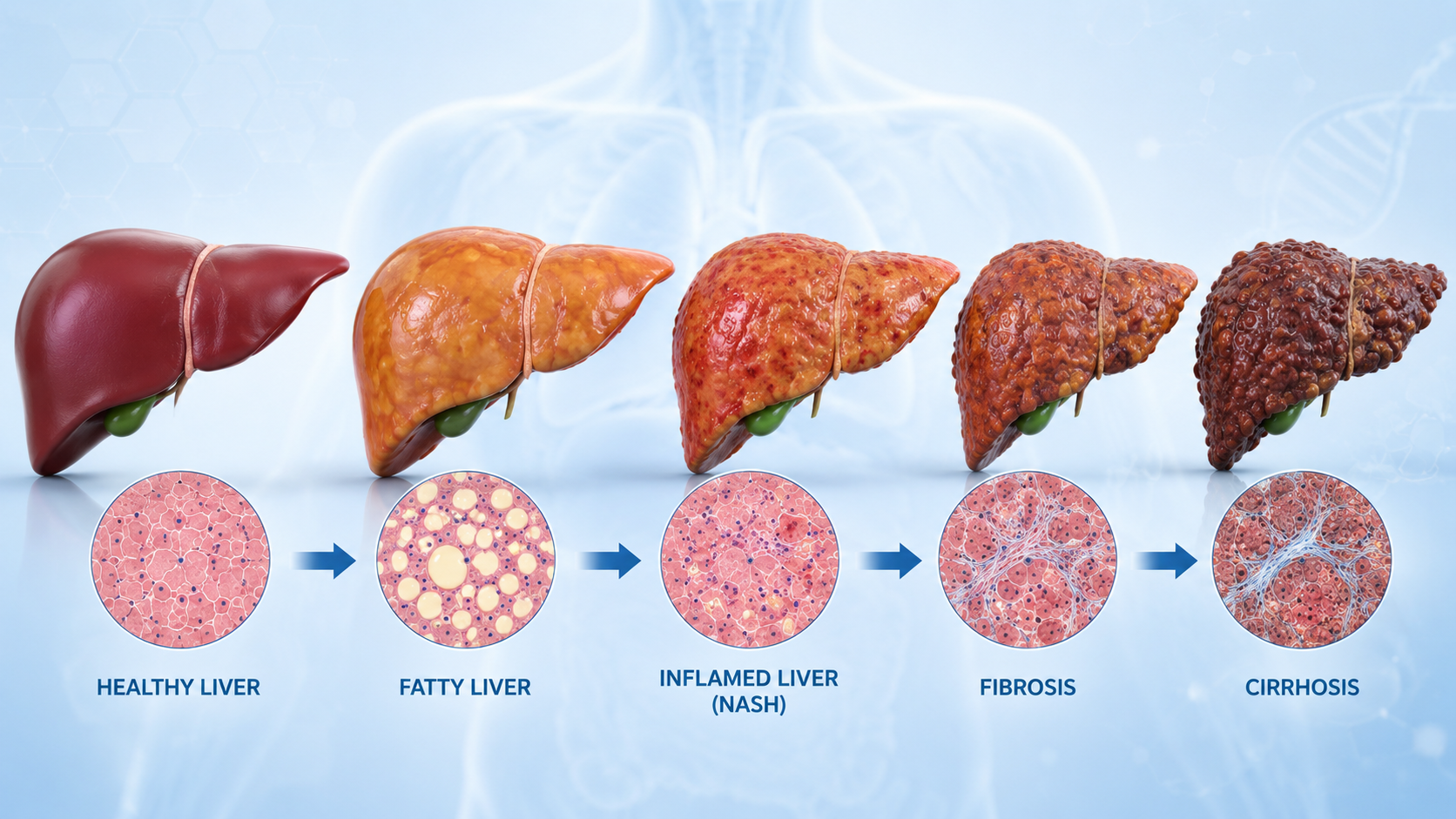
MASH liver disease is a common liver problem in America. A lot of people who have it do not even know they have it. At BodEvolve Bariatric Surgery Center Texas Dr. Frenzel and the team see MASH liver disease in a lot of patients who come in for checks. Most of these patients found out they had MASH liver disease from a blood test or ultrasound not because they felt sick.
The problem with MASH liver disease is that it is quiet. It gets worse over time without showing any signs. By the time most patients feel something is wrong their liver has already been damaged for a time.
The good news is that MASH liver disease can be reversed.. This only happens at certain stages and with the right treatment. This guide will explain what MASH liver disease is, why it happens, what the signs look like when they appear and which treatments can actually reverse it.
What Is MASH Liver Disease?
MASH stands for Metabolic dysfunction-Associated Steatohepatitis. This is a name. Let me break it down for you:
- Steatosis means fat has built up in the liver.
- Hepatitis means the liver is inflamed.
- MASH means both of these things are happening at the time. Fat and inflammation and liver cell damage.
A healthy liver has no fat in it. When fat makes up than 5% of the livers weight you have fatty liver disease. Most people with fatty liver disease stay at that stage. In MASH liver disease the disease has gotten worse. The liver is not just storing fat it is also inflamed, liver cells are being damaged and scar tissue has started forming.
That progression is what makes MASH liver disease more serious than fatty liver disease. It is also why catching it early is so important.
What Was NASH? What Changed in 2023?
If you were diagnosed with NASH before 2023 you actually have MASH liver disease. It is the disease, the same treatment, just a different name.
In 2023 a big group of liver disease specialists decided to change the names of NAFLD and NASH. They did this because the old names did not accurately describe what was causing the disease. The new names are more accurate.
Here is what the new names mean:
- NAFLD is now called MASLD. This is when you have simple fatty liver. Fat without inflammation.
- NASH is now called MASH. This is when you have inflammation plus liver cell damage.
Most doctors still use the names, NASH and NAFLD because the change is recent.. Both the old and new names are correct and you will see both of them in this guide.
MASH vs Fatty Liver Disease: What Is the Difference?
Patients often use these terms to mean the thing.. They are not the same condition.
Fatty liver disease or MASLD is when fat has built up in the liver. There is no inflammation, no liver cell damage. This is the form of the disease. Most people with fatty liver disease stay at this stage for their lives and never get serious complications if they make some changes.
MASH liver disease is different. It is when you have active inflammation plus liver cell damage. This is a step further. The liver is being damaged. Scar tissue is forming. Without treatment MASH liver disease gets worse. Can lead to fibrosis, cirrhosis and eventually liver failure.
The difference between fatty liver disease and MASH liver disease comes down to inflammation and cell damage. You can have fatty liver disease for decades without it becoming MASH liver disease.. Once MASH liver disease develops the clock starts ticking and you need real medical treatment to stop it.
The 4 Stages of MASH Liver Disease
MASH liver disease has four stages:
- Steatosis or MASLD: This is when you have fat in the liver but no inflammation. This stage is fully reversible with weight loss.
- MASH: This is when you have inflammation plus liver cell damage. This stage is still reversible with weight loss, medication or surgery. This is the window.
- Fibrosis: This is when the liver is forming tissue. You can partially reverse this stage with intervention. This stage needs treatment.
- Cirrhosis: This is when there is permanent scarring. The livers structure is altered. At this stage treatment is more about managing the damage and evaluating the need for a transplant.
The reason to treat MASH liver disease aggressively is to prevent it from getting to Stage 3. Once fibrosis develops treatment gets harder.. Once cirrhosis develops reversing the disease is no longer possible.
Symptoms of MASH Liver Disease
Patients with MASH liver disease do not have any symptoms in the early and middle stages. This is why the condition is often missed.
When symptoms do appear they usually mean the disease has moved to fibrosis or beyond:
In the to middle stages of MASH liver disease you might feel:
- Tired all the time after resting
- Mild. A dull ache in the upper right part of your belly
- Feeling full quickly after eating
- Unexplained weight gain around your belly
In the stages of MASH liver disease you might feel:
- More persistent discomfort in the side of your belly
- Tired after a full nights sleep
- Nausea after eating fatty foods
- Swelling in your legs or ankles
In the advanced stages of fibrosis and cirrhosis you might see:
- Yellowing of the skin and eyes
- Significant swelling in your belly from buildup
- Easy bruising or bleeding
- Mental confusion or difficulty concentrating
- Significant unintentional weight loss and muscle wasting
Not having symptoms does not mean you do not have MASH liver disease. Most cases are found through liver enzymes on routine blood work or through imaging done for a different reason. If you have obesity, type 2 diabetes, high cholesterol or metabolic syndrome you should talk to your doctor about liver checks even if you do not have symptoms.
What Causes MASH Liver Disease?
MASH liver disease is a metabolic disease. The same factors that cause type 2 diabetes high blood pressure and heart disease also cause MASH liver disease. The root causes are:
- Obesity and excess body fat: This is the risk factor. 20 To 30% of people with obesity develop MASH liver disease. The fat stored around your organs releases chemicals that directly damage the liver.
- Insulin resistance: When your cells stop responding to insulin your liver stores fat and produces more glucose. This drives both buildup and inflammation in the liver.
- Type 2 diabetes: People with type 2 diabetes are more likely to have MASH liver disease. Insulin. High blood sugar accelerate liver damage faster than obesity alone.
- triglycerides and abnormal cholesterol: Elevated triglycerides increase the amount of fat stored in the liver. Low HDL cholesterol removes a metabolic defense.
- weight loss: Losing weight too fast can temporarily worsen liver inflammation. This is why medically supervised weight loss is important for patients with known liver disease.
The reason MASH liver disease is closely tied to obesity is that obesity drives almost every item on this list at the same time. This is also why treating obesity is the effective way to treat MASH liver disease.
How MASH Liver Disease Is Diagnosed
Because most patients with MASH liver disease do not have symptoms diagnosis usually happens through:
- Blood tests: Elevated liver enzymes on a metabolic panel are often the first sign. These indicate liver inflammation or damage and trigger investigation.
- Imaging: Ultrasound is the common first imaging test and can detect fatty liver but cannot reliably distinguish simple fatty liver from MASH liver disease. FibroScan measures liver stiffness. Can estimate fibrosis non-invasively. MRI-based techniques provide more detailed information on fat content and scarring.
- Liver biopsy: This is the gold standard. A small needle sample of liver tissue is examined under a microscope to assess content, inflammation, cell damage and fibrosis grade. It is the test that definitively confirms MASH liver disease and stages it. Because it is invasive it is typically used when non-invasive tests are inconclusive or when staging is critical to guide treatment decisions.
- Blood-based fibrosis scores: These scores give clinicians a -invasive estimate of fibrosis risk. They help identify who needs aggressive evaluation without requiring a biopsy.
MASH Liver Disease Treatment Options in 2026
Treating MASH liver disease means reducing liver fat, halting inflammation preventing fibrosis from worsening and ideally reversing existing damage. Here is what actually works:
- Lifestyle Changes: This is the foundation of MASH liver disease treatment at every stage. The research gives targets:
- Losing 7 to 10% of body weight significantly reduces MASH liver disease activity in 60% of patients.
- Losing 10% or more can completely reverse MASH liver disease in some patients. Improve early fibrosis.
- The Mediterranean diet is the evidence-backed dietary approach for MASH liver disease.
- Resistance training and aerobic exercise both reduce liver fat independently of weight loss.
The limitation is that achieving and maintaining 10%+ weight loss through lifestyle alone is extremely difficult. For patients with significant obesity or insulin resistance. For patients lifestyle changes are necessary but not sufficient on their own.
- Rezdiffra (Resmetirom): This is the FDA-approved drug specifically for MASH liver disease approved in March 2024. Rezdiffra targets thyroid hormone receptors in the liver reducing accumulation and inflammation without affecting thyroid function in the rest of the body.
- Clinical trial results show MASH liver disease resolution in 26 to 30% of patients at 52 weeks.
- Significant fibrosis improvement in 24 to 26% of patients.
- Generally well tolerated. Main side effects are mild. Gi-related.
Rezdiffra is an advance but works best in combination with weight loss and lifestyle changes. It is not a standalone cure. Requires ongoing use to maintain its effects.
- GLP-1 Medications: Medications like semaglutide and tirzepatide were not designed for MASH liver disease but have shown secondary liver benefits driven by weight loss and direct metabolic effects.
- Research shows semaglutide resolved MASH liver disease in 59 to 73% of patients in Phase 2 trials at doses used for obesity.
- Tirzepatide shows stronger effects, in early research.
- Both medications measurably reduce liver fat within 3 to 6 months of treatment.
The problem with medications for weight loss is that they are not a long term solution for people with obesity. When patients stop taking GLP-1 medications they usually gain weight again. Their liver disease gets worse. These medications are very helpful. They are not a permanent solution for people with a lot of weight to lose.
For information on these medications you can look at our guides on Mounjaro vs Zepbound, and how Ozempic works for weight loss.
Bariatric Surgery for MASH
Bariatric surgery is an effective treatment option for people with MASH and significant obesity. The results are very impressive.
What bariatric surgery can do for people with MASH is:
- Resolve MASH in 50 to 85 percent of patients within one to two years
- Improve liver fibrosis in 30 to 65 percent of patients which is something that lifestyle changes and medications rarely achieve
- Provide benefits that last five to ten years, not a few months
- Treat every metabolic problem that causes MASH at the time
The American Society for Metabolic and Bariatric Surgery and the American Association for the Study of Liver Diseases both agree that bariatric surgery is a good treatment option for people with MASH. This is not a fringe idea it is what most doctors think.
Bariatric surgery works well for people with MASH because it changes the way the digestive system works. The levels of hormones like GLP-1, PYY and ghrelin change dramatically after surgery which improves insulin sensitivity before the person has even lost a lot of weight. This is why liver function often improves within weeks after surgery long before the person has lost all of their weight.
Here is how different treatment approaches compare:
- Approach: MASH resolution rate, fibrosis improvement, duration of benefit
- Lifestyle changes 40 to 60 percent resolution rate rarely improves fibrosis requires permanent behavior change
- Rezdiffra: 26 to 30 percent resolution rate, 24 to 26 percent fibrosis improvement requires medication
- GLP-1 medications: 59 to 73 percent resolution rate, limited data on fibrosis improvement requires ongoing medication
- Bariatric surgery: 50 to 85 percent resolution rate, 30 to 65 percent fibrosis improvement provides benefits for five to ten years
Bariatric surgery can do a lot for people with MASH. It can:
- Resolve MASH entirely in patients
- Improve liver fibrosis, which is something that few other treatments can do
- Treat type 2 diabetes, high cholesterol and sleep apnea at the time
- Provide results that for years without daily medication
However bariatric surgery is not:
- A guaranteed cure for fibrosis or cirrhosis
- Suitable for patients who’re not good candidates for surgery
- A substitute for dietary and lifestyle changes after surgery
To learn about procedure options read our guide on difference between gastric bypass and gastric sleeve and which bariatric surgery is best for type 2 diabetes, a common comorbidity associated with MASH.
Can MASH Liver Disease Be Reversed?
The answer depends on what stage the disease’s at when treatment starts.
- Stage 1: reversible with five to ten percent weight loss in most patients
- Stage 2: reversible in 50 to 85 percent of patients with aggressive treatment
- Stage 3: partial reversal is possible bariatric surgery can improve fibrosis in 30 to 65 percent of patients
- Stage 4: largely irreversible treatment focuses on slowing progression and managing complications
The Pre-Surgery Liver Shrinking Diet for MASH Patients
However, the issue that needs to be addressed when conducting bariatric surgery on patients with MASH, but which does not have to be considered for those without liver problems, is the nature of the liver itself. The liver of patients with MASH is often enlarged, weighed down, and more fragile compared to a normal liver.
In MASH patients undergoing bariatric surgery, the pre-surgical liver shrinking diet for bariatric surgery (a high protein, low carbohydrate protocol that should be followed by all patients prior to bariatric surgery, lasting between 2 and 4 weeks) is extremely crucial because it causes rapid depletion of glycogen stores and reduces the size of the liver, thereby making the operation much safer.
Who Qualifies for Bariatric Surgery as MASH Treatment
You may be a candidate for surgery as a treatment for MASH if:
- Your BMI is 35 or higher. You have confirmed MASH on imaging or biopsy
- Your BMI is 40 or higher regardless of conditions
- You have MASH and other obesity-related conditions like type 2 diabetes sleep apnea or high blood pressure
- You have been unable to achieve weight loss through lifestyle changes and medications
- You are medically and psychologically cleared for surgery
For more information on BMI requirements, check BMI for gastric sleeve and BMI for gastric bypass.
When to See a Specialist
You should talk to an metabolic specialist if:
- You have been told you have MASH or NASH on a biopsy or imaging report
- Your liver enzymes have been elevated on rounds of blood work
- You have obesity plus type 2 diabetes, high cholesterol or metabolic syndrome
- You have tried lifestyle changes for six or more months without improvement in liver markers
- Your gastroenterologist or hepatologist has raised the possibility of fibrosis progression
At BodEvolve Bariatric Surgery Center Dr. Frenzel and Dr. Holt evaluate MASH as part of the metabolic health assessment for every surgical candidate. The center has performed over 14,000 procedures. Holds ASMBS Center of Excellence accreditation. The earlier MASH is. Treated the more completely the liver can recover.
BodEvolve Bariatric Surgery Center has locations in:
- Arlington– serving Tarrant County
- Richardson– our primary facility
- Dallas– serving central Dallas County
- Texarkanas- serving East Texas and Southwest Arkansas
If you have been diagnosed with MASH or NASH and want to know if bariatric surgery is the right treatment for you you can schedule a consultation, with Dr. Frenzel and our team.
Book Your Consultation today.
