

What Is a Calorie Controlled Diets for weight loss? A calorie controlled diet is an eating plan built around a specific daily calorie target set below what your body burns, creating a consistent deficit that leads to weight loss. Most people following calorie controlled diets for weight loss aim for a moderate deficit of 300 to 500 calories per day below their total daily energy expenditure (TDEE).
This guide gives you an honest, realistic look at how calorie control works, when it genuinely helps, and when your body might be telling you it needs a different kind of support. If you have been putting in real effort and still not seeing the results you deserve, that is not a character flaw. It is a signal worth paying attention to.
How Many Calories Do You Actually Need to Lose Weight?
Before you can create a calorie deficit, you need to know where your baseline is. Your body burns calories at rest through basic functions like breathing, circulation, and cell repair. This is your basal metabolic rate, or BMR. On top of that, you burn calories through daily movement, activity, and exercise, which together make up your total daily energy expenditure, or TDEE.
To lose approximately one pound of body fat per week, most guidelines suggest maintaining a calorie deficit of around 500 calories per day below your TDEE. For someone whose TDEE is 2,000 calories, that means eating around 1,500 calories daily. These numbers shift based on age, sex, body composition, activity level, and how long you have already been dieting.
The critical point that most online calorie calculators skip is this: your TDEE is not a fixed number. It changes as your body adapts to the deficit. That part matters more than most diet plans acknowledge, and we will get to it in detail shortly.
What to Eat on a Calorie Controlled Diet Plan
Not all calories behave equally when it comes to satiety, muscle preservation, and metabolic health. Calorie deficit tend to produce the best results when the foods you choose are working with you, not against you.
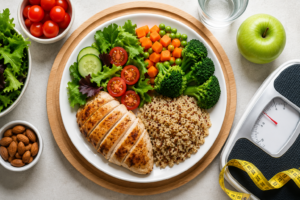
Foods that support a calorie deficit well include high protein sources like chicken breast, turkey, Greek yogurt, eggs, cottage cheese, and legumes. Protein keeps you fuller for longer and helps protect lean muscle mass during a restriction period. Fiber-rich vegetables and fruits add volume to your meals without adding many calories. Leafy greens, broccoli, cauliflower, apples, and berries are practical staples. Complex carbohydrates like oats, quinoa, lentils, and sweet potatoes provide steady energy and avoid the blood sugar spikes that drive hunger between meals. Healthy fats from avocado, olive oil, nuts, and seeds support hormone function, brain health, and absorption of fat-soluble nutrients.
Foods that tend to quietly destroy a calorie deficit include ultra-processed snacks, sweetened beverages, fast food, alcohol, and refined grains. These are calorie-dense but low in the protein and fiber that generate real fullness. If you find it hard to stop eating certain processed foods once you start, that is not a willpower problem. Many of these products are deliberately engineered to override your body’s fullness signals.
Pairing a structured calorie plan with evidence-backed natural support can add meaningful momentum. Our guide to natural supplements for weight loss separates what has genuine clinical evidence behind it from what is mostly marketing noise, which saves you time and money. And the drinks in your routine matter more than most people realize. This practical breakdown of low calorie drinks for weight loss covers specific options that support your goals without quietly adding hundreds of hidden calories to your day.
What Is a Calorie Controlled Diet?
A calorie controlled diet for weight loss is an eating plan that keeps your daily calorie intake below what your body burns, creating an energy deficit. Most people aim for 300 to 500 calories below their daily expenditure to lose about one pound per week while preserving muscle and energy.
The 1,200 Calorie Threshold: What the Research Actually Shows
You will see 1,200 calories referenced constantly as the minimum safe daily intake for women following a weight loss plan. It is a real number with a legitimate basis, but it is applied far too broadly without enough context.
For a small, sedentary woman in her mid-50s, 1,200 calories might be a reasonable starting point. For an active woman in her 30s weighing 180 pounds, 1,200 calories is a significant restriction that can lead to muscle loss, fatigue, hair thinning, hormonal disruption, and significant metabolic slowdown.
Calorie restriction for weight loss that are set too low can actually reverse your progress. Your body interprets severe calorie restriction as a survival threat and responds by lowering its resting metabolic rate, reducing thyroid output, and increasing hunger hormones. You end up burning fewer calories at rest, feeling significantly hungrier, and fighting harder to maintain a deficit that is already punishingly small.
The practical sweet spot for most people is a moderate deficit of 300 to 500 calories below their TDEE, not a dramatic slash to the lowest possible number. Sustainable beats aggressive every single time.
Why Calorie Controlled Dieting Hits a Ceiling: Metabolic Adaptation Explained
Here is the honest conversation that most diet blogs avoid entirely. Your body is extraordinarily effective at defending its current weight. When you consistently eat less than you burn, your body begins to adapt. This process is called metabolic adaptation, and it is the primary reason controlled-calorie eating often produce impressive results in months one and two, then stall frustratingly around months four and five with no obvious explanation.
During metabolic adaptation, your body responds to the calorie deficit on several fronts simultaneously. It reduces your resting metabolic rate. It makes your muscles more fuel-efficient, meaning they burn less energy to perform the same work. And it significantly increases production of ghrelin, the hunger hormone, while simultaneously reducing leptin, the hormone responsible for signaling fullness and regulating long-term energy balance.
This is not a failure of discipline. It is biology doing exactly what it evolved to do: protect you from what it reads as a famine. The problem is that the food environment most of us live in today bears no resemblance to the conditions that system was designed for. You can be eating 1,400 calories in a modern kitchen and your body can still respond as though you are rationing food through a winter shortage.
Understanding this is important because it reframes what a plateau actually means. It does not mean you failed. It means your biology responded.
Hormones, Insulin Resistance, and the Hidden Forces Undermining Your Diet
For a meaningful portion of people struggling with persistent weight issues, the challenge is not primarily calorie math. There is a hormonal picture running underneath the surface that makes calorie restriction far less effective than it should be.
Insulin resistance is one of the most common drivers of stubborn weight gain, particularly around the abdomen. When cells stop responding normally to insulin, the body produces more of it to compensate. High circulating insulin levels directly promote fat storage and make it significantly harder for the body to access stored fat as a fuel source during a deficit. Even on a well-structured calorie controlled diet for weight loss, insulin resistance can slow or stall measurable progress.
Chronic stress and poor sleep both elevate cortisol, which promotes abdominal fat storage and drives cravings for high-calorie, high-sugar foods at the exact moments when your resolve is lowest. Hypothyroidism, polycystic ovary syndrome, and certain common medications can each create hormonal conditions that override calorie control entirely. If you suspect something hormonal is working against your progress, a clinical evaluation will give you far more useful answers than adjusting your macros for the sixth time.
How Long Does It Take to See Results on a Calorie Controlled Diet?
Realistic timelines matter because unrealistic expectations are one of the most common reasons people abandon approaches that could eventually work for them.
Most people following controlled-calorie eating for weight loss with a consistent 500-calorie daily deficit can expect to lose approximately one to two pounds per week in the early stages. That rate typically slows as metabolic adaptation kicks in. Here is a realistic progression for someone starting from scratch with a structured calorie deficit:
In weeks one and two, most people lose two to four pounds, a combination of water weight and early fat loss. Between weeks three and eight, fat loss becomes more consistent, typically averaging one to one and a half pounds per week. Between months three and six, progress slows and plateaus become more common, which is where diet cycling, adjustments to macronutrient ratios, and changes to exercise patterns tend to help. Beyond six months, outcomes vary considerably. Some people continue to lose at a slower, steady rate. Others find that returns diminish significantly and that calorie control alone is no longer moving the needle.
Plateauing after three to four months is normal and does not mean the approach has permanently failed. But if you have been consistent for six months or more and results have stalled completely, your body may genuinely need a different type of clinical support.
Meal Timing, Protein Targets, and Practical Strategies for Calorie Control
The research on meal timing has become more nuanced in recent years. Front-loading calories earlier in the day, specifically eating a larger breakfast and a smaller dinner, is associated with better blood sugar control, improved satiety, and more favorable fat oxidation patterns compared to the more common pattern of eating the majority of calories in the evening.
For protein specifically, the current evidence supports a target of 0.7 to 1 gram of protein per pound of body weight for people in a calorie deficit. This level helps preserve lean muscle mass as you lose fat, which protects your resting metabolic rate and improves body composition outcomes even when the scale moves slowly.
Practical tools that consistently improve adherence to controlled-calorie eating for weight loss include food logging apps that include a barcode scanner for packaged items, meal prepping two to three days of food at a time to reduce decision fatigue, keeping high-protein snacks available to handle unexpected hunger, and planning for social eating events in advance rather than abandoning tracking entirely on those days.
When Calorie Controlled Diets Are Not Enough: What Medical Weight Loss Actually Offers
This is the section most diet blogs skip, and it is arguably the most important one on this page.
For people with a BMI above 35, or a BMI above 30 accompanied by weight-related health conditions like type 2 diabetes, sleep apnea, or hypertension, calorie deficit for weight loss are rarely sufficient as a standalone long-term solution. Clinical research consistently shows that lifestyle interventions alone produce a five to ten percent reduction in body weight. That is meaningful progress for general health, but it is typically insufficient to resolve serious obesity-related conditions or deliver the kind of sustained, transformative results that genuinely change quality of life.
At BodEvolve Bariatric Surgery Center in Texas, dr Frenzel and Dr. Brian Holt evaluate patients who have tried multiple dietary approaches including calorie counting, low-carb meal plans, medical weight management programs, and everything in between. The pattern they encounter most often is not a lack of effort. It is a mismatch between the tool being used and the actual complexity of the underlying medical condition.
For patients who qualify, surgical options like gastric bypass and gastric sleeve create physiological changes that go far beyond anything calorie restriction can replicate. These procedures alter hunger hormones, modify gut microbiome composition, and in the case of gastric bypass, produce significant metabolic changes that can put type 2 diabetes into remission even before major weight loss occurs. These are not shortcuts. They are precision medical tools for a complex chronic condition.
BodEvolve serves patients across Texas with clinics in Arlington, Richardson, Dallas, and Texarkana. If you have spent years working at calorie control without the results you deserve, a consultation is worth more than another diet reset. One of the most practical first questions to address is whether your coverage will help. This page on how to get insurance to cover revision bariatric surgery walks you through how that process typically works and what documentation tends to be required.
