
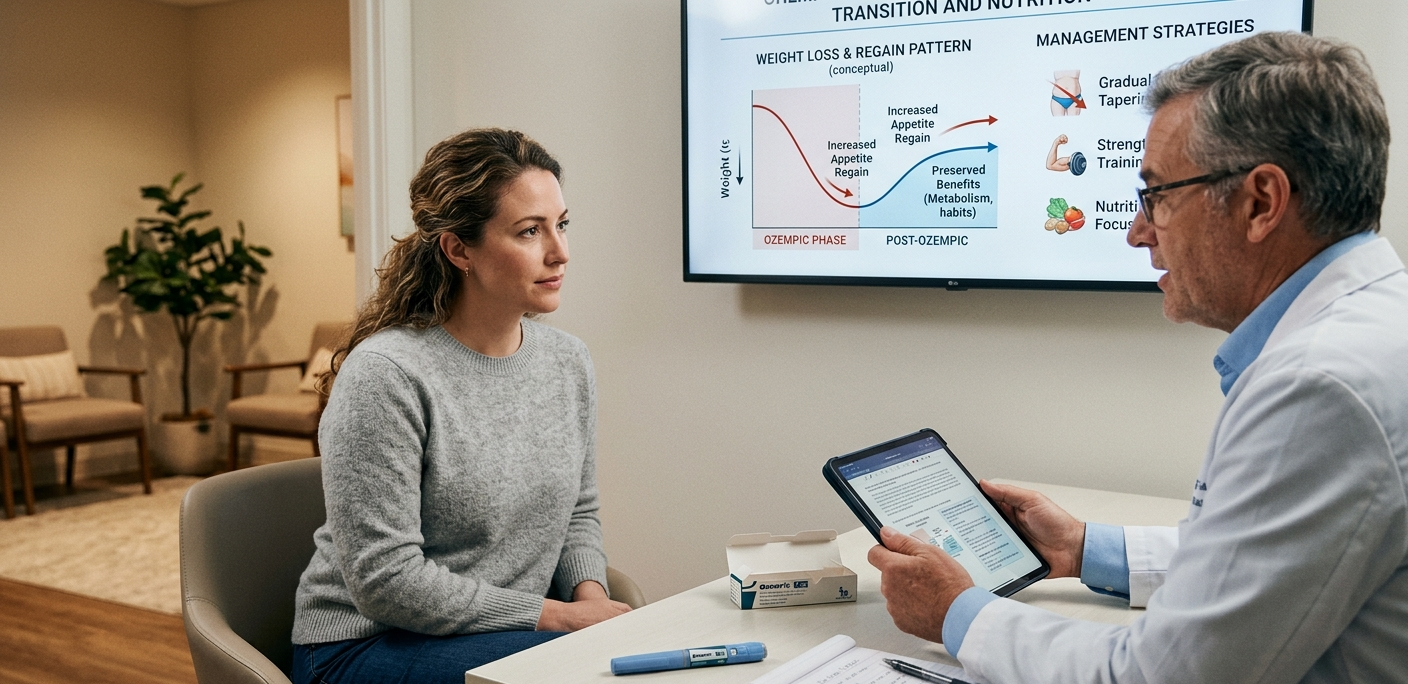
What happens when you stop taking Ozempic for weight loss ? When you stop taking Ozempic for weight loss, appetite suppression fades within two to three weeks, hunger hormones rebound, digestion speeds up, and most patients regain about two-thirds of their lost weight within 12 months. Because obesity is a chronic condition, the body drifts back toward its original setpoint once semaglutide clears the system.
Both Ozempic (semaglutide for type 2 diabetes) and Wegovy (semaglutide for chronic weight management) work by mimicking a hormone called GLP-1, which slows digestion, suppresses appetite, and helps regulate blood sugar. When you stop the medication, that hormonal suppression lifts and your body largely goes back to doing what it did before.
When you stop taking Ozempic for weight loss, appetite and hunger hormones return within two to three weeks, digestion speeds up, and most people regain about two-thirds of their lost weight within a year. Because obesity is a chronic condition, the body drifts back toward its original weight once the medication stops.
What Happens After You Stop Taking Ozempic: A Whole-Body Response
What happens to your body when you stop taking Ozempic is a multi-system response, not just about the number on the scale. Here is a rough timeline of what happens after your last dose:
- Week 1: Drug levels are still high. Most people feel no change yet.
- Weeks 2 to 4: Semaglutide clears the system. Appetite and “food noise” start returning.
- Weeks 4 to 8: Hunger and cravings often peak. Portions creep up and meals feel less satisfying.
- Months 2 to 6: Gradual weight regain begins for most people without a structured plan.
- Month 12: On average, about two-thirds of lost weight is regained.

What Happens to Hunger Signals When You Stop Ozempic After Significant Weight Loss?
This is the part that catches people off guard. Ozempic works by mimicking GLP-1, the hormone that tells your brain you are full. After significant weight loss, your body is already fighting to regain that weight through its own hunger hormones. Leptin, the hormone that signals fullness, drops as you lose fat, while ghrelin, the hormone that drives hunger, climbs. As long as you are on the medication, GLP-1 keeps that pressure in check. When you stop, the suppression lifts at the same time your hunger hormones are running high from the weight loss itself. The result is that many people feel hungrier after stopping than they ever did before starting. This is biology, not weakness, and it is exactly why durable solutions matter for patients who have lost a lot of weight.
Stopping Ozempic After 1 Week: Does Anything Actually Change?
Week 1-2: The medication is still clearing your system. Most people feel relatively normal, though some report a return of food cravings toward the end of week two.
Week 3-4: Hunger hormones, particularly ghrelin, begin rebounding. You may notice you feel hungrier between meals or that portion sizes that felt satisfying before no longer do.
Month 2-3: For most people, this is when the scale starts moving in the wrong direction. Without the appetite suppression Ozempic provided, caloric intake tends to creep upward even when you’re actively trying to control it.
Month 6-12: Studies show roughly two-thirds of lost weight is regained within this window. The body’s hormonal setpoint actively works to restore the weight it considers its baseline.
The Weight Regain Pattern: What the Data Actually Shows
This is what everyone actually wants to know. What happens to your weight when you stop taking Ozempic depends on a few factors: how long you were on it, whether you made lifestyle changes during treatment, and your underlying metabolic profile.
The average? Studies show roughly two-thirds of lost weight is regained within a year of stopping. For some people, it happens faster within weeks. For others, a structured diet and exercise routine post-medication can slow the rebound. But for most people with obesity, the weight comes back.
This isn’t a willpower failure. Obesity is a chronic disease with a strong biological component. Ozempic addresses the biology while you take it but it doesn’t reprogram the underlying physiology permanently.
- Appetite and hunger return, often stronger than before
- Digestion speeds up and meals feel less filling
- Blood sugar can rise in people with type 2 diabetes
- Food cravings and “food noise” come back
- Most lost weight gradually returns within 12 months
Stopping Ozempic After 2 Years: Why the Rebound Still Happens
What happens when you stop taking Ozempic after 2 years is similar in outcome, but the experience can feel more frustrating because the longer you’ve been on the medication, the more adjusted your lifestyle may feel, and the more jarring it is when hunger and cravings return.
After two years of consistent use, patients often assume their body has “reset.” It hasn’t, not permanently. The neurological and hormonal drivers of obesity are deeply ingrained. Two years of GLP-1 therapy can help you lose significant weight, but the moment the drug stops, your body’s setpoint pulls it back toward where it was.
This is one of the most important reasons bariatric surgery is often recommended for patients with a BMI over 35 or 40, especially those with weight-related comorbidities it produces structural, anatomical changes that don’t disappear when you stop taking a pill.
Why Am I Still Losing Weight After Stopping Ozempic?
If you stopped Ozempic and the scale is still moving down, you are not imagining it. This happens more often than people expect, and there are a few real reasons behind it.
Semaglutide has a long half-life, about one week, which means the drug does not leave your system the moment you take your last dose. It keeps suppressing appetite and slowing digestion for several weeks after your final injection, so many people continue losing small amounts of weight into week three or four simply because the medication is still active in the background.
There is also a habit and portion effect. Months of appetite suppression often retrain how much food actually feels like enough. Some patients keep eating smaller portions out of habit even after hunger starts to return, which can continue the deficit for a short window.
If you paired Ozempic with structured changes such as strength training, higher protein intake, or better sleep, those habits do not disappear the day the prescription stops. They carry momentum for weeks or even months on their own.
The catch is that this window is temporary. Once semaglutide fully clears your system, usually by week five or six, and hunger hormones fully rebound, the biological pressure to regain returns for most patients. Continued weight loss after stopping is a delay, not proof that the results will hold on their own.
When Ozempic Stops Working: Hitting the Weight-Loss Plateau
Before the stopping conversation, many patients hit another wall first: what happens when you stop losing weight on Ozempic. Plateaus on semaglutide are real and common.
As you lose weight, your caloric needs decrease. The dose that produced results at month two may not produce the same results at month twelve. Some providers address this by titrating the dose upward. Others find that after plateauing, the math simply doesn’t add up anymore meaning the medication is holding the weight steady but not pushing further loss.
If you’ve hit a plateau on Ozempic and aren’t reaching your health goals, this is often the conversation that leads patients to explore surgical options like gastric bypass or gastric sleeve both of which provide mechanical and hormonal changes that outlast any medication.
Who Should Not Stop Ozempic Cold Turkey
Not everyone can safely walk away from semaglutide on their own timeline. If any of the following apply to you, stopping without a medical plan can cause real harm:
- You use Ozempic for type 2 diabetes, not weight loss. Blood sugar can spike quickly once the drug clears, and A1C levels tend to return to pre-treatment numbers within months.
- You have lost more than 15% of your body weight. The larger the loss, the harder your hunger hormones fight back.
- You have a history of binge eating, night eating, or emotional eating patterns. The return of food noise can feel overwhelming without behavioral support in place.
- You are considering pregnancy or are on other appetite-affecting medications.
In every one of these cases, a board-certified bariatric or obesity medicine specialist should build the taper and the transition plan with you. A rushed exit almost always ends in rebound.
How Long Do People Stay on Ozempic?
There’s no single answer, but the data gives a clear pattern. Clinical trialstypically run 68 weeks, and many real-world patients stay on Ozempic for 1 to 2 years before stopping whether by choice, cost, side effects, or reaching a goal weight. A smaller group stays on it indefinitely, the way you’d stay on a blood pressure medication.
How long do people stay on Ozempic in practice usually depends on three things:
- Insurance coverage – Once a prior authorization lapses or coverage for weight loss specifically gets denied, many patients stop within months, not years.
- Tolerance of side effects – Nausea and GI symptoms drive a meaningful share of early discontinuations, often inside the first 3 to 6 months.
- Whether the goal was weight loss or diabetes management – Type 2 diabetes patients are far more likely to stay on GLP-1 therapy long term, since stopping affects blood sugar control, not just weight.
The shorter someone’s time on Ozempic, the less their body has adapted to a new set point which is part of why timing your exit matters just as much as the decision to stop.
What Happens When You Stop Taking Ozempic and Wegovy
Ozempic and Wegovy are both semaglutide, just approved for different uses Ozempic for type 2 diabetes, Wegovy for chronic weight management, often at a slightly higher maintenance dose. Because they’re the same active drug, what happens when you stop taking Ozempic and Wegovy is essentially identical: appetite suppression fades within two to three weeks, ghrelin and other hunger hormones rebound, and most patients see gradual weight regain over the following months.
The one meaningful difference is dose. Wegovy’s higher maintenance dose (up to 2.4mg weekly, versus Ozempic’s typical 2mg cap) means some patients notice a slightly more pronounced rebound in appetite after stopping, simply because the suppression was stronger to begin with. The underlying biology, and the outcome, is the same drug doing the same thing in reverse.
The One Thing Ozempic Still Can’t Fix
Ozempic can quiet your appetite. It can’t rewire the underlying biology that made losing weight hard in the first place. That’s **the one thing Ozempic still can’t fix the moment the drug clears your system, your original hormonal setpoint is still sitting there, untouched, waiting to pull you back.
This is the core difference between medication and bariatric surgery. Procedures like gastric bypass and gastric sleeve physically and hormonally change how your gut produces GLP-1 and other appetite hormones a structural shift that doesn’t reverse when you stop taking a pill, because there’s no pill to stop taking.
What Happens When You Stop Microdosing Ozempic
Microdosing Ozempic taking doses lower than what’s clinically prescribed, often 0.1mg to 0.25mg weekly has become increasingly common as a way to manage appetite without the full side effect profile of standard doses. It’s not FDA-approved at these levels, and the long-term data is limited, but many people are doing it.
- What happens when you stop microdosing Ozempic follows the same basic pattern as stopping a full therapeutic dose, though the rebound tends to feel slightly less abrupt. Here’s what to expect:
- Within the first 1-2 weeks: The mild appetite suppression fades. Food noise returns gradually.
- By weeks 3-6: Hunger signals normalize to your pre-Ozempic baseline. Portions feel smaller, cravings intensify, and you may notice yourself eating more frequently.
- After 2-3 months: Weight regain begins if dietary habits weren’t significantly restructured during the period of use. Because microdoses produce less dramatic weight loss to begin with (typically 3-5% body weight vs. 10-15% on full doses), the total regain is usually smaller but it’s still real.
- The key risk with microdosing is that users often haven’t built the structured behavioral support that helps maintain weight post-medication. If you’ve been microdosing and you’re concerned about stopping, a consultation with a bariatric specialist in Texas can help you build a realistic transition plan.
Why Relying on Ozempic Alone May Not Be a Long-Term Plan
Here’s the conversation worth having: what happens when you stop using Ozempic for weight loss is a preview of what life looks like when the medication is no longer available, affordable, or appropriate.
GLP-1 medications are currently facing supply shortages, insurance challenges, and significant cost barriers. For many patients especially those with severe obesity relying on a monthly injection indefinitely isn’t sustainable. And for the patients who need the most dramatic metabolic change, the results from medication alone often fall short of what surgery can achieve.
Bariatric surgery isn’t just about restriction. Procedures like gastric bypass and gastric sleeve alter gut hormones including GLP-1 naturally and permanently. Patients often experience the same appetite suppression and blood sugar control that Ozempic provides, but without a monthly prescription.
Side Effects of Ozempic: What Fades When You Stop
The side effects of Ozempic that show up while you’re taking it
nausea, constipation, diarrhea, and reflux are almost all tied to one mechanism: slowed digestion. When you stop the medication, that mechanism reverses, and most of these symptoms fade within a couple of weeks.
- Nausea and reflux typically ease first, often within days to a week
- Constipation resolves as digestion speeds back up to normal pace
- Fatigue when present, often improves as caloric intake normalizes
- What replaces them isn’t withdrawal it’s the return of appetite itself, which many patients find harder to manage than the side effects ever were
In other words, stopping Ozempic doesn’t feel like quitting a substance. It feels like your hunger coming back online.
When Ozempic Isn’t Enough: A Surgical Path Forward
If you’re frustrated by Ozempic’s limits, or worried about what happens to your body when you stop Ozempic long-term, you deserve a conversation with someone who can walk you through every option not just the pharmaceutical ones.
At BodEvolve Bariatric, our team led by Dr. Frenzel, a triple board-certified, dual fellowship-trained bariatric surgeon takes a patient-first approach to every weight loss decision. We don’t push surgery unless it’s genuinely the right fit. But when it is, we want you to have access to the most effective, long-lasting tools available.
Many of our patients come to us after years on GLP-1 medications Ozempic, Wegovy, Mounjaro having lost weight and regained it more than once. For those patients, surgery creates a durable change that doesn’t depend on a prescription refill.
Talk to a Board-Certified Bariatric Surgeon in Texas
Whether you’re in Arlington, Richardson, Dallas, or Texarkana BodEvolve Bariatric has a location near you with a team ready to listen.
You don’t have to figure out your next step alone. If Ozempic worked for a while but stopped working, or you stopped and the weight came back, or you’re just wondering whether there’s a more permanent solution that’s exactly the kind of conversation we’re here for.
Book a consultation today and let’s find out what the right path looks like for you.
