
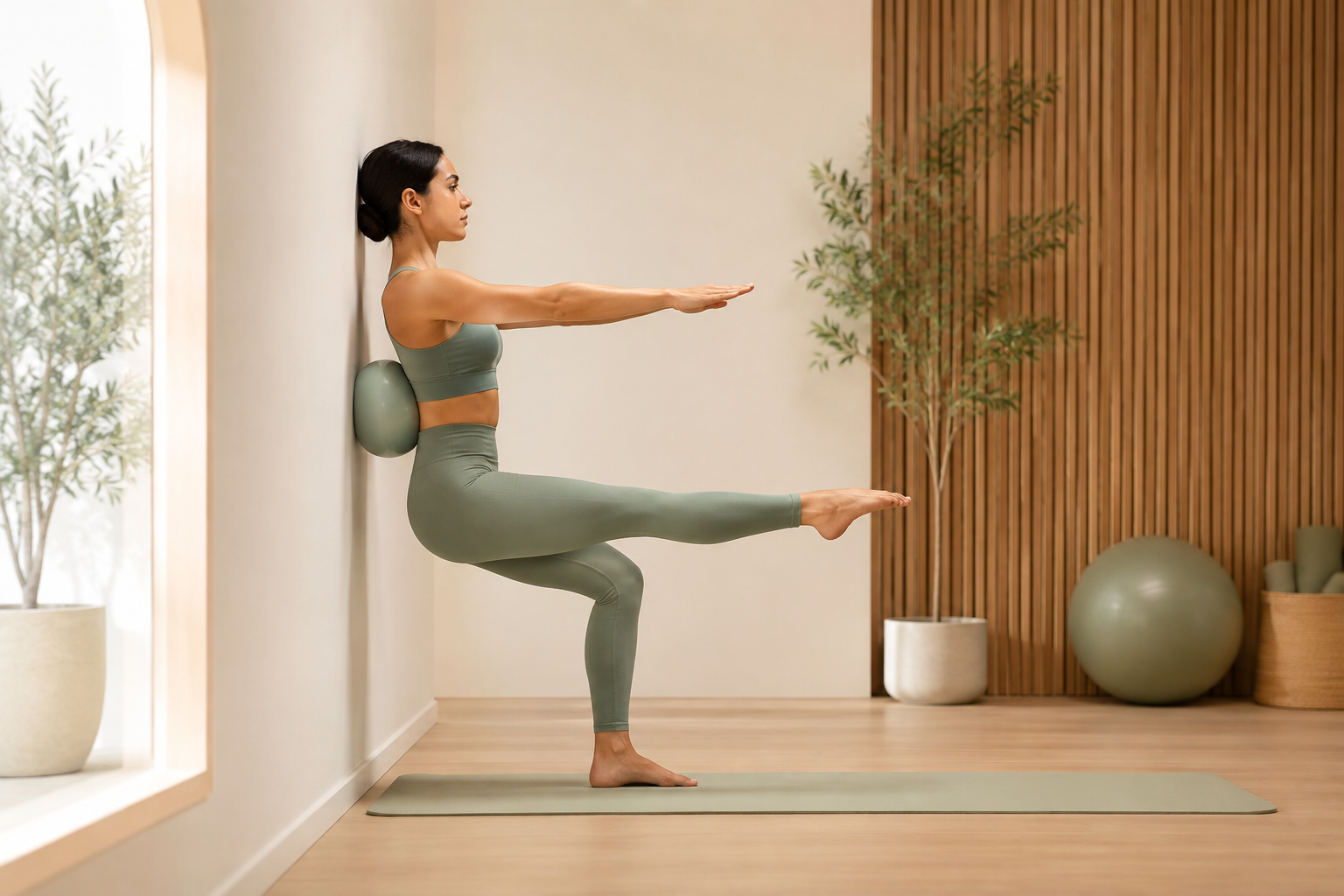
Wall Pilates is a home-based variation of traditional Pilates that uses a wall for resistance and alignment, making it one of the most accessible low-impact workouts available today. You lie on the floor, press your feet against the wall, and let that surface do what a reformer machine or a personal trainer normally would. The wall gives you feedback, keeps your form honest, and adds isometric resistance that traditional mat Pilates cannot offer. It has taken off on TikTok and Instagram for good reason. You need no equipment, no gym membership, and roughly ten minutes of floor space to get started.
For anyone easing back into movement, recovering from an injury, or working through weight loss goals, this workout deserves a closer look before you write it off as another social media trend.
What Actually Makes Wall Pilates Different
Traditional mat Pilates relies almost entirely on gravity for resistance. That works, but it caps how much your muscles can be challenged in any single move. When you press against a wall, you introduce something called isometric resistance, which means your muscles work against an immovable object without changing length. Heather Milton, an exercise physiologist at NYU Langone, has pointed out that this kind of resistance lets you exert force at varying levels of your maximum effort, something you cannot really do on a mat alone.
That is why wall Pilates feels harder than it looks. Your feet are elevated for most of the session, which improves circulation, reduces pressure on the lower back, and forces the deep core muscles to stabilise you constantly. It is also why beginners often report better posture and less back pain within the first two weeks.
Who Wall Pilates Is Genuinely Good For
If you are new to fitness, this is one of the friendliest starting points available. If you have desk-job posture, tight hamstrings, or knees that complain when you try to jog, you will likely find wall Pilates forgiving. Older adults benefit because balance and stability improve without any impact on the joints. People carrying extra weight often struggle with floor-based exercises where they have to lift limbs against gravity for long periods. The wall changes that equation.
There is a catch worth being honest about. If you are recovering from bariatric surgery or any abdominal procedure, wall Pilates is not something to start on your own. The core engagement is real, and even gentle bridges can strain incisions if you begin too soon. Our team at BodEvolve Bariatric typically clears patients for low-impact movement between four to six weeks after surgery, and Pilates specifically often needs a longer runway. If you have had a gastric sleeve procedure, gastric bypass, or a duodenal switch, speak to your surgeon before rolling out a mat. The same applies if you are pregnant, have a hernia, or manage a chronic back condition.
The Foundational Moves That Anchor a Wall Pilates Routine
Before you commit to a 28-day challenge, get comfortable with a handful of movements that appear in almost every session. These form the vocabulary of the practice.
Elevated hip bridge: Lie on your back with your feet flat on the wall, knees bent at roughly ninety degrees, calves parallel to the floor. Tuck your hips, press through your heels, and lift your back off the mat one vertebra at a time. Hold for two seconds at the top, then lower slowly. Ten to fifteen reps is enough for a first session. This trains your glutes and hamstrings without loading your spine.
Wall-supported leg raises: Lie flat with legs extended vertically and heels resting on the wall. Lower one leg toward a forty-five-degree angle, keeping the movement slow, then bring it back. Alternate legs for twenty reps total. Beginners feel this in the lower abdomen almost immediately.
Wall sits with calf raises: Stand with your back flat against the wall, walk your feet out, and slide down until your knees form a ninety-degree angle. Ankles should sit directly below the knees. Once you are stable, lift your heels off the floor and lower them. Fifteen repetitions is a solid starting number. Your quads will burn, and that is the point.
Wall roll down: Stand with your back against the wall, feet a foot away from it. Slowly roll your spine down one vertebra at a time as if peeling a sticker off a surface. Reverse the movement to come back up. This one is deceptive in how much it teaches your body about proper spinal alignment.
Side-lying leg lifts against the wall: Lie on your side with your feet touching the wall. Slide your top heel up the wall as high as you can without shifting your hips. This variation ensures your form stays clean because the wall will not let you cheat by tilting.
The 28-Day Wall Pilates Structure That Makes Sense
Most viral challenges throw twenty-eight random workouts at you and call it a program. That is not how the body adapts. A workable structure follows a progressive pattern where difficulty rises each week rather than each day.
Week one should focus on ten-minute sessions, four days across the week, with an emphasis on learning the movements slowly. The goal is not to feel exhausted. It is to teach your nervous system what the moves feel like when done correctly.
Week two stretches sessions to fifteen minutes, still four days a week. Add a second round of the foundational moves and start noticing which ones challenge you most. Those are the ones your body needs.
Week three pushes to twenty minutes across five days. Introduce longer holds during the bridge and wall sits. This is when strength gains begin to show up, which lines up with what exercise science tells us about neuromuscular adaptation.
Week four is where you consolidate. Twenty-five to thirty-minute sessions five days a week, mixing endurance holds with slower controlled reps. By day twenty-eight, most people can complete the sequence with better form than they had on day one and noticeable improvements in posture, flexibility, and core control.
What Results Actually Look Like After 28 Days
Social media makes wall Pilates look like a body transformation tool. The honest picture is more nuanced. If you are starting from very little activity, four weeks of consistent practice can genuinely improve strength, balance, and how your clothes fit. If you are already active, you will notice better core control and flexibility but probably not dramatic visual changes.
Strength gains take four to six weeks for your nervous system to catch up and closer to twelve weeks for muscles to visibly change. Wall Pilates is a low-to-moderate intensity workout, which means it will not produce the same fat loss as running or heavy resistance training on its own. What it does exceptionally well is build the foundation that lets you take on harder training later without injury.
For patients on a broader weight loss journey, wall Pilates works best as a companion practice, not a standalone solution. Whether you are pursuing medical weight management or considering surgical options, movement helps the body respond better to metabolic changes. If you are curious about the ideal heart rate for weight loss, it is worth understanding that wall Pilates rarely reaches fat-burning zones, which is another reason to pair it with walking or light cardio a few times a week.
Common Mistakes That Waste Your Effort
New practitioners tend to rush the movements. Wall Pilates rewards slow, deliberate reps far more than fast ones. If you are counting to two on the way up and two on the way down for a bridge, you are moving too fast. Try counting to four each direction.
Another mistake is holding your breath. Every Pilates instructor will tell you the same thing, and every beginner ignores it for the first week. Exhale during the exertion phase and inhale as you return to start. This is not a suggestion. It is the difference between engaging your deep core and just flexing your surface abs.
Finally, do not skip the wall check. Your feet should be planted flat, your lower back should not arch off the mat, and your shoulders should stay relaxed. If any of these drift, stop and reset. Ten clean reps beat thirty sloppy ones every single time.
Does Wall Pilates Actually Work for Weight Loss
The short answer is that it helps but does not do the heavy lifting. Weight loss comes down to a sustained energy deficit over time, and wall Pilates burns roughly a hundred and fifty to two hundred calories in a thirty-minute session for most adults. That is useful but modest. What it does contribute is muscle tone, better posture, and the kind of consistent movement habit that supports long-term results.
For anyone who has struggled with weight for years, layering wall Pilates on top of medical or surgical intervention gives better outcomes than either alone. Patients recovering from procedures at our Arlington,Richardson,Dallas, or Texarkana offices often start with walking, then graduate to wall Pilates once their surgeon signs off. That progression works because it builds strength without pushing a healing body past its limits.
Getting Started This Week
You need almost nothing to begin. A clear wall, enough floor space to lie down with your arms extended, and a mat or thick towel for comfort. Wear clothing you can move in without adjusting constantly.
Start with ten minutes tomorrow. Do the elevated hip bridge, wall-supported leg raises, and wall sits with calf raises. That is your first workout. Repeat it three times this week, resting a day between sessions. If those exercises feel manageable by day seven, you are ready to move into a proper 28-day progression.
Wall Pilates is not magic, but it is one of the few workouts that consistently delivers what it promises for the effort involved. It builds real strength, real flexibility, and real body awareness without the joint impact of most other training styles. For most people, that combination is worth showing up for.
