
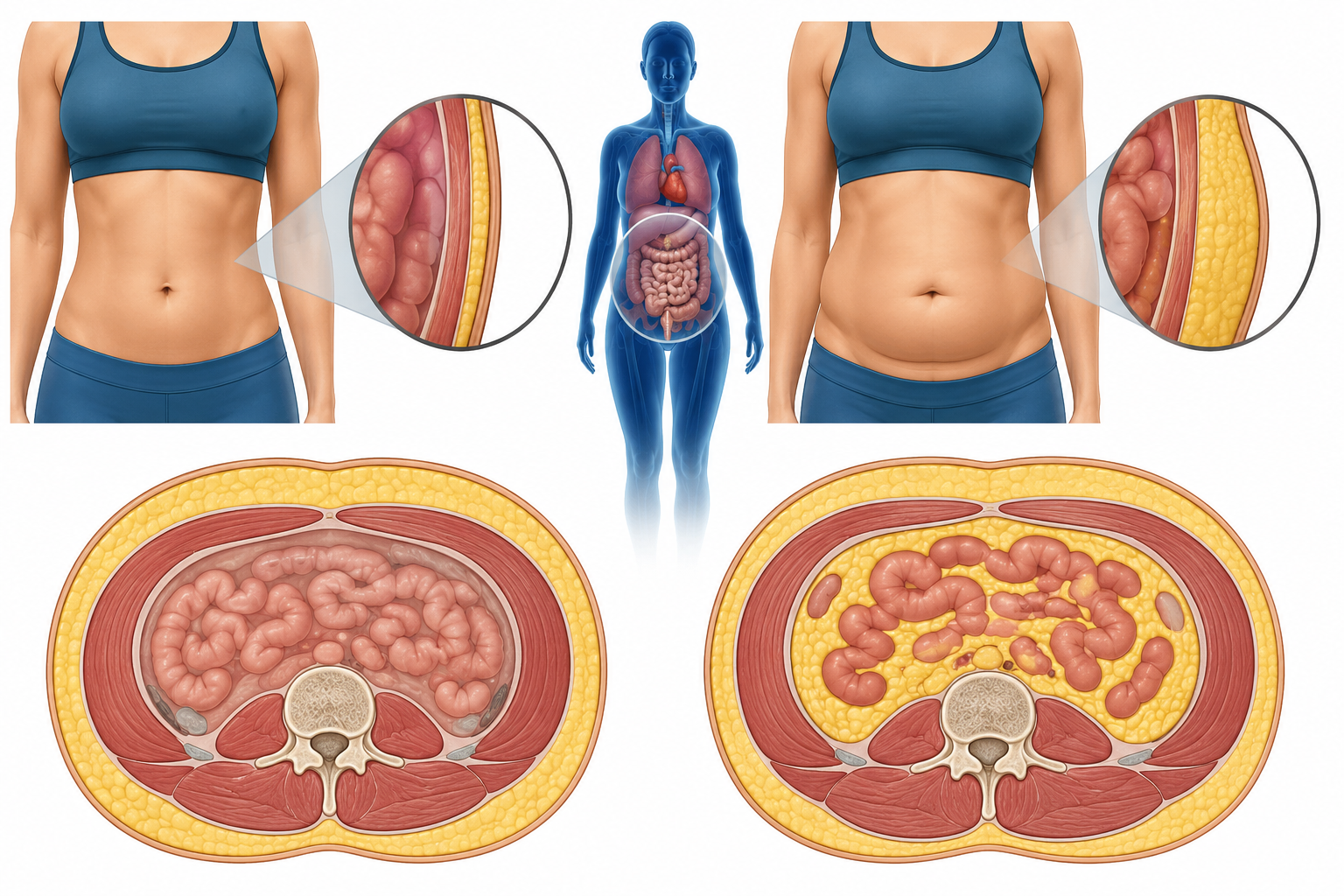
When patients sit down in our office and pinch the roll around their waist, most of them assume that soft handful is the fat causing their health problems. It usually isn’t. The layer you can grab with your fingers and the layer sitting deep behind your abdominal wall behave like two completely different organs, and understanding visceral fat vs subcutaneous fat changes how you approach weight loss, what results you should expect, and how quickly your health markers improve after a procedure like a gastric bypass or gastric sleeve. At BodEvolve Bariatric, dr Frenzel explains this distinction to almost every patient because the type of fat you carry, not just how much, decides your real health risk.
| Feature | Subcutaneous Fat | Visceral Fat |
|---|---|---|
| Location | Just under the skin | Deep inside the abdominal cavity |
| Feel | Soft, pinchable, jiggly | Firm, drum-tight belly |
| Visible? | Yes, you can grab it | No, hidden behind abdominal wall |
| Metabolically active? | Low | Very high, hormonally disruptive |
| Health risk | Low to moderate | High: diabetes, heart disease, fatty liver |
| Burns first? | No, comes off months later | Yes, first to leave during weight loss |
| How to measure | Pinch test, calipers | Waist-to-height ratio, DEXA, MRI |
What Is the Difference Between Visceral Fat and Subcutaneous Fat?
The main difference between visceral fat and subcutaneous fat is location and health impact. Subcutaneous fat sits just under the skin and is relatively harmless. Visceral fat sits deep in the abdominal cavity around the organs and is metabolically active, releasing hormones and inflammatory compounds that raise the risk of type 2 diabetes, fatty liver disease, and heart disease.
Think of it like this. Subcutaneous fat is storage. Visceral fat is a live wire. It secretes inflammatory chemicals, disrupts insulin signalling, and floods your liver with free fatty acids. That is why two people with the same waist size can have wildly different health risks. One might be storing most of their fat under the skin, the other deep around the organs. The scale will not tell you which one you are. Body fat distribution matters far more than total pounds.
What Does Subcutaneous Fat Look Like Compared to Visceral Fat?
Patients often ask what each type actually looks like on a body. Subcutaneous fat gives the body a soft, doughy feel. It jiggles. It moves when you walk. It is the fat you feel when you sit down and your stomach folds over your waistband. In a belly fat cross section, subcutaneous fat forms the outermost ring, sometimes several centimetres thick.
Visceral fat looks and feels completely different. A visceral-heavy abdomen is often round, firm, and pushes outward like a drum. When someone taps their belly and it feels tight rather than soft, that firmness is not muscle. It is visceral fat pushing the abdominal wall forward from the inside. This is why some men with lean-looking arms and legs still carry a hard, protruding gut. Their subcutaneous layer is thin, but their organs are packed in fat. In visceral fat vs subcutaneous fat pictures, the deep fat shows up on scans as bright white pockets wedged between organs, while surface fat appears as a smooth outer layer.
How to Tell Subcutaneous Fat From Visceral Fat at Home
A DEXA or MRI scan is the gold standard, but you do not need one to get a reasonable read. Here is what we use in clinic.
The pinch test tells you about subcutaneous fat. Grab the skin above your belly button. If you can pinch more than an inch or two, that is surface fat. Now stand up straight, relax your abdominal muscles, and look at your side profile. If your belly sticks straight out and feels firm when you press it, visceral fat is likely dominant. A soft, sagging lower belly usually means subcutaneous.
Waist-to-height ratio is another honest indicator. Measure your waist at the belly button and divide by your height. Anything above 0.5 suggests elevated visceral fat, regardless of your BMI. Waist circumference alone works too. For men, over 40 inches is a red flag. For women, over 35 inches. These numbers are not vanity metrics. They are strong predictors of metabolic disease. If you are trying to work out how to tell visceral fat vs subcutaneous fat at home, these three checks give you a clearer picture than the scale ever will.
Three ways to tell visceral fat from subcutaneous fat at home:
1. Pinch test: if you can pinch more than an inch of belly, it is subcutaneous.
2. Waist-to-height ratio: divide waist by height, above 0.5 means high visceral fat.
3. Firmness check: a hard, forward-pushing belly means visceral fat is dominant.
The Two Stomach Types Most Patients Fall Into
Patients almost always fall into one of two stomach type patterns, and knowing which one you have changes the conversation. The first is the soft, apron-style belly that sags over the waistband, moves when you walk, and pinches easily. That is a subcutaneous-dominant stomach type. The second is the round, hard, forward-pushing belly that feels tight when you press it and does not budge with cardio alone. That is a visceral-dominant stomach type, and it is the pattern most closely linked to metabolic disease. Many patients carry both, but one usually leads.
Visceral Fat vs Subcutaneous Fat Pictures: How to Recognize Each on a Scan
When patients search for visceral fat vs subcutaneous fat pictures,
they are usually trying to match what they see in the mirror to
what is happening inside their body. On an MRI or CT scan,
subcutaneous fat appears as a smooth, uniform ring wrapping the
entire torso just under the skin. It looks like a padded jacket
worn over the muscles.
Visceral fat looks nothing like that. On the same scan, it shows
up as bright white pockets wedged between the liver, intestines,
and kidneys, filling the space around the organs. A visceral-heavy
abdomen on imaging looks crowded, with fat pressing against
organs from every angle. This is why two patients with the same
waist size can have completely different scans. One might have a
thick outer ring and a clean interior. The other might have a
thin outer ring and an interior that looks packed. The second
patient is the one at real risk.
Visceral Fat vs Subcutaneous Fat: Health Risks Compared
This is where the two diverge sharply. Subcutaneous fat, especially on the hips and thighs, is relatively harmless in moderate amounts. Some research even suggests lower-body subcutaneous fat has a mild protective effect against diabetes. It is unsightly to some people, but it is not, on its own, deadly.
The numbers are not subtle. Studies published in the Journal of Clinical Endocrinology & Metabolism have linked high visceral adipose tissue to a two to three times higher risk of type 2 diabetes, independent of BMI. It is also the single strongest fat-related predictor of nonalcoholic fatty liver disease, now the most common chronic liver condition in Texas adults. A patient with a normal BMI but high visceral fat can carry more cardiometabolic risk than someone twenty pounds heavier whose fat sits mostly under the skin.
For patients coming in for a consultation, this is often the moment the conversation shifts. It is not about the number on the scale anymore. It is about what type of fat is driving their diabetes, their blood pressure, their exhaustion, their sleep apnea.
What Causes Each Type of Belly Fat to Build Up
Both types respond to calorie surplus, but they store fat under different conditions. Subcutaneous fat accumulates fairly predictably with excess calories and low activity. Visceral fat is driven more aggressively by chronic stress, poor sleep, high sugar and refined carbohydrate intake, alcohol, and hormonal shifts. Cortisol in particular pushes fat storage inward. This is why chronically stressed people often develop a hard, protruding belly even without dramatic weight gain.
Genetics play a role too. Some people are wired to store fat around organs first. Others carry it on their thighs and hips well before it goes to the abdomen. Age accelerates visceral storage, especially in women after menopause when oestrogen drops and fat redistributes toward the midsection. In visceral fat vs subcutaneous fat differences that matter clinically, this hormonal shift is one of the most important.
Does Visceral Fat Burn First? The Real Order of Fat Loss
Yes, visceral fat burns first. Because visceral fat is metabolically active and sits deep around your organs, your body breaks it down before touching the subcutaneous layer under your skin. Most patients lose 30 to 40 percent of their visceral fat within the first six months of consistent weight loss, months before the belly visibly shrinks. This is why blood pressure, blood sugar, and liver enzymes often improve long before the mirror shows any change.
This is why some patients feel dramatically better long before they look dramatically different. Their blood sugar normalises, their blood pressure drops, their liver enzymes improve, their sleep apnea eases, and their energy returns, all while their belly still looks soft to the eye. That is the visceral fat leaving. Subcutaneous fat, especially in the lower belly, thighs, and upper arms, is slower. It comes off over 12 to 24 months and often requires resistance training to tighten the underlying muscle once the fat is gone. Understanding this order of fat loss visceral vs subcutaneous keeps patients patient. The mirror lags behind the metabolism.
Order of fat loss during weight loss:
1. Visceral fat around organs (months 1 to 6)
2. Upper body subcutaneous fat, including arms and chest (months 3 to 9)
3. Abdominal subcutaneous fat (months 6 to 12)
4. Lower body subcutaneous fat on hips and thighs (months 9 to 24)
For a fuller look at how the timeline actually plays out, our guide on gastric bypass before and after results walks through what patients see month by month.
Visceral Fat vs Subcutaneous Fat Loss After Bariatric Surgery
Weight loss surgery accelerates the fat-loss order in a way that diet alone rarely matches. Within the first three months after a gastric sleeve or gastric bypass, patients typically see a rapid drop in visceral fat because the caloric deficit is steep and hormonal changes reduce insulin and cortisol simultaneously. Type 2 diabetes often resolves before the majority of the weight is even lost. That is not a coincidence. That is visceral fat leaving the liver and pancreas.
Subcutaneous fat loss becomes noticeable around month four to six, and full body contour changes usually stabilise between 12 and 18 months. Some patients keep losing modest amounts through month 24. The lower abdomen, inner thighs, and upper arms are typically the last areas to change, which is why some patients consider skin removal procedures once their weight has plateaued.
If you want a practical breakdown of what to eat, how to train, and how to protect muscle while losing fat during this window, our guide on how to lose weight after bariatric surgery covers the day-to-day habits that separate patients who reach their goal from patients who plateau early.
Why the Distinction Matters Before You Choose a Procedure
The reason we spend time on this in consultation is simple. A patient carrying mostly visceral fat with diabetes, sleep apnea, or fatty liver disease is a strong candidate for surgery because the metabolic upside is enormous and comes quickly. A patient carrying mostly subcutaneous fat without severe metabolic complications may have different goals, and the conversation shifts accordingly. Both are valid reasons to lose weight. They just come with different timelines and different expectations.
This is also where insurance conversations begin, because payers weigh comorbidities heavily when evaluating coverage. If visceral fat has already driven you into diabetes, hypertension, or sleep apnea, your case for coverage is often stronger. Our guide on how to get insurance to cover revision bariatric surgery walks through what documentation payers actually look for.
Ready to Take the Next Step
If you have been carrying stubborn belly fat that will not respond to diet, or if you have been diagnosed with conditions that visceral fat drives, a consultation is the fastest way to know your options. Our team at BodEvolve Bariatric sees patients from across Arlington, Richardson, Dallas, and Texarkana, and we take the time to explain what your body is actually doing before we recommend any path forward.
