
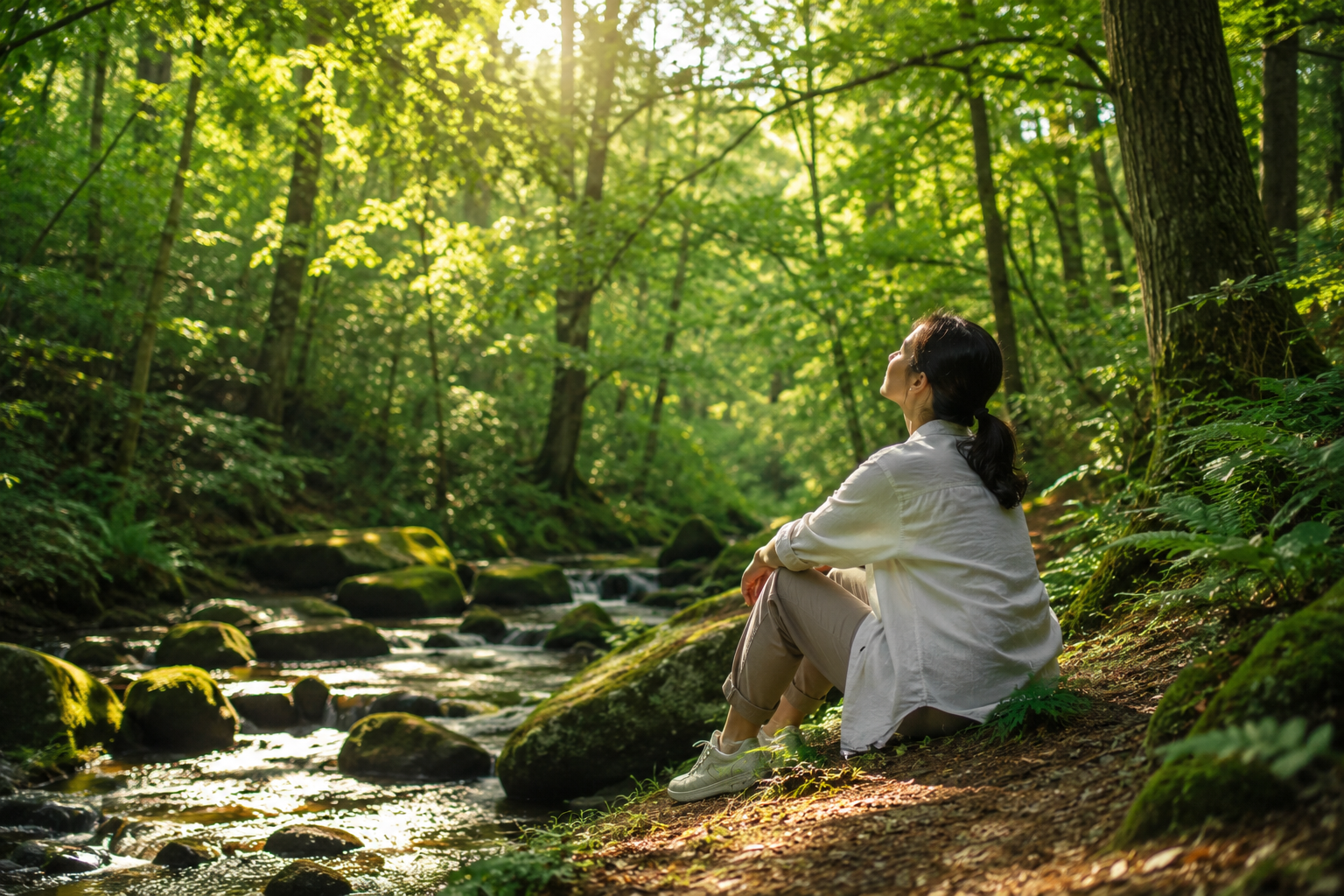
Shinrin-yoku forest bathing is a Japanese wellness practice that involves slowly and mindfully spending time among trees, taking in the sights, sounds, and smells of a forest through all five senses. The term translates literally as “forest bath,” though there is no water involved. It was coined in Japan in 1982 by the Forest Agency as part of a national public health campaign to counter urban stress and reconnect people with the natural environment. What makes shinrin-yoku different from a walk or a hike is intention. There are no fitness goals, no distance to cover, no photos to take. You are there to be with the forest, and the forest, in turn, has measurable effects on your body, your mind, and even your immune system.
For anyone dealing with stress-related weight gain, high blood pressure, sleep problems, or general burnout, this ancient practice is now backed by decades of modern research that is difficult to ignore.
What Shinrin-Yoku Actually Means
The Japanese word breaks down into two parts. Shinrin means forest. Yoku means bath or immersion. Put together, the phrase describes the act of letting the forest wash over you. It is not exercise. It is not meditation in the traditional sense. It is closer to a slow, sensory encounter with a natural place.
Dr. Qing Li, one of the leading researchers in the field, has spent decades studying what happens to the human body during a forest visit. His work at Nippon Medical School helped establish what the Japanese now call “forest medicine,” a branch of preventive healthcare that treats time in nature as a genuine health intervention. In Japan, doctors can now recommend forest bathing the same way they might recommend physiotherapy or a change in diet.
The Science Behind the Practice
If shinrin-yoku sounds too poetic to be real medicine, the research tells a different story. Studies conducted primarily in Japan, South Korea, and more recently in Europe and the United States have found consistent, measurable effects.
Forest bathing reduces salivary and serum cortisol, the body’s primary stress hormone. It lowers blood pressure and heart rate, shifting the autonomic nervous system away from the fight-or-flight response and into a calmer parasympathetic state. It boosts natural killer cell activity, a type of white blood cell involved in immune defence, with effects that can last up to seven days after a single visit. It improves sleep quality, reduces markers of inflammation, and consistently lowers scores for anxiety, depression, anger, and fatigue on standardised mood assessments.
Much of this appears to be driven by phytoncides, the antimicrobial volatile compounds that trees release into the air. When you breathe forest air, you are inhaling low doses of these compounds, which appear to modulate immune function and reduce stress hormones directly.
This matters for anyone on a weight loss journey because chronic stress and elevated cortisol contribute directly to abdominal fat storage, insulin resistance, and cravings. Our post on cortisol belly fat covers this connection in detail, but the short version is that lowering stress hormones is not a soft, feel-good goal. It is a metabolic one.
How Shinrin-Yoku Differs From a Regular Walk
Most of us walk through nature without truly being in it. We are thinking about work, checking our phones, tracking our steps, or planning our next meeting. Shinrin-yoku asks you to leave all of that behind for a stretch of time and simply notice where you are.
There is no set distance. A typical session covers less than a mile of walking, sometimes far less. You move slowly. You stop often. You touch the bark of trees. You listen to the small sounds, the wind through leaves, birds, water, insects. You look up at the canopy and out into the depth of the woods. If it feels awkward or slow at first, that is normal. Most people have never given themselves permission to move through a place without a goal.
The physical effort is minimal, which is part of the point. Unlike rucking for weight loss or a treadmill workout, this practice is not about calorie burn. It is about downshifting the nervous system.
Who Shinrin-Yoku Is Especially Good For
Anyone dealing with chronic stress can benefit, but a few groups tend to see the biggest returns.
People with high blood pressure:
Studies consistently show reductions in both systolic and diastolic pressure after forest bathing sessions, sometimes lasting for days.
People with sleep problems:
Time in nature, especially in daylight, helps reset circadian rhythms and improves sleep depth and duration.
People carrying weight-related stress:
If you have spent years cycling through diets, feeling frustrated with your body, or navigating the emotional weight of considering surgery, shinrin-yoku offers something rare. A practice that costs nothing, requires no equipment, and asks nothing of you except your attention.
Post-bariatric patients also benefit:
Recovery from a gastric sleeve, gastric bypass, or duodenal switch procedure is not purely physical. The emotional adjustment to a rapidly changing body, changing relationships with food, and shifting identity can be significant. Our guide on depression after bariatric surgery covers this in more depth, but gentle nature exposure is one of the lowest-cost, lowest-risk tools available for supporting mood during that transition.
How to Actually Do Shinrin-Yoku
You do not need a Japanese forest. Any wooded area with a reasonable density of trees will do. City parks work if that is what you have, though larger, quieter woodlands tend to produce stronger effects.
Plan for at least two hours. Research suggests the physiological benefits build significantly after the ninety-minute mark, so anything shorter is a start rather than a full session.
Leave your phone in your pocket or, better, in your bag. If you must have it for safety, put it on silent and do not check it during your time in the forest.
Begin by standing still for a minute or two once you enter the woods. Take a few slow breaths. Notice what changes when you stop moving. The sounds around you become more distinct. The temperature and light shift. Your shoulders start to drop before you have even realised they were tense.
Walk slowly. Slower than feels natural. If you normally walk a mile in twenty minutes, aim for forty or more. Stop whenever something catches your attention.
Use all five senses on purpose. Look at patterns in the bark. Listen to the wind moving through different layers of the canopy. Touch a leaf and notice its texture. Smell the air, particularly after rain or in areas dense with pine or cedar. If you feel comfortable, taste something safe like a wild raspberry or the tip of a spruce needle, but only if you know what you are looking at.
Find a spot to sit for at least twenty minutes near the end of your session. This is when the deepest calming effects often show up. Your nervous system needs time to fully arrive.
When you leave the forest, do so slowly. Do not rush straight back into traffic and email. Sit in your car for a few minutes first if you can.
Common Misunderstandings
Shinrin-yoku is not a hike. It is not aerobic exercise. Do not expect it to replace your regular movement routine.
It is also not silent meditation. You are welcome to talk quietly with a partner, though most practitioners find they naturally speak less as the session goes on.
It is not spiritual or religious in any organised sense, though many people describe it as deeply restorative. Whether that restoration comes from the phytoncides, the sensory input, the absence of screens, or some combination is still being studied. What is clear is that the effects are real and measurable.
Finally, it is not a substitute for medical care. If you have hypertension, mood disorders, or metabolic conditions like insulin resistance, shinrin-yoku can complement your treatment but should never replace it. For metabolic syndrome or established cardiovascular disease, always speak with your doctor about how to integrate lifestyle practices with clinical care.
Practical Tips for Getting Started
You do not need to live near a national park to make this work. Look for the largest wooded green space within reasonable driving distance. Even a mid-sized city park with dense trees can serve as a starting point.
Dress for the weather in layers you can adjust. Wear shoes that let you move comfortably on uneven ground.
Bring water and a snack, particularly if you are post-surgery and following specific hydration or protein guidelines from your surgical team. Our post-bariatric surgery diet guide can help you plan sensible options to take along.
Start with weekend visits. Once a month is genuinely useful. Research suggests that even a single monthly forest bath produces sustained improvements in stress markers.
Consider going alone at least some of the time. Solo sessions often go deeper. If safety is a concern, choose well-travelled trails or go with a friend who understands you would like quiet stretches.
Where This Fits in a Broader Health Plan
Shinrin-yoku will not, on its own, produce significant weight loss. That is worth stating plainly. What it will do is help reduce the chronic background stress that makes weight loss harder, sleep worse, and cravings stronger. Combined with a sustainable nutrition plan and appropriate medical care, it can be a genuine contributor to long-term wellbeing.
For patients working with our team at BodEvolve Bariatric across our Arlington, Richardson, Dallas, or Texarkana offices, we often talk about the full picture of health, which includes stress, sleep, and mental wellbeing alongside nutrition and physical activity. Whether you are exploring medical weight management or planning surgery, adding a monthly forest bath to your routine is one of the simpler ways to support the process.
Shinrin-yoku has been called a practice, a therapy, and a form of preventive medicine. It might be simpler to call it what it is. Time spent honestly and slowly among trees, which turns out to be surprisingly good for you.
