
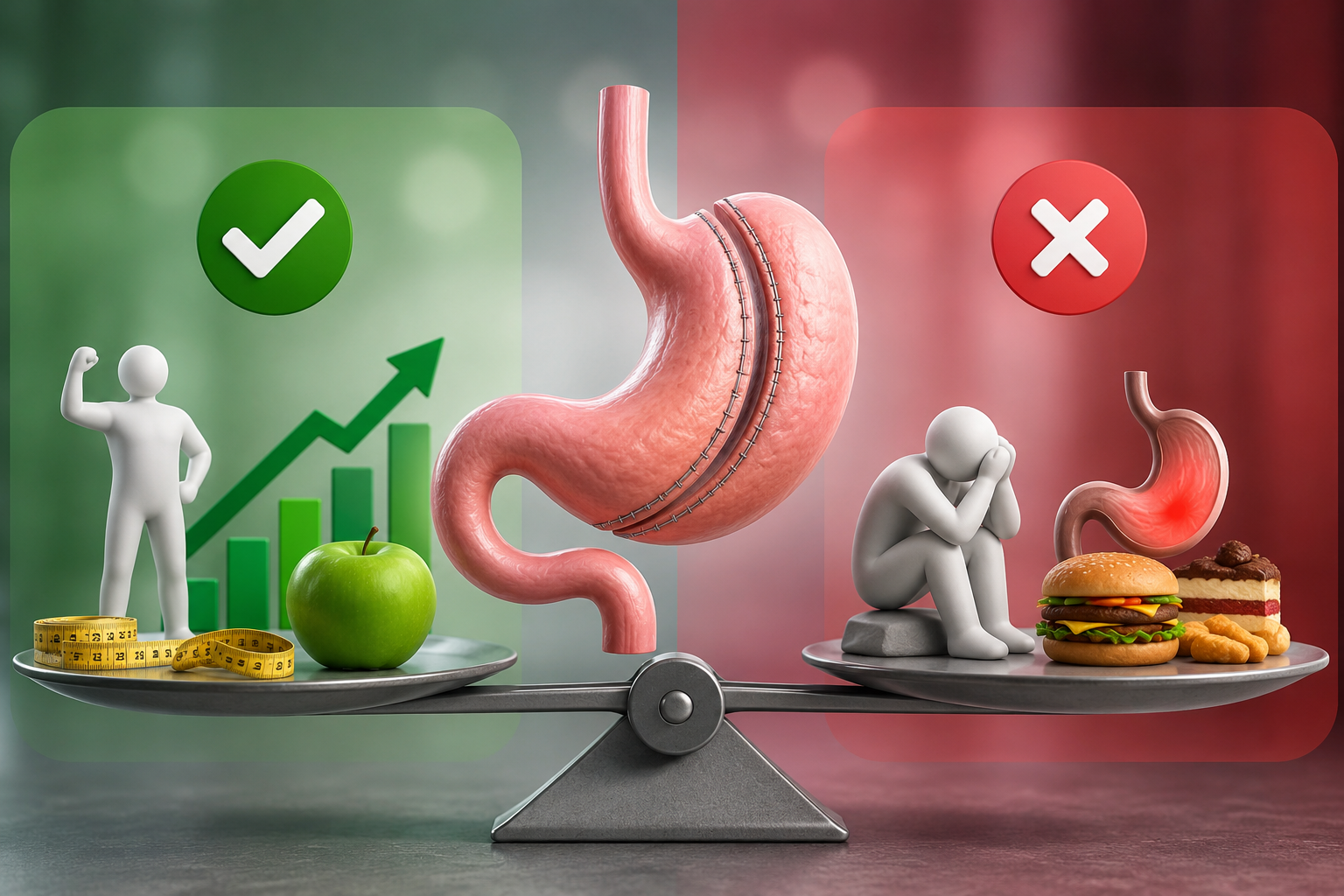
Most articles about weight loss surgery either scare you away or oversell the results. Neither approach helps you make a real decision. The pros and cons of gastric sleeve deserve a straight conversation, the kind you would have across the desk from a surgeon who has performed thousands of these procedures. That is what this guide is. No sugarcoating, no fear tactics, just what we tell our own patients in DFW when they sit down for a consultation with dr Frenzel and our team.
If you have been researching for weeks, jumping between Reddit threads, YouTube testimonials, and confusing medical sites, this blog is meant to bring you back to solid ground.

Gastric Sleeve Surgery Pros and Cons at a Glance
Before we go deep, here is the honest snapshot most patients tell us they wish they had found earlier.
- The upside: Significant, lasting weight loss (typically 60 to 70 percent of excess weight in the first 18 months), reduced hunger hormones, resolution of type 2 diabetes and sleep apnea for many patients, no rerouting of the intestines, and a shorter recovery than bypass.
- The trade-offs: It is permanent (about 80 percent of the stomach is removed and cannot be added back), acid reflux can worsen or newly appear, some patients regain weight after year three if habits slide, and long-term vitamin supplementation becomes part of daily life.
That is the honest version. Now let’s unpack why each of these matters.
What Actually Happens During Gastric Sleeve Surgery
Vertical sleeve gastrectomy, often shortened to VSG, is done laparoscopically through a few small incisions. We remove roughly 80 percent of the stomach, leaving behind a narrow, banana-shaped pouch. That pouch holds about four to five ounces at first, compared to the roughly one-quart capacity of a normal stomach.
The part of the stomach we remove is not random. It is the section that produces most of your ghrelin, the hormone that drives hunger. This is the mechanical piece most weight loss articles skip, and it is arguably the most important one. Your appetite does not just shrink because your stomach did. It shrinks because your body is producing less of the hormone telling you to eat.
Learning what the recovery journey actually looks like in the months after surgery is worth the read. Our blog on gastric bypass before and after walks through timelines that overlap heavily with sleeve recovery, and it gives an honest look at what months one, three, six, and twelve feel like on the ground.
Pros and Cons of Gastric Sleeve Surgery: The Real Benefits
Let’s talk about why this procedure has become the most popular bariatric surgery in the United States.
- Substantial, durable weight loss. Most patients lose 60 to 70 percent of their excess body weight within 12 to 18 months. Some lose more. Unlike diets, this loss holds for years when patients stay engaged with their care team.
- Genuine appetite reduction. Because we remove the ghrelin-producing section of the stomach, the constant food noise most patients live with quiets down significantly. Many describe it as thinking about food normally for the first time in decades.
- Resolution of obesity-related conditions. Type 2 diabetes goes into remission for a large share of our patients, often within weeks. High blood pressure, sleep apnea, joint pain, and fatty liver disease frequently improve or resolve entirely.
- No intestinal rerouting. Unlike bypass, the digestive tract stays intact. This means less risk of certain vitamin deficiencies, no dumping syndrome in most cases, and the ability to take common medications like NSAIDs (with your surgeon’s guidance).
- Shorter hospital stay and recovery. Most sleeve patients go home the next day and are back to desk work in one to two weeks.
- Lower long-term complication rates than bypass. Fewer moving parts means fewer things that can go wrong long term.
The Cons You Deserve to Know Before Deciding
Any surgeon who only lists benefits is not being straight with you. Here is the honest side.
- It is permanent. We cannot add the removed stomach back. This is not a “try it and see” procedure.
- Acid reflux can appear or worsen. This is the single most discussed downside among patients online, and it is a real one. Some patients who never had reflux develop it. Some with existing reflux find it gets worse. For patients with severe GERD, we often recommend bypass instead, and we discuss this openly during consultation.
- Weight regain is possible. After year two or three, patients who drift from their nutrition and activity plan can regain 10 to 30 percent of what they lost. The tool works. It does not replace the habits.
- Vitamin deficiencies are a lifelong reality. B12, iron, vitamin D, calcium, and thiamine supplementation is not optional. Skipping it leads to real problems.
- Loose skin. Rapid weight loss of 80 to 150 pounds usually leaves excess skin. Some patients later choose body contouring procedures.
- Diet restrictions in the first months. Liquid, then pureed, then soft foods for the first six to eight weeks. Small meals for life.
- Risks of any major surgery. Bleeding, infection, staple line leak (rare, but serious), and anesthesia complications exist. Choosing a high-volume, fellowship-trained surgeon is how you keep these risks low.
Gastric Sleeve vs Gastric Bypass Pros and Cons
This is the comparison patients ask about most, so let us give it the space it deserves.
The gastric sleeve removes part of the stomach. That is it. No intestinal rerouting.
The gastric bypass creates a small stomach pouch and reroutes a section of the small intestine to attach to it, bypassing part of your digestive tract entirely.
- Sleeve pros over bypass: Simpler procedure, faster recovery, no dumping syndrome for most, lower risk of vitamin malabsorption issues, can still take NSAIDs in most cases, no internal hernia risk.
- Bypass pros over sleeve: Slightly more total weight loss on average (65 to 80 percent excess weight loss), stronger and faster resolution of type 2 diabetes, gold standard for severe GERD (bypass often eliminates reflux, sleeve can worsen it), and stronger long-term data going back over 50 years.
- Sleeve cons vs bypass: Higher risk of new or worsening acid reflux, slightly less total weight loss on average.
- Bypass cons vs sleeve: More complex surgery, dumping syndrome (which some patients actually use as a behavior guardrail), higher risk of vitamin and mineral deficiencies, cannot take NSAIDs long term, internal hernia risk.
Neither procedure is universally better. The right one depends on your BMI, medical history, reflux status, diabetes severity, and honestly, your personality and habits. This is the conversation we sit down and have with every patient during consultation.
Pros and Cons of Lap Band vs Gastric Sleeve
The lap band was popular in the 2000s and early 2010s. It is not anymore, and there are good reasons for that.
- Lap band pros: Reversible, adjustable, no stomach or intestine is cut, shortest recovery.
- Lap band cons: Weight loss is significantly lower (often only 40 to 50 percent excess weight loss), high rate of complications requiring band removal (slippage, erosion, port issues), frequent office visits for adjustments, and high long-term revision rates.
By comparison, the sleeve delivers roughly 60 to 70 percent excess weight loss with far fewer long-term complications. Most bariatric practices, ours included, have moved away from lap bands. We now see many patients coming to us for lap band revisions, often converting to sleeve or bypass.
Pros and Cons of Vertical Gastric Sleeve (VSG)
“Vertical gastric sleeve” and “gastric sleeve” refer to the same procedure. The “vertical” describes the shape of the remaining stomach after the outer curve is removed. The formal medical name is vertical sleeve gastrectomy.
Everything we have covered above applies. If you have been reading about vertical gastric sleeve and standard gastric sleeve as if they were different procedures, they are not. You are researching the same operation.
Gastric Sleeve Testimonials Pros and Cons: What Patients Actually Say
Testimonials can be helpful and misleading in equal measure. Here is what we notice from patients five years out, both the highs and the honest complaints.
- What patients love: The quiet in their head around food. The ability to walk up stairs without gasping. Getting off blood pressure medication. Playing with their kids on the floor. Fitting into airline seats. Not being the biggest person in the room.
- What patients wish they had known: That the first six weeks are hard emotionally, not just physically. That some friendships change when you change. That reflux can appear out of nowhere at month four. That regain is real if you stop showing up for yourself.
For a deeper look at how real patients navigate the years after surgery, our blog on weight loss success stories covers the parts most testimonials skip, the plateaus, the mental shifts, and what maintenance actually looks like at year three and beyond.
Reading through gastric sleeve pros and cons on Reddit or Facebook groups can be useful for community and honesty, but remember that the loudest voices online are often the ones with unusual experiences, good or bad. The average outcome is quieter, and it is closer to what your surgeon can predict for you based on your specific health profile.
Who Is the Ideal Candidate?
Gastric sleeve is generally considered for adults with:
A BMI of 40 or higher, or a BMI of 35 or higher with obesity-related conditions (diabetes, sleep apnea, high blood pressure, joint disease). Some patients with a BMI of 30 to 34 and metabolic disease also qualify under newer guidelines.
You are likely not the ideal sleeve candidate if you have severe, uncontrolled GERD, a large hiatal hernia, or are unable to commit to lifelong nutrition and follow-up. In those cases, bypass often makes more sense, and we will tell you so directly.
Insurance, Cost, and Long-Term Follow-Up
Cost is one of the biggest reasons patients delay surgery, and often it is unnecessary delay. Most major insurance plans cover bariatric surgery when medical criteria are met, but the approval process has specific requirements that trip patients up.
If you are considering surgery, or if you have had a previous bariatric procedure that did not deliver what you needed, our full guide on how to get insurance to cover revision bariatric surgery walks through the documentation, timelines, and appeals process step by step.
Ready to Talk to a Surgeon Who Will Be Honest With You?
The pros and cons matter, but they matter most when they are applied to your body, your health history, and your goals. A 30-minute consultation with our team will tell you more than 30 hours of online research.
We see patients from across DFW and East Texas at our Arlington, richardson, Dallas, and texarkana clinics. Book a consultation and let’s have the straight conversation you have been looking for.
