
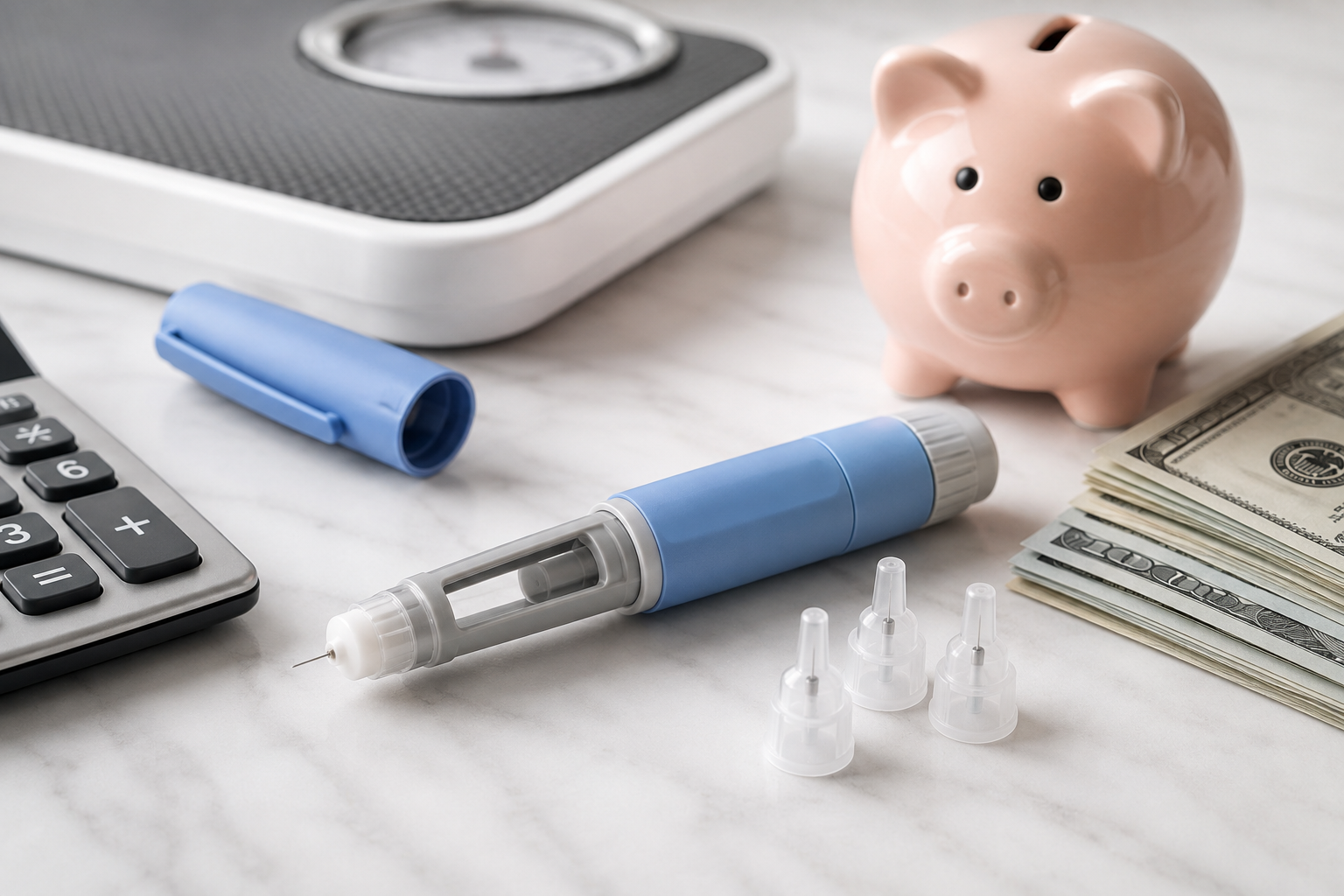
If you’ve been researching Ozempic for weight loss or type 2 diabetes management, the first thing you probably noticed is how much the numbers move around. One website says a thousand dollars a month. Another says $199. A third says $25. So which one is real?
The honest answer: all of them, depending on who you are, what insurance you carry, and which pharmacy path you use. Ozempic pricing in the United States has shifted meaningfully over the last twelve months, and if you’re deciding whether this medication fits your budget (or whether a permanent solution like a gastric bypass or gastric sleeve might make more financial sense over five years), you deserve a clear breakdown, not a sales pitch. Here’s what we tell our patients when they ask.
Ozempic Pricing US: What You’ll Actually Pay in 2026
Novo Nordisk, the manufacturer, has a published list price of around $997 per month for a single Ozempic pen (a 28-day supply). That’s the “sticker price,” and almost nobody actually pays it. What you end up spending depends on which of three lanes you fall into.
If you have commercial insurance that covers Ozempic for type 2 diabetes, your monthly copay usually lands somewhere between $25 and $150, depending on your plan’s formulary tier and deductible. With the Ozempic Savings Card and a qualifying commercial plan, eligible patients can pay as little as $25 per month, up to a maximum savings of $100 per month. That’s the best-case scenario, and it’s only realistic if diabetes is the documented reason for your prescription.
If you’re paying cash through NovoCare (Novo Nordisk’s direct-to-consumer pharmacy), new self-pay patients pay $199 per month for the first two fills of the 0.25 mg and 0.5 mg starter doses, then $349 per month for 0.25 mg, 0.5 mg, or 1 mg, and $499 per month for the 2 mg dose. This offer runs through December 31, 2026.
If you’re walking into a retail pharmacy with no insurance and no manufacturer program, you’re looking at the ugly number. The typical cash price at a pharmacy can run around $1,396 for a single injection pen, which puts the annual expense in the neighborhood of $17,000. Nobody should ever pay that if they don’t have to, and later in this article we’ll walk through the paths that keep you off that number.
One thing worth pointing out: coverage for Ozempic when it’s prescribed off-label for weight loss (rather than diabetes) is rare. Most commercial insurers will only cover it with a diabetes diagnosis and prior authorization documentation. That’s a big deal, because the majority of people searching for Ozempic pricing information are looking at it for weight management, not blood sugar.
Ozempic 340B Pricing: Why Hospital Pricing Looks So Different
You may have come across mentions of “340B Ozempic pricing” and wondered what that actually means for you as a patient. Here’s the plain-English version.
The 340B Drug Pricing Program is a federal program run by the Health Resources and Services Administration (HRSA). It allows certain safety-net hospitals, federally qualified health centers, Ryan White clinics, and specific covered entities to purchase outpatient prescription drugs at deeply discounted prices from pharmaceutical manufacturers. The savings are meant to be reinvested into care for uninsured and underinsured patients.
For medications like semaglutide, the 340B price is significantly lower than commercial retail pricing. A widely cited independent analysis published in 2024 found that semaglutide could theoretically be produced for between $0.89 and $4.73 per month, which gives you a sense of how much markup sits between raw manufacturing cost and pharmacy shelf price.
What this means practically: if you are uninsured or on Medicaid and you receive care from a 340B-eligible community health center or safety-net clinic, you may be able to access Ozempic at a substantially reduced cost through that facility’s pharmacy program. It’s not a discount you can request at your local CVS. It has to come through a qualifying covered entity. If you’re in North Texas, calling your closest federally qualified health center (FQHC) and asking whether they participate in the 340B program for GLP-1 medications is a legitimate first step.
There is one important caveat for 2026. Novo Nordisk changed its Patient Assistance Program (PAP) so that Medicare beneficiaries with Part D coverage are no longer eligible to receive Ozempic through the PAP. If you’re on Medicare, you’ll need to work with your Part D plan or explore the Medicare Prescription Payment Plan (M3P) to spread out costs, not the manufacturer PAP.
GoodRx Ozempic Pricing: Do the Coupons Actually Work?
Short answer: sometimes, but not the way most people think.
If you search “GoodRx Ozempic” you’ll see two very different numbers on the same page, and it trips a lot of people up. One is the standard discount-card price, which typically lands around $791 to $965 for a single pen. Better than the full retail price of $1,300+, but still expensive.
The second number is much lower, because GoodRx now partners with Novo Nordisk directly. Through this partnership, eligible patients can pay $149 for the first two fills through GoodRx-Novo pricing, roughly 88 percent off the average retail price of $1,211 for the most common Ozempic pen. After the introductory period, pricing steps up to the standard NovoCare cash rates.
Two things to know before you rely on GoodRx for Ozempic:
The GoodRx-Novo partnership pricing and standard insurance coverage cannot be combined on the same fill. You choose one payment route per prescription, not both.
Government insurance beneficiaries (Medicare, Medicaid, TRICARE, VA) are excluded from manufacturer savings cards, including the discounted GoodRx-Novo pathway. If you’re on any federal health program, you’ll need to work through your plan’s formulary and copay structure instead.
New Ozempic Pricing in 2026: What Changed and What It Means for You
A few meaningful shifts have happened in the pricing landscape over the last year, and they’re worth understanding if you’re planning ahead.
Novo Nordisk extended its $199 introductory pricing multiple times through 2026, most recently pushing the deadline to December 31, 2026, for new patients starting the 0.25 mg or 0.5 mg dose. This gives new starters a cushion of two months at reduced cost before they move into the standard $349 or $499 tiers.
Medicare price negotiation results are also beginning to take effect. When the first round of negotiated prices apply, they will range from 38 percent to 79 percent lower than list prices, with an estimated $6 billion in Medicare savings. Ozempic is on the list of negotiated drugs, though the full patient-level pricing impact will roll out over time.
The compounded semaglutide market, which surged during the FDA-declared shortage in 2023 and 2024, is contracting. Enforcement stepped up in 2025 as the shortage resolved, and many compounding pharmacies have paused or restructured their programs. Prices for compounded alternatives now typically run $129 to $299 per month, but availability is inconsistent and the regulatory picture is unsettled. If you’re considering compounded semaglutide, verify that the pharmacy is a licensed 503A or 503B facility and understand that quality and consistency vary.
Generic Ozempic will not be available until Novo Nordisk’s patent expires around 2031. Anyone promising you “generic Ozempic” today is selling you a compounded product, not a true generic.
The Number Nobody Talks About: What Happens When You Stop
This is where most Ozempic pricing articles go quiet, and it’s the number that matters most for anyone thinking long-term.
Ozempic is not a course of treatment you finish. It’s a maintenance medication. Multiple clinical follow-up studies now confirm that patients who discontinue GLP-1 medications regain a significant portion of the weight they lost, often within twelve months. So the real financial question isn’t “what does Ozempic cost this month,” it’s “what does Ozempic cost over five, ten, or twenty years, and can I sustain that indefinitely?”
Let’s do the math honestly. If you’re a self-pay patient using NovoCare at $349 per month, that’s $4,188 per year. Over five years, you’re looking at close to $21,000 in medication costs alone, not counting provider visits, labs, and any titration to the $499 dose. Over ten years, you’re near $42,000. And that assumes pricing stays flat, which it historically has not.
Compare that to bariatric surgery. According to a 2025 NYU study reported by ScienceAlert, patients who had bariatric surgery lost 25.7 percent of body weight over two years, while patients on GLP-1 medications lost 5.3 percent. Surgery is a one-time investment with sustained results, and many commercial insurance plans cover it when you meet the BMI and comorbidity criteria. It’s not the right choice for everyone, but it deserves an honest place in the conversation, especially when you’re staring down a decade of $349-and-climbing monthly refills.
Insurance denials for weight loss medications are common, and appeals are exhausting. Insurance coverage for medically necessary bariatric surgery, by contrast, is far more standardized. If you’ve been fighting your insurer over GLP-1 coverage, it’s worth reading our guide on how to get insurance to cover revision bariatric surgery to understand what documentation typically unlocks approval.
A Better Question Than “How Much Does Ozempic Cost”
The pricing question is real, but it’s the wrong starting point. The right starting point is: what does your five-year and ten-year plan look like? If insurance covers Ozempic and you’ll stay on it for life, the math can work. If you’re self-paying at $349 a month indefinitely, or if you’re likely to stop treatment at some point and regain weight, a permanent solution deserves serious consideration.
BodEvolve Bariatric has been helping North Texas patients think through exactly this decision. We serve patients across Arlington, Dallas, Richardson, and Texarkana, and every consultation with dr Frenzel starts with an honest look at your health profile, your insurance, and your long-term goals, not a sales pitch for surgery. If Ozempic is working for you and it’s affordable, that’s a legitimate path. If the numbers don’t add up over the long haul, you deserve to know what your other options actually cost, and what results they produce.
