
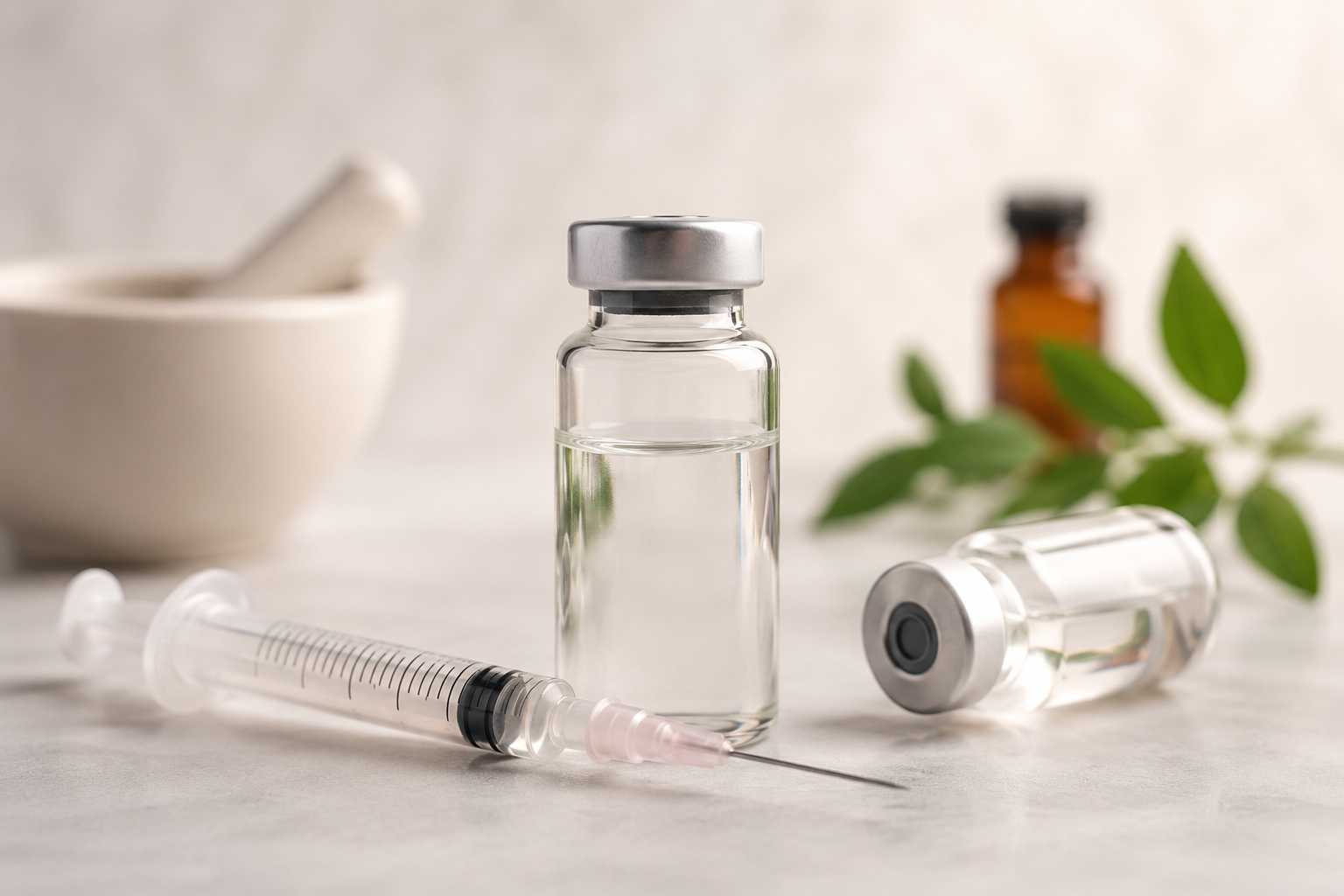
The GLP-1 wave changed weight loss in America. And somewhere in the middle of that wave, compounded semaglutide became the workaround millions of people turned to when Ozempic and Wegovy were out of stock, out of budget, or both. What started as a legal shortcut during a shortage has turned into one of the most confusing corners of the weight loss market, especially with the FDA changing the rules and telehealth companies scrambling to adjust. At BodEvolve, patients ask us about this weekly. This guide is our straight answer.
What Is Compounded Semaglutide? A Straight Answer From a Bariatric Surgeon
Compounded semaglutide is a version of the drug made by a licensed compounding pharmacy rather than by Novo Nordisk, the manufacturer of the brand-name versions. During the FDA’s official shortage declaration for Ozempic and Wegovy (which ran from 2022 into 2025), compounding pharmacies were legally permitted to make semaglutide to fill the supply gap. That is where nearly every telehealth GLP-1 program (Hers, Hims, Ro, Noom, Weight Watchers) sourced its supply. A telehealth platform on the front end, a compounding pharmacy on the back end, and a shipped vial at your door.
Many formulations mix semaglutide with additional compounds, most commonly vitamin B12 or glycine. Compounded semaglutide with B12 is popular because B12 may help offset some fatigue-related side effects. Compounded semaglutide with glycine has been used because glycine can improve stability of the injectable solution. Compounded oral semaglutide (troches and sublingual tablets) also exists, though injectable remains the most common form.
The active molecule is the same. The delivery, dosing accuracy, and quality control depend entirely on the specific pharmacy filling it.
Is Compounded Semaglutide Safe in 2026?
This is the real question, and the honest answer has two parts.
If it comes from a reputable 503B outsourcing facility or a well-regulated 503A pharmacy that sources API from an FDA-registered supplier, it can be reasonably safe, though not identical to the brand product. If it comes from an unregulated source that imports powder from overseas, mixes it in a facility without proper sterility controls, and ships it without cold-chain handling, it is not safe. The FDA has issued repeated warnings about salt forms of semaglutide (sodium and acetate versions) that are not the same as the base semaglutide used in Ozempic and Wegovy. There have been reports of dosing errors, contamination, and adverse events tied specifically to compounded versions.
The gray area is this. Most patients have no easy way to tell which category their pharmacy falls into. A slick website and a doctor’s signature do not equal quality control. If you cannot get a straight answer about where the API is sourced, what the sterility testing looks like, and whether the pharmacy is state-board accredited, that silence is your answer.
Does Compounded Semaglutide Work?
Yes, if the dose is accurate and the formulation is legitimate. Compounded semaglutide works because the active ingredient is the same as Ozempic and Wegovy. Patients on properly dosed compounded semaglutide typically see appetite suppression within the first two weeks and meaningful weight loss over three to six months, in the same 10 to 15 percent body weight range that clinical trials show for brand semaglutide.
Compounded semaglutide reviews on Reddit and elsewhere skew positive when patients are on the correct dose from a reputable source. They skew negative when patients report no appetite change (usually a dosing or potency issue) or severe side effects (usually a formulation or purity issue). Scroll r/compoundedsemaglutide long enough and the pattern is consistent: source and dose are everything.
That said, “does compounded semaglutide work” is a different question from “does compounded semaglutide work long term.” Most people who stop the medication regain 60 to 70 percent of lost weight within a year. That is not a compounded semaglutide problem. It is a GLP-1 problem across the board. The scale rebounds because the underlying appetite regulation returns to baseline the moment the drug leaves the system.
Compounded Semaglutide vs Ozempic
The active molecule is the same. What differs is everything around it.
Brand Ozempic is manufactured under FDA-mandated Good Manufacturing Practices, tested batch by batch, and shipped in a temperature-controlled prefilled pen with a precise dose delivery mechanism. You know exactly how much semaglutide you are injecting because Novo Nordisk built the pen to deliver it.
Compounded semaglutide is typically shipped in a multi-dose vial with syringes. You draw your own dose. That introduces a real-world variable: patients who misread markings on an insulin syringe can under-dose or over-dose without realizing it. The difference between compounded semaglutide and Ozempic on a chemistry level is small. The difference in delivery reliability is not.
For patients asking whether compounded semaglutide is the same as Ozempic, the fairest answer is this. The medicine is the same, the packaging and quality control are not. Our Ozempic vs Wegovy comparison breaks down the brand-side differences in more detail.
Compounded Semaglutide vs Wegovy
Wegovy is FDA-approved specifically for weight loss at doses up to 2.4 mg per week. Ozempic caps at 2 mg. Compounded semaglutide can be titrated to whatever a prescriber authorizes, which in practice often lands in the 0.25 to 2.4 mg range. So compared to Wegovy, compounded semaglutide can theoretically match the higher weight-loss dose without the insurance obstacle course.
The catch: Wegovy has 68 weeks of published Phase 3 data behind it. Compounded semaglutide has no such trial. If it works, it works for the same biological reason. But you are also outside the clinical evidence base, which matters when things go sideways.
Compounded Semaglutide vs Tirzepatide
Tirzepatide (brand names Mounjaro and Zepbound) works on two receptors, GLP-1 and GIP. Semaglutide only works on GLP-1. In head-to-head clinical trials, tirzepatide produced greater average weight loss, roughly 20 to 22 percent of body weight versus 15 to 17 percent for semaglutide. Compounded tirzepatide has faced the same shortage-and-ban cycle as compounded semaglutide. For patients who did not respond well to semaglutide, tirzepatide is often the next conversation. We covered the full landscape of semaglutide alternatives in a separate guide.
Compounded Semaglutide Side Effects
Side effects of compounded semaglutide overlap almost entirely with brand semaglutide. The most common:
- Nausea, especially in the first few weeks and after dose increases. This is the top reason patients stop.
- Constipation or diarrhea, often alternating. Fiber and hydration help, but not always.
- Fatigue, particularly at higher doses. Some formulations include B12 specifically to counter this.
- Reflux and burping. Not dangerous, but socially awkward.
- Injection site reactions. Small red bumps that resolve in a day or two.
The rarer but more serious risks include pancreatitis, gallbladder problems (especially in patients losing weight quickly), thyroid tumor concerns based on rodent studies, and vision changes tied to worsening diabetic retinopathy. Compounded formulations can carry an added risk of injection site infection if sterility was compromised in production. If you develop severe stomach pain that radiates to the back, that is a pancreatitis warning sign and needs an ER visit, not a wait-and-see.
Compounded Semaglutide Cost: What You Actually Pay
Compounded semaglutide cost varies more than almost any medication on the market. Typical 2026 pricing:
- Ro compounded semaglutide: roughly $145 to $299 per month depending on dose and package.
- Hims compounded semaglutide: around $199 per month starting price.
- Hers compounded semaglutide: around $199 per month starting price.
- Noom compounded semaglutide: around $149 per month intro pricing.
- Weight Watchers compounded semaglutide: around $199 per month baseline.
- 3 month supply compounded semaglutide weight loss medication packages: $600 to $900 total.
- 6 month supply compounded semaglutide weight loss medication: $1,200 to $1,800.
- 12 month supply compounded semaglutide weight loss medication: $1,800 to $3,000.
Cheapest compounded semaglutide online is generally found through smaller direct-to-consumer pharmacies, but cheapest and safest are almost never the same vendor. If a monthly price seems too low to be real, the sourcing question becomes even more important. Brand Ozempic without insurance runs around $1,000 per month at retail. That gap is why compounded semaglutide exploded in the first place.
FDA Approved Compounded GLP 1: What the Rules Really Say
Here is a common misconception worth cleaning up. There is no such thing as an “FDA approved compounded GLP 1.” The FDA approves finished drug products, and every FDA approved GLP 1 medication on the market today (Ozempic, Wegovy, Rybelsus, Mounjaro, Zepbound) is manufactured by its brand-name maker, not compounded.
What the FDA does regulate on the compounding side are the pharmacies themselves. A 503B outsourcing facility must register with the FDA, follow current Good Manufacturing Practices, and undergo FDA inspection. A 503A pharmacy is licensed at the state board level and does not carry the same federal oversight. Both can legally compound semaglutide under narrow circumstances, but neither produces an “FDA approved” version of the drug.
If a website is marketing “FDA approved compounded semaglutide” or “FDA approved compounded GLP 1,” that phrasing is a marketing red flag. The pharmacy might be legitimate, but the language is not accurate. Ask what facility type they are (503A or 503B), where they source the active pharmaceutical ingredient, and whether they publish batch testing results.
The Compounded Semaglutide Ban: What Is Happening in 2026
Here is the short version. The FDA officially resolved the semaglutide shortage in early 2025. Once a shortage is resolved, the legal window for 503A compounding pharmacies to produce that drug closes. The FDA gave pharmacies a wind-down period, and the FDA compounding semaglutide enforcement November 2025 timeline hit small compounding pharmacies first, then broader ones.
Larger 503B outsourcing facilities have more room to continue producing compounded semaglutide under specific medical necessity exceptions, for example when a patient cannot use the commercial product due to an allergy, a dosage need the commercial pen cannot deliver, or another documented clinical reason. That exception is narrow. It is not a workaround for everyone who wants the drug cheaper.
Is compounded semaglutide going away? For the general public buying it through telehealth for weight loss, largely yes. The mass-market compounded semaglutide era is closing. Will compounded semaglutide be banned entirely? Not entirely, because the medical necessity carve-out remains. But the days of $150-a-month vials from any telehealth platform are ending. Can you still get compounded semaglutide? In some cases through 503B facilities and specific clinical exceptions, yes. Broadly and easily, no.
Can I Still Get Compounded Semaglutide? Your Legal Options in Texas
Can I still get compounded semaglutide in 2026? Yes, but only in limited cases. Patients with a documented medical necessity (verified allergy, dose requirement, or other clinical exception) can access it through a 503B outsourcing facility. General telehealth access for weight loss is largely closed.
Here is where things stand for Texas patients specifically:
Through a 503B outsourcing facility with a documented medical necessity. If a Texas-licensed physician documents a clinical reason you cannot use commercial Ozempic or Wegovy (a verified allergy to an inactive ingredient, a dose the branded pen cannot deliver, or another qualifying circumstance), a 503B facility can still legally fill it. This is the narrow, legitimate lane.
Through your existing prescription if one is already active. Some Texas patients with active prescriptions are still receiving shipments while pharmacies work through wind-down inventory. New prescriptions for general weight loss are much harder to obtain.
Not through “research peptide” sites. Anything sold as “not for human use,” “research grade,” or shipped without a prescription is outside legal and medical bounds regardless of what the marketing says.
If you are in Arlington, Richardson, Dallas, or Texarkana and you want to know whether you personally qualify for the medical necessity carve-out, that conversation is best had with a physician who understands both the medication and the surgical alternatives. Not every patient qualifies. Not every patient should.
Storage, Refrigeration, and Shelf Life
Does compounded semaglutide need to be refrigerated? Yes. Store it between 36 and 46 degrees Fahrenheit until you start the vial. Once opened, some formulations allow room temperature storage for up to 28 days, but many require continued refrigeration. Check the pharmacy’s specific label.
How long does compounded semaglutide last in the fridge? Unopened vials typically remain stable through the beyond-use date on the label, usually 28 to 90 days from compounding. After opening, most vials should be used within 28 to 56 days depending on the formulation.
Compounded semaglutide left out of fridge for a few hours (under about 8 hours) is usually still viable if the formulation permits limited excursion. Extended time above 46 degrees, or exposure to freezing, degrades the peptide. Does compounded semaglutide expire? Yes, both the vial expiration date and the beyond-use date apply. Does compounded semaglutide expire after 28 days once opened? Often yes, depending on your specific pharmacy’s protocol.
When Compounded Semaglutide Is Not Enough: The Bariatric Surgery Conversation
Here is what a lot of guides will not tell you directly. Compounded semaglutide is a tool. It is not a cure. And it is a tool that is now becoming much harder to access.
For patients with a BMI over 35, or over 30 with related conditions like type 2 diabetes, sleep apnea, or high blood pressure, medication alone rarely produces the long-term result they are hoping for. Studies consistently show significant weight regain when GLP-1 medications are stopped, and staying on them indefinitely (which was already expensive) is now a legal question, not just a financial one.
Gastric bypass and gastric sleeve produce durable weight loss in the 25 to 35 percent range at five and ten years out, without requiring a weekly injection for the rest of your life. Our lead surgeon, Dr Frenzel, is the only triple-board-certified bariatric surgeon and dual fellowship-trained physician in DFW, and he and Dr. Brian Holt evaluate every patient across the full range of options: medical management, GLP-1 therapy, and surgery, based on what actually fits the patient in front of them.
For patients worried about affordability, our guide on how to get insurance to cover revision bariatric surgery walks through the exact documentation most commercial and Medicare plans require. Coverage for primary bariatric surgery follows a similar path.
Talk to a Bariatric Team That Sees the Full Picture
Compounded semaglutide made sense as a bridge during the shortage. In 2026, it is a shrinking option, and it was never a long-term answer for severe obesity. If you are in DFW or East Texas and you want an honest evaluation of what actually fits your body, your budget, and your future, our team sees patients at Arlington, Richardson, Dallas, and Texarkana. Book a consultation and let a triple-board-certified surgeon lay out every path, medical, medication, and surgical, before you commit to one.
