
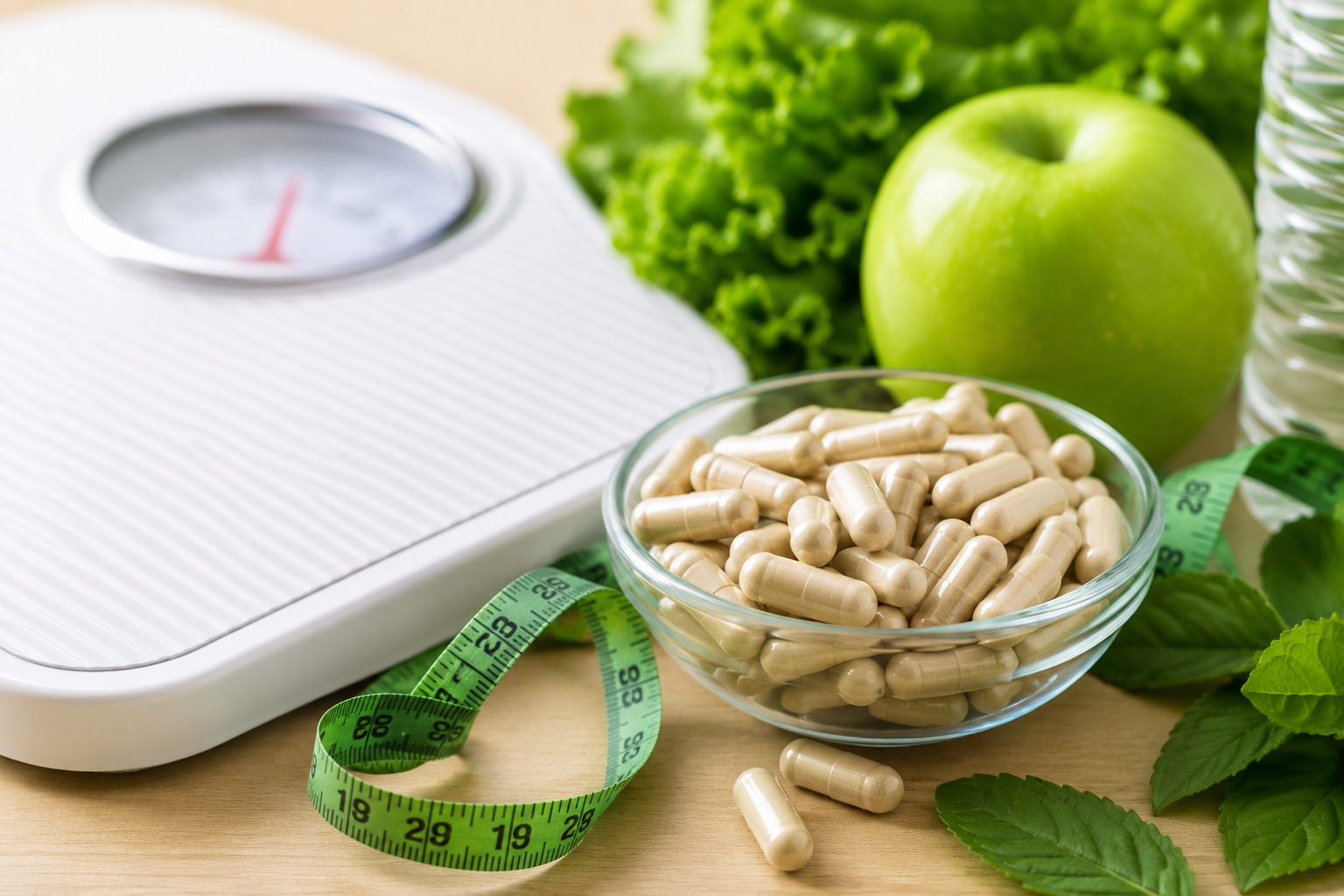
The best OTC weight loss pills with FDA drug approval is Alli (orlistat 60mg), which blocks roughly 25% of dietary fat absorption and produces 5 to 10 pounds of additional weight loss over six months. Plenity, an FDA-cleared hydrogel device, is a second option. All other OTC weight loss pills are dietary supplements and are not required to prove they work.being sold.
The best OTC weight loss pills reviewed by bariatric surgeons in 2026:
1. Alli (Orlistat 60mg) — Only FDA-approved OTC weight loss drug
2. Plenity — FDA-cleared oral hydrogel capsule
3. Green Tea Extract — Minor supplement effect
4. Glucomannan — Fiber-based appetite support
5. Berberine — Blood sugar support marketed as “GLP-1 booster”
What Are the Best OTC Weight Loss Pills? Quick Answer
Here’s the honest, slightly disappointing answer. There is really only one over the counter weight loss pill with real FDA approval behind it, and that’s orlistat, sold under the brand name Alli. It works by blocking about a quarter of the fat you eat from being absorbed. In clinical studies, people combining it with a reduced calorie diet lost roughly 5 to 10 pounds more over six months than diet alone. That’s meaningful, but it’s not dramatic, and it comes with a real tradeoff. Orlistat can cause loose stools, oily spotting, and urgent bathroom trips if you eat more fat than your body can process on the medication.
Everything else marketed as an OTC weight loss pill, fat burners, appetite suppressant blends, “natural GLP-1 boosters,” is a dietary supplement. Supplements are not required to prove they work before they hit the shelf, and the FDA has spent years flagging weight loss supplements that were secretly spiked with banned prescription drugs. So when someone asks what the best OTC weight loss pill is, the real answer is that the category is smaller and less exciting than the marketing suggests.
What Is the Best Diet Pill You Can Buy Over the Counter Today?
Here’s the honest, slightly disappointing answer. There is really only one over-the-counter weight loss pill with real FDA approval behind it, and that’s orlistat, sold under the brand name Alli. It works by blocking about a quarter of the fat you eat from being absorbed. In clinical studies, people combining it with a reduced-calorie diet lost roughly 5 to 10 pounds more over six months than diet alone. That’s meaningful, but it’s not dramatic, and it comes with a real tradeoff. Orlistat can cause loose stools, oily spotting, and urgent bathroom trips if you eat more fat than your body can process on the medication.
Everything else marketed as an OTC drug for weight loss, fat burners, appetite suppressant blends, or “natural GLP-1 boosters,” is technically a dietary supplement. Supplements are not required to prove they work before hitting the shelf, and the FDA has spent years flagging weight loss supplements that were secretly spiked with banned prescription drugs. So when someone asks what is the best diet pill you can grab without a prescription, the honest answer is that the category is smaller and less exciting than the marketing suggests.
Best FDA Approved OTC Weight Loss Pills in 2026
When people search for the best OTC diet pills for weight loss, they’re usually picturing a menu of solid choices to compare. In reality, the comparison is short. Alli (orlistat 60mg) stands alone as the FDA-cleared option. There’s also Plenity, which isn’t technically a drug, it’s an FDA-cleared hydrogel capsule that expands in your stomach to help you feel full sooner, available through a doctor’s order but taken like a pill.
Beyond those two, you’re in supplement territory: green tea extract, glucomannan, garcinia cambogia, caffeine-based thermogenics. Some of these ingredients have modest research behind them individually. Almost none of the branded combination products selling them have been tested as a finished product the way a drug would be. That distinction matters more than the label design does.
Best OTC Weight Loss Meds for Women Over 40
A lot of the searches we see for best OTC weight loss pills for women are really about something more specific: perimenopause weight gain, slower metabolism after 40, or stubborn weight that didn’t respond the way it used to. No OTC pill, orlistat included, is formulated differently for women’s hormonal shifts, and no supplement on the market has solid evidence of working better for female biology specifically.
What actually helps in that situation is addressing the hormonal piece directly, often through a physician who can evaluate thyroid function, insulin resistance, and menopause status rather than guessing from a supplement label. If you’re in your 40s or 50s and OTC options haven’t moved the needle, that’s usually a sign the underlying driver isn’t something a pill from the drugstore was ever going to fix.
Top Rated Weight Loss Pills: Full OTC Comparison Table
| Product | FDA Status | Avg. Weight Loss | Prescription Needed | Common Side Effects |
|---|---|---|---|---|
| Alli (Orlistat 60 mg) | FDA-Approved Drug | 5–10 lbs over 6 months | No | Oily stools, urgency |
| Plenity | FDA-Cleared Device | 3–6% body weight | Yes (order only) | Bloating, fullness |
| Green Tea Extract | Dietary Supplement | Minimal in trials | No | Liver stress at high doses |
| Garcinia Cambogia | Dietary Supplement | No consistent effect | No | Headache, digestive upset |
| Berberine “GLP-1” Blends | Dietary Supplement | Small blood sugar effect | No | Digestive upset |
| Oral Semaglutide (Rx) | FDA-Approved Drug | 12–15% body weight | Yes | Nausea, appetite loss |
Best OTC Diet Pill for Weight Loss vs Prescription GLP-1 Pills
This is where the conversation has shifted the most in the last two years. New oral prescription options, including the Wegovy pill and Foundayo, now exist in a pill format, and they work through a completely different mechanism than anything OTC. Instead of blocking fat absorption or adding caffeine, they mimic gut hormones that control appetite and fullness at the brain level. Clinical trials show weight loss in the range of 12 to 14 percent of body weight, a different category entirely from the 3 to 5 pounds typical of OTC options.
The best OTC diet pill for weight loss will always be limited by what’s legally allowed in an unsupervised product. Prescription oral GLP-1 medications require bloodwork, monitoring, and a doctor’s involvement, which is exactly why they can do more. If cost or needle-phobia was the only thing keeping you in the OTC aisle, it’s worth knowing that pill-form prescription options now exist too.
Best OTC GLP-1 Pills for Weight Loss: Do They Work?
We get this question constantly right now, so let’s be direct about it. If a product on Amazon or in a supplement store calls itself a “GLP-1 support” or “natural GLP-1 booster,” it is not the same as GLP-1 medication, and it does not work through the same pathway. Real GLP-1 medications are peptide drugs that require a prescription and a manufacturing process no supplement company has legal access to.
What these OTC “GLP-1” products actually contain is usually a mix of berberine, fiber, probiotics, or plant extracts that may support digestion or blood sugar in small ways, but nothing close to the appetite and weight effects of actual GLP-1 drugs. If a supplement label uses the phrase GLP-1 without a prescription requirement attached, treat that as a marketing choice, not a clinical claim.
Best OTC Weight Loss Pills Reddit Users Recommend (And What Those Threads Miss)
Search “best OTC weight loss pills Reddit” and you’ll see the same names cycling through r/loseit and r/PetiteFitness: Alli, Hydroxycut, Leanbean, PhenQ, and berberine stacks. What most of those threads leave out is that only Alli has actual FDA drug approval. The rest are supplements marketed with clinical-sounding language.
The other pattern in Reddit threads is honest and worth respecting: users who lost meaningful weight on OTC pills almost always credit the calorie deficit they were already running, not the pill itself. That’s clinically consistent. Orlistat produces 5 to 10 extra pounds over six months only when paired with a reduced-calorie diet. On its own, it does very little.
If you’re evaluating OTC pills based on Reddit reviews, cross-check every supplement against the FDA’s tainted weight loss products database before you buy. It’s updated regularly and lists over 1,000 supplements pulled for containing hidden prescription drugs.
Best OTC Weight Loss Pills: 2023 vs 2026 Landscape
If you searched for the best OTC weight loss pills 2023, the top results were dominated by Alli, PhenQ, Hydroxycut, Leanbean, and a handful of caffeine-based fat burners. The 2026 shortlist looks almost identical, and that’s the story worth telling.
What changed isn’t the OTC aisle. It’s what sits next to it. Prescription oral GLP-1 medications, including new pill-form semaglutide options, launched between 2023 and 2026 and shifted the entire weight loss category. OTC pills didn’t get stronger. Prescription options got easier to access. If you last researched OTC pills a couple of years ago and found them underwhelming, the OTC options themselves haven’t improved, but your prescription alternatives have expanded significantly.
What Is the Strongest Weight Loss Pill Over the Counter?
The strongest OTC weight loss pill available in the U.S. today is Alli (orlistat 60mg). That’s not a marketing claim, it’s a legal one. Alli is the only OTC weight loss product classified by the FDA as an approved drug rather than a dietary supplement. Its prescription version, Xenical (orlistat 120mg), is twice as strong but requires a doctor.
“Strongest” is a slightly misleading question, though. In clinical trials, Alli produces roughly 5 to 10 pounds more weight loss over six months compared to diet alone. Prescription GLP-1 medications, taken as a pill or injection, produce 12 to 22 percent of body weight loss over the same period. So the strongest thing you can legally buy without a prescription is meaningfully weaker than what a doctor can prescribe. That gap is the reason most patients who start with OTC pills eventually ask about medical or surgical options.
Where the Best OTC Weight Loss Pills Fall Short
Even the legitimate option, orlistat, was never designed to produce major weight loss on its own. It’s built to modestly support a calorie-controlled diet, not replace medical treatment for obesity. For someone with 10 or 15 pounds to lose, that might be enough of a nudge. For someone carrying 40, 60, or 100+ extra pounds, or dealing with a weight-related health condition like sleep apnea, high blood pressure, or prediabetes, an OTC pill is not going to close that gap, no matter how consistently it’s taken.
This is the part most articles selling you a product won’t say out loud. If you’ve tried OTC options and the number on the scale hasn’t moved in a way that matters for your health, that’s not a failure on your part. It usually means the tool doesn’t match the size of the problem.
When to Move Beyond OTC Pills: Medical and Surgical Options
If you’ve read this far because OTC pills haven’t worked, here’s what we’d actually walk you through in a consultation. Prescription medications, including semaglutide, tirzepatide, and oral GLP-1 pills, produce results in a completely different range, often 12 to 22 percent of body weight, with medical supervision built in. For patients with more significant weight to lose, or who have already tried medication without lasting results, surgical options like gastric sleeve and gastric bypass deliver outcomes no pill, OTC or prescription, can match, typically 60 to 80 percent excess weight loss along with real improvement in conditions like type 2 diabetes and hypertension.
Our surgical team is led by dr Frenzel, a triple board-certified, dual fellowship-trained bariatric surgeon, alongside our medical weight management program for patients who aren’t ready for surgery but need more than a supplement aisle can offer. We see patients across Texas at our clinics in Arlington, Richardson, Dallas, and Texarkana,and every plan starts with an honest look at what will actually work for your situation, not what’s easiest to sell.
If cost is the thing holding you back from exploring medical or surgical options, it’s worth knowing insurance covers more than most people assume. Our guide on how to get insurance to cover revision bariatric surgery walks through exactly how to build that case with your provider. And if you’re weighing medication first, our breakdown of alternatives to semaglutide or our guide to the best injection for weight loss at home are good next reads.
