
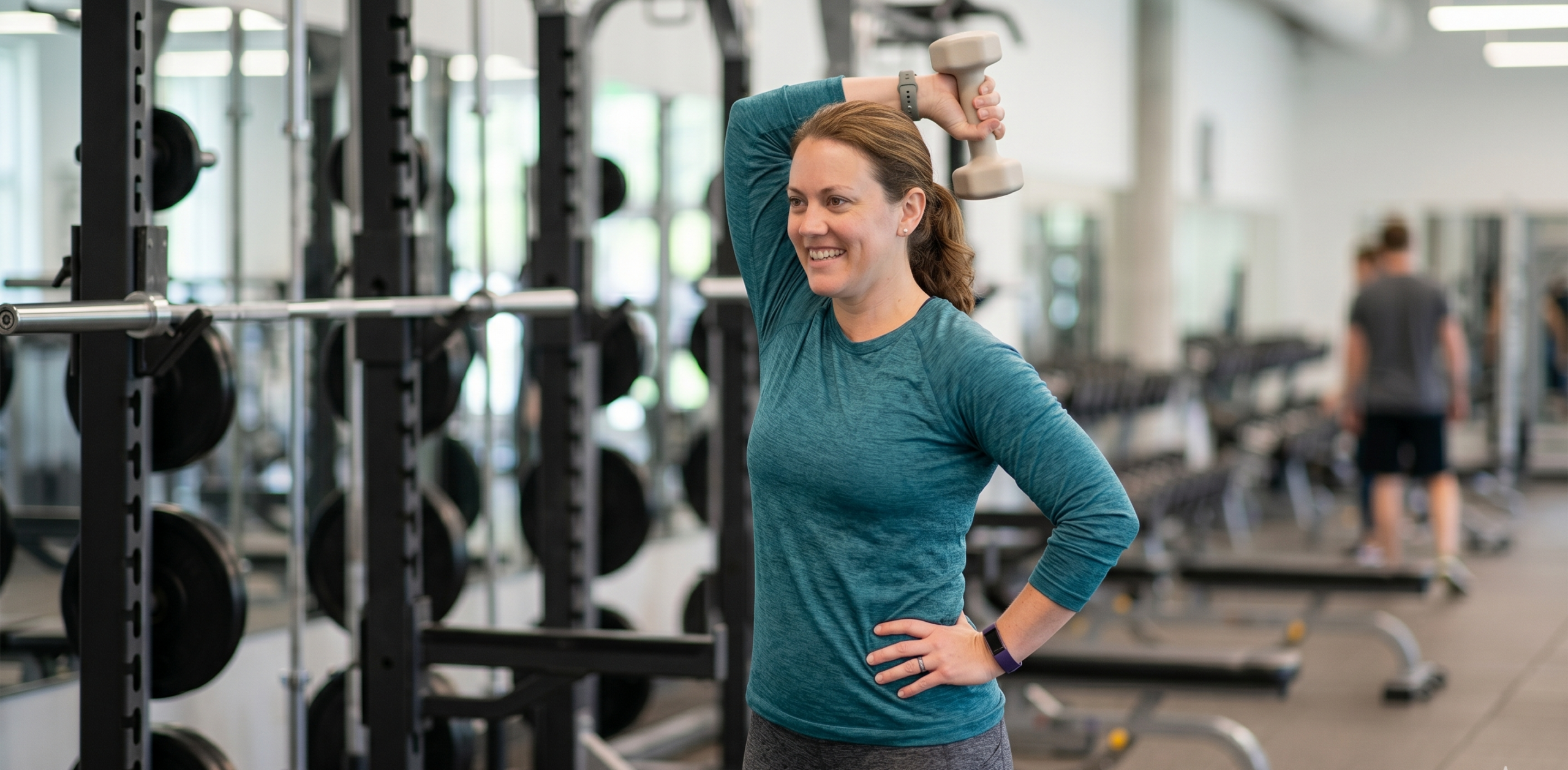
Exercise after bariatric surgery starts the same day, with short walks in your hospital room. Longer walks begin week 2, low-impact cardio at week 5 to 6, and strength training at week 8 with surgical clearance. Full higher-intensity workouts are typically cleared at 12 weeks post-op.
Exercise after bariatric surgery typically begins on the same day as the procedure with short walks around the hospital ward. Here’s the general progression:
- Day of surgery: Short walks around the hospital room, several times a day
- Week 1–2: Gentle 5–10 minute walks, 2–3 times daily
- Week 3–4: Build to 15–20 minute continuous walks
- Week 5–6: Add low-impact cardio (stationary cycling, water walking)
- Week 8+: Begin light resistance training with surgical clearance
- Month 3–6: Progress to yoga, Pilates, and structured fitness classes
Always confirm each phase transition with your bariatric surgeon timelines shift based on your specific procedure and healing pace.
Best Exercise for Bariatric Patients: Safe Workouts Phase by Phase
Here’s the truth most people don’t expect: you start moving the same day as your surgery.
That doesn’t mean hitting the gym. It means getting up from bed, walking a few steps down the hospital corridor, and doing it again a few hours later. Those early steps aren’t optional they’re medically important. Movement prevents blood clots, reduces gas pain, and kick-starts your circulation during healing.
The general timeline for exercise after bariatric surgery looks like this:
Week 1-2: Gentle Walking Only Short, slow walks around the house or neighborhood – 5 to 10 minutes at a time, two to three times per day. No incline. No rushing. Just steady, consistent movement. Your incisions are fresh and your body is redirecting all its energy toward healing.
Week 3-4: Build Your Walking Base Increase to 15–20 minute walks daily. You’ll start to feel more like yourself – more energy, less soreness. This is still walking territory. Resist the urge to do more.
Week 5-6: Light Activity Expands Low-impact cardio like stationary cycling or water walking can be introduced if your surgeon has cleared you. Yoga and gentle stretching routines work well here too.
Week 6-8 and Beyond: Progressive Fitness Begins With surgical clearance, you can begin structured fitness – light resistance training, longer cardio sessions, low-impact group classes. This is where the real body transformation starts picking up speed.
Always confirm each phase transition with your surgical team. What applies to one patient may not apply to another depending on the procedure, your starting health, and how healing progresses. Curious what that transformation actually looks like? Explore real weight loss surgery before and after stories from patients who committed to both.

Best Exercises After Bariatric Surgery, Phase by Phase
Here’s where it gets practical. These are the best exercises after bariatric surgery that are not just safe they’re effective. Each one is chosen for a reason: joint protection, muscle preservation, calorie burn, or all three at once.
Phase 1 (Weeks 1-4): Walking Is Your Superpower
You’ll hear this from every bariatric surgeon and it might sound boring but walking genuinely is the single best exercise for bariatric patients in the early weeks. Here’s why it’s so powerful:
- It’s low-impact, meaning no stress on your healing abdomen
- It burns calories without triggering excessive hunger
- It improves insulin sensitivity, which matters enormously post-surgery
- It builds the habit of daily movement, which is what long-term success runs on
Target: Work toward 30 continuous minutes by the end of week 4. Don’t time yourself by speed just by duration.
Phase 2 (Weeks 4-8): Water-Based Exercise
Swimming and aqua aerobics are among the best exercises after bariatric surgery for patients dealing with joint discomfort or significant starting weight. The buoyancy of water takes 60–90% of your body weight off your joints, letting you move freely, get your heart rate up, and build early endurance all without pain.
Bonus: Water exercise is particularly useful for patients who had a gastric bypass and may be navigating dumping syndrome triggered by high-intensity land exercise.
Phase 2-3 (Weeks 6-12): Stationary Cycling
The stationary bike is a quiet hero of bariatric fitness. It’s low-impact, easily adjustable, and you can do it while watching TV. Start with 10–15 minutes at a comfortable resistance, and slowly work up to 30-45 minutes as your stamina builds. Your heart rate should feel elevated but conversational if you can’t speak a sentence, ease back.
Phase 3 (Week 8+): Light Resistance Training
This is the one people skip and later regret. Exercise after bariatric surgery that includes resistance training is critical for one specific reason: muscle preservation.
When you lose weight rapidly as bariatric patients do your body doesn’t automatically know to keep the muscle. Without resistance work, you lose both fat and muscle, which slows your metabolism over time and affects your long-term maintenance. Light resistance training tells your body to hold onto lean tissue while the fat comes off.
Start with bodyweight movements: wall push-ups, seated leg presses, glute bridges, resistance band pulls. Progress to light dumbbells after 10-12 weeks with clearance.
Phase 3+ (Months 3-6): Yoga, Pilates, and Core Work
Many best exercise for bariatric patients lists skip yoga, but they shouldn’t. Post-bariatric bodies often carry years of compensatory movement patterns slouching, favoring one side, limited hip mobility. Yoga and Pilates address all of this while building core strength, improving posture, and reducing the stress response that can sabotage weight loss.
The core work also matters for a practical reason: stronger abdominal muscles protect your surgical site long-term and reduce the risk of hernias as you move into more demanding exercise.
3 Best Exercises to Lose Belly Fat After 60 (Post-Bariatric)
Patients over 60 lose belly fat more slowly after bariatric surgery, but three specific exercises consistently move the needle without stressing joints or the surgical site:
1. Incline treadmill walking at 3 to 4 mph, 25 to 30 minutes, 4 to 5 times a week. The incline forces the deep core to stabilize and burns visceral fat without knee load.
2. Seated cable rows or resistance-band rows, 3 sets of 12, twice a week. Rows engage the entire posterior chain and preserve the muscle mass that keeps resting metabolism high.
3. Wall sits, 3 sets of 30 to 45 seconds, twice a week. Isometric holds build lower-body strength and are safe for patients with knee osteoarthritis, which is common in the post-bariatric 60-plus group.
None of these replace nutrition work, but combined with 80 to 100 grams of protein a day, they consistently outperform pure cardio for belly fat loss in patients over 60.
Does Exercise Help With Loose Skin After Bariatric Surgery?
Exercise can’t eliminate loose skin entirely that’s a job for skin elasticity, age, and sometimes body contouring surgery. But resistance training makes a real difference in how loose skin looks and feels. Building muscle underneath loose skin fills out the area, which is why patients who add strength training after bariatric surgery consistently report tighter-looking arms, thighs, and abdomens compared to patients who only did cardio.
Strength Training After Bariatric Surgery: When and How to Start
Most patients focus so hard on cardio that strength training after bariatric surgery gets pushed to “later.” Later usually turns into never. That’s a mistake, because rapid weight loss burns through muscle right along with fat, and the muscle you lose is exactly what keeps your metabolism running long after the scale settles.
Around week 8 to 10, with your surgeon’s clearance, start with bodyweight and resistance band work: wall push-ups, glute bridges, seated rows with a band, and sit-to-stand from a chair. Two sessions a week is enough at first. By month 3, most patients can safely add light dumbbells, typically 3 to 8 pounds, working the major muscle groups twice weekly.
The payoff shows up months later. Patients who included strength training after bariatric surgery consistently keep more lean mass, sit at a higher resting metabolic rate, and rebound from plateaus faster than patients who only walked.
Bariatric Fitness Training: Building a Long-Term Routine in Texas
Six months in, most patients hit the same fork in the road. The initial weight comes off fast, and the workouts that got you here start to feel too easy. This is where long-term bariatric fitness planning becomes the difference between patients who keep the weight off and those who slowly regain.
A sustainable routine for Texas bariatric patients usually looks like this:
- 3 days a week of strength training after bariatric surgery — full-body sessions, 30 to 45 minutes, focused on compound movements like squats, rows, and presses using dumbbells or resistance bands.
- 2 to 3 days a week of moderate cardio — walking, cycling, swimming, or hiking one of the many state parks across Texas like Cedar Hill or Lake Mineral Wells.
- 1 to 2 mobility sessions — yoga, Pilates, or stretching to protect joints and posture as your body composition shifts.
- Daily movement outside of workouts — aim for 7,000 to 10,000 steps a day. Hot Texas summers make early morning or evening walks the smart move.
The patients who succeed are not the ones training the hardest. They are the ones who stayed consistent for years, adjusted their plan when life shifted, and treated fitness like part of their identity, not a phase.
What to Eat Around Your Workouts After Bariatric Surgery
Nutrition and exercise after bariatric surgery aren’t separate conversations they’re the same one. As your workouts increase in intensity, your body’s demand for protein rises with it.
General guidelines for bariatric patients exercising regularly:
- Eat a protein-rich snack (Greek yogurt, cottage cheese, a protein shake) 30–60 minutes before moderate exercise
- Avoid exercising within 90 minutes of a full meal to reduce dumping syndrome risk
- After a workout, prioritize protein within 30–45 minutes this is your muscle-repair window
- Hydrate consistently throughout the day; aim for at least 48–64 oz of water daily, more on workout days
Ask your BodEvolve team for a nutrition plan that’s coordinated with your exercise phase the two work together.
How Long After Gastric Bypass Can I Exercise?
light walking begins the same day as your gastric bypass, but structured workouts follow a stricter timeline than a gastric sleeve because the rerouted anatomy needs longer to heal.
Here is what most BodEvolve gastric bypass patients follow:
- Day of surgery to week 2: Slow walking only, 5 to 10 minutes at a time, several times a day.
- Week 3 to 4: Longer walks of 20 to 30 minutes, still no incline, no lifting over 10 pounds.
- Week 5 to 6: Low-impact cardio like stationary cycling or water walking, with your surgeon’s clearance.
- Week 8 to 10: Light resistance bands and bodyweight movements, once cleared by Dr. Frenzel or Dr. Holt.
- Week 12 and beyond: Full return to gym-style workouts, including moderate weight training and higher-intensity cardio.
Gastric bypass patients also need to be more cautious about exercising too close to a meal, since dumping syndrome can be triggered by movement on a full stomach. Wait at least 60 to 90 minutes after eating before any moderate activity.
Workout After Gastric Sleeve vs. Gastric Bypass: What’s Different
A workout after gastric sleeve tends to progress a little faster than a gastric bypass workout because there is no intestinal rerouting to heal around. Most sleeve patients tolerate 20-minute walks by week 2 and low-impact cardio by week 4, with resistance training starting around week 6 to 8.
The two things that stay the same across both procedures: no heavy lifting for 12 weeks, and no high-impact activity like running or jumping until your surgical team clears you. What changes is pace, not principle. Gastric sleeve patients often report feeling ready for more sooner, but the muscle preservation window and hernia risk window are identical.
If you had a sleeve and feel ready to push earlier, still confirm it with your surgeon before adding intensity.
Exercise After Bariatric Surgery Weight Loss: Breaking Through Plateaus
Surgery changes your relationship with food. Exercise changes your relationship with your body.
Exercise after bariatric surgery weight loss works through multiple pathways and understanding them helps you stay motivated when the scale slows down.
- It offsets metabolic adaptation. As you lose weight, your resting metabolic rate drops your body adjusts to operating on less. This is the biological root of the dreaded plateau. Exercise, particularly resistance training, counteracts this adaptation by preserving and building muscle mass, which is metabolically expensive (in a good way).
- It improves satiety hormones. Regular movement positively influences ghrelin (the hunger hormone) and leptin (the fullness signal). Bariatric surgery already helps regulate these, but exercise amplifies the effect meaning you feel full sooner, crave junk food less, and feel more energized overall.
- It protects bone density. Rapid weight loss can reduce bone mineral density, especially in the first year. Weight-bearing exercise walking, light strength training counteracts this by stressing the bone in healthy ways that stimulate density. This is one reason exercise after bariatric surgery weight loss programs must include more than just cardio.
- It builds your mental resilience. The physical transformation is visible. But the psychological work runs just as deep. Regular exercise elevates mood, reduces anxiety, and builds a sense of agency over your body that many bariatric patients haven’t felt in years.
Toning Exercises After Bariatric Surgery for Breaking Plateaus
Six months post-surgery and the scale hasn’t budged in three weeks. Sound familiar?
Plateaus are normal and they’re not a sign of failure. But best exercise for bariatric patients coming off a plateau looks slightly different from early-stage recovery work.
Try these plateau-busting moves:
- Interval walking: Alternate 2 minutes of brisk walking with 1 minute of slower recovery pace. Repeat 6–8 times. This simple change spikes your calorie burn and challenges your cardiovascular system in a new way.
- Add a third weekly strength session: If you’re doing two days of resistance training, add a third. Muscle is metabolically active more of it means a higher resting calorie burn.
- Change your cardio modality: If you’ve been cycling, switch to swimming. If you’ve been walking, try an elliptical. Novel movement patterns recruit different muscle fibers and break your body’s efficiency adaptations.
- Don’t undereat: This sounds counterintuitive, but bariatric patients who go too low on protein while exercising harder often see plateaus because the body enters preservation mode. Making sure your nutrition is supporting your activity level is just as important as the workouts themselves.
Exercise Mistakes to Avoid After Bariatric Surgery
Knowing what not to do is as valuable as knowing what to do.
- Don’t rush into high-impact activity. Running, jumping, heavy lifting, and HIIT workouts before you’re cleared typically 12 weeks minimum puts unnecessary strain on healing abdominal tissue and increases hernia risk. Your results will not suffer if you wait. Your recovery could if you don’t.
- Don’t skip hydration. Bariatric patients have reduced stomach capacity and often forget to hydrate adequately before and after exercise. Dehydration during workouts magnifies fatigue, causes dizziness, and long-term can contribute to kidney stones. Sip consistently throughout the day, not just during exercise.
- Don’t exercise immediately after eating. Dumping syndrome, common particularly after gastric bypass, can be triggered by vigorous movement after a meal. Wait at least 60–90 minutes after eating before exercising.
- Don’t ignore unexpected symptoms. Pain near your incision, unusual shortness of breath, chest tightness, or sudden dizziness are not “pushing through” situations. They’re stop-and-call-your-surgeon situations.
- Don’t neglect nutrition while exercising. Heavy exercise without adequate protein intake accelerates muscle loss. Diet after gastric sleeve recovery and exercise work together — one without the other limits your results. Aim for 60-80g of protein daily, more if your surgical team recommends it.
Hair Loss During Your Fitness Journey – What It Means and What to Do
Some patients notice hair shedding around months 3-5, sometimes coinciding with when they ramp up their fitness routine. Don’t panic. This is called telogen effluvium a temporary response to the rapid physiological changes post-surgery. Exercise doesn’t cause it; inadequate protein and micronutrient intake during high-output periods can accelerate it. Understanding hair loss after bariatric surgery and addressing the nutritional side is the key to managing it.
How BodEvolve’s Texas Surgeons Support Your Post-Op Fitness
At BodEvolve Bariatric, our surgical team led by Dr. Frenzel, triple board-certified and dual fellowship-trained understands that surgery is just the beginning. The work that happens in the months after your procedure is where your transformation becomes permanent.
Every patient gets a custom post-op plan, with exercise advice that matches their specific surgery, fitness level, and recovery speed. When it comes to the best exercises after bariatric surgery, we zero in on helping you regain strength, move more easily, and keep the weight off in the long run. We don’t believe in a cookie-cutter plan this personal touch runs through everything we do, from the moment you’re in surgery to your very first walk after.
We serve patients across Arlington, Richardson, Dallas, and Texarkana and we’re here for every step of your journey, not just the surgical one.
