
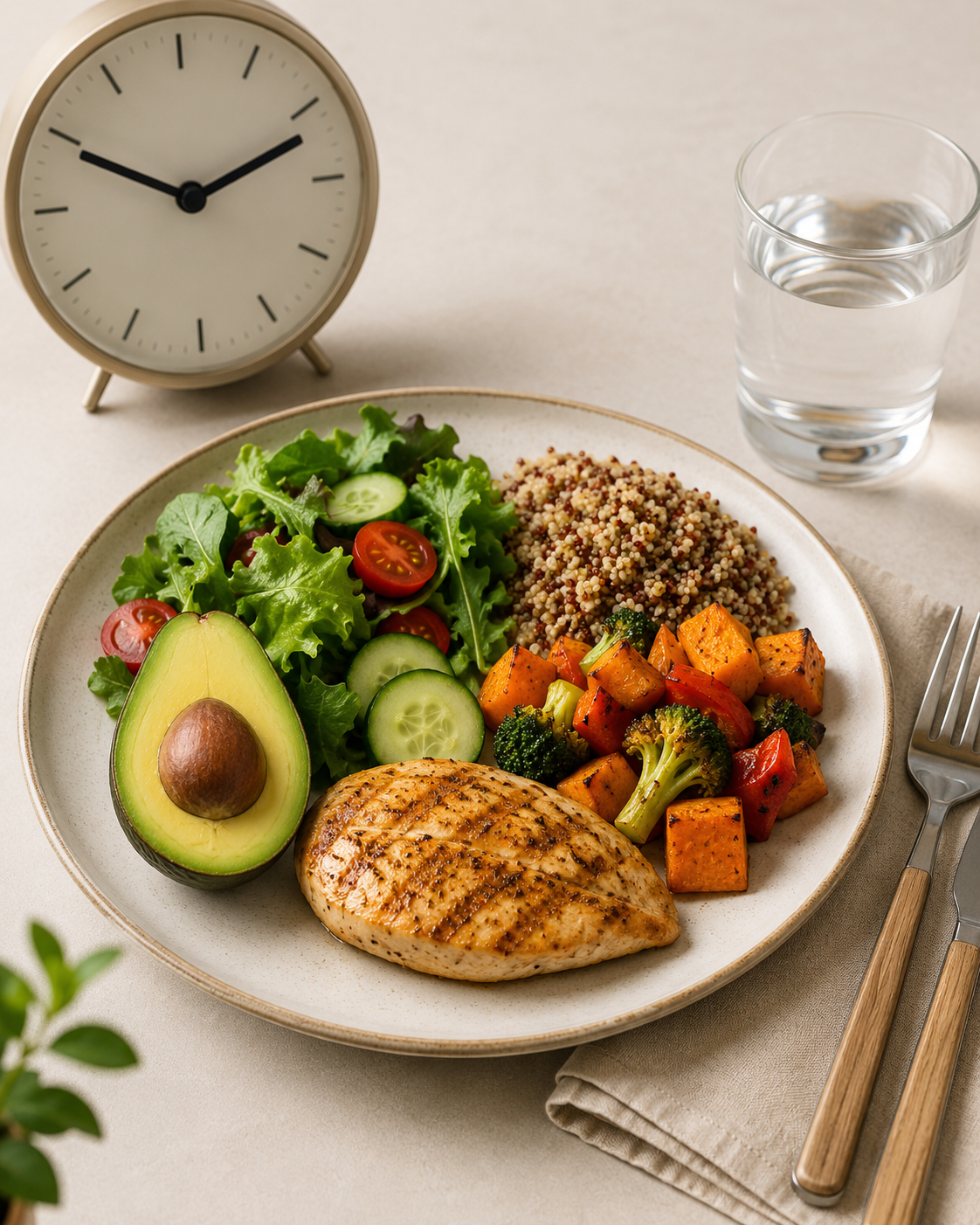
One meal a day (OMAD) is an intermittent fasting pattern where all daily calories are consumed in a single one-hour eating window, followed by 23 hours of water, black coffee, or tea only. Typical OMAD meals contain 1,200 to 1,800 calories with 40 to 60 grams of protein. Results in the first 30 days average 8 to 15 pounds of weight loss, though up to half is water and lean muscle, not fat.
At BodEvolve Bariatric and Cosmetic Surgery Center in Texas, our surgical team sees patients every week who have tried the extreme end of dieting, OMAD included, and are wondering why the results never stuck. This is the honest version of what happens when you eat one meal a day, why it works for some people short term, and why it can backfire in ways nobody warns you about.
Best Time for One Meal a Day
The best time for one meal a day depends less on the clock and more on your life. Most people who stick with OMAD for any length of time eat between 4 PM and 7 PM. That window works because it lines up with family dinner, keeps you social, and gives your body a few hours to digest before bed.
Late lunch, roughly 1 PM to 3 PM, is the second most common choice, especially for people who train in the evening or wake up naturally hungry. What you want to avoid is eating your one meal right before sleep. Lying down on a full stomach hurts digestion, spikes reflux, and wrecks sleep quality, which quietly undoes half the benefit you were chasing.
Whatever time you pick, keep it consistent. Your hunger hormones, especially ghrelin, learn your schedule within about two weeks. Random meal timing keeps you hungry all day.
Calories in One Meal
Calories in one meal is the question that trips up almost everyone starting OMAD. If your maintenance calories are 2,000 a day, a single meal that hits 2,000 calories is enormous. Picture a full dinner plate plus a second, plus dessert. Most people cannot physically eat that in an hour, which is exactly why weight loss happens.
A realistic OMAD meal for weight loss usually lands between 1,200 and 1,800 calories, and it should be heavy on protein (at least 40 to 60 grams), fiber-rich vegetables, and healthy fats. If you eat 800 calories in one meal and stop there, you are not dieting, you are semi-starving, and your body will fight back with fatigue, muscle loss, and eventual binges.
What Happens If You Only Eat One Meal a Day for a Week
What happens if you only eat one meal a day for a week is usually a mix of dramatic scale movement and quiet warning signs. In the first three days, you drop three to seven pounds. Almost all of that is water and glycogen, not fat. Your body stores about three grams of water for every gram of glycogen, and both leave fast when you stop eating regularly.
By day four or five, energy usually dips, workouts feel heavier, and sleep sometimes gets choppy. Some people report sharper focus in the fasting window; others get headaches, mood swings, and constipation. By day seven, the scale shows real progress, but your body has started to slow its metabolism to protect itself, which is why the second week always feels harder than the first.
What Eating One Meal a Day Actually Involves
When people talk about eating one meal a day, they usually mean compressing all of their food into a single sitting, often within a one-hour window, and consuming nothing but water, black coffee, or tea for the remaining 23 hours. Some people build it around one big meal a day at dinner. Others pick lunch. The label OMAD gets used interchangeably with this pattern.
The appeal is obvious. You stop counting, stop meal-prepping, and stop thinking about food for most of the day. But it is worth being clear about what OMAD is underneath the branding. It is not a magic metabolic switch. It is one specific, and fairly aggressive, way of creating a calorie deficit. Everything else follows from that.
One Meal a Day Fasting: Where OMAD Fits in Intermittent Fasting
One meal a day fasting sits at the far end of the intermittent fasting spectrum. More common approaches like 16:8 give you an eight-hour eating window. Intermittent fasting one meal a day shrinks that window to roughly one hour, which makes it one of the strictest fasting protocols regular people attempt without supervision.
That matters because the longer your fasting window, the harder it becomes to hit your nutritional needs in the time you have left. A 16-hour fast leaves room for two balanced meals. A 23-hour fast leaves room for one, and most people simply cannot eat enough protein, fiber, vitamins, and minerals in a single sitting to cover a full day. The fasting part gets the attention. The nutrition gap is the part that actually causes problems.
Is Eating One Meal a Day Healthy or Bad for You?
This is the question most people are really searching for, so here is a straight answer: for a healthy adult, eating one meal a day is not automatically dangerous in the short term, but it is rarely the healthiest choice, and for a lot of people it is a genuinely bad idea.
Whether one meal a day is healthy or bad for you depends on who you are. Someone with a stable relationship with food, no history of disordered eating, no blood sugar issues, and a nutrient-dense single meal might tolerate it fine for a while. But is it safe to eat one meal a day if you have diabetes, take medication that requires food, are pregnant, are underweight, or have any history of an eating disorder? For those groups the honest answer is no, and it is not close. The risk profile changes completely.
Even for healthy people, common downsides of only eating one meal a day include low energy, irritability, poor sleep, dizziness, constipation, and difficulty concentrating. Over longer periods, the bigger concerns are muscle loss, nutrient deficiencies, gallstones from rapid weight change, and a metabolism that adapts by slowing down.
One Meal a Day and Weight Loss: What Really Happens
Yes, you can lose weight by eating one meal a day, at least at first. But not for the reason most articles claim. There is nothing special about the single-meal timing itself. One meal a day and weight loss are connected only because eating once tends to cut your total calories, and a calorie deficit is what drives fat loss no matter how you arrive at it.
That distinction is the whole game. If you managed to eat a full day’s worth of calories in one enormous meal, the weight loss would stop. And if you can create the same deficit across two or three balanced meals, you get the fat loss without spending 23 hours hungry. This is exactly why our clinical team points patients toward the mechanics rather than the marketing. You can read the honest breakdown in our guide to the calorie deficit diet for weight loss, which explains how to set up a sustainable deficit and why the scale eventually stalls for almost everyone.
One Meal a Day Results: What to Realistically Expect
Search “one meal a day results” and you will find dramatic before-and-after claims tied to two weeks, 30 days, 60 days. Here is the part those posts leave out. Early weight loss on any very-low-intake pattern is heavily water weight and glycogen, not pure fat. The number on the scale moves fast at first, then slows, then often bounces back the moment normal eating resumes.
More importantly, a meaningful share of what you lose on an aggressive single-meal approach can be lean muscle, especially without enough protein and resistance training. Losing muscle makes it harder to keep weight off, leaves you weaker, and lowers the calories your body burns at rest. Sustainable, boring, repeatable habits beat dramatic restriction almost every time, which is the entire premise of our overview of weight loss strategies that actually work.
One Meal a Day Results 30 Days: How Much Weight Loss to Expect
Realistic one meal a day results 30 days out fall somewhere between 8 and 15 pounds for most people with 30 or more pounds to lose. Those with less to lose typically see 4 to 8 pounds. The catch is that a meaningful chunk of that number is not fat. Between water weight, glycogen depletion, and lean muscle loss, actual fat loss on a strict OMAD month is usually 40 to 60 percent of what the scale shows.
If protein stays above 0.7 grams per pound of goal body weight and you keep some form of resistance training in the week, you protect more muscle and your one meal a day results 30 days how much weight loss numbers hold up better long term.
One Meal a Day Results 60 Days: What Changes and What Doesn’t
By 60 days, most OMAD dieters have lost another 6 to 12 pounds, but the rate has clearly slowed. This is metabolic adaptation, not failure. Your body has adjusted to the lower intake and is burning fewer calories at rest.
The bigger issue at the 60-day mark is what has changed underneath the scale. Iron, B12, and vitamin D often drop. Women frequently report cycle changes. Hair thinning starts around week eight for some people. This is the point where most patients we see either double down and hurt themselves, or quit and rebound. A better move is to transition to a two-meal structure with the same daily calories.
Is Eating One Meal a Day an Eating Disorder?
Eating one meal a day is not, by itself, an eating disorder. Plenty of people try OMAD out of curiosity or convenience without any disordered pattern behind it. The pattern becomes a red flag when the motivation shifts.
Warning signs worth taking seriously include intense fear of eating more, guilt or panic after eating, using the single meal to punish yourself, hiding your eating from others, or feeling unable to stop even when you feel unwell. If restricting to one meal a day feels less like a diet choice and more like a rule you are afraid to break, that is a sign to talk to a professional, not to push harder.
If any of that sounds familiar for you or someone you love, support is available and confidential help lines exist, including the National Alliance for Eating Disorders. Reaching out early is a strength, not a setback.
Who Should Never Try One Meal a Day
This is where a bariatric surgical clinic can tell you something most OMAD content will not. For our patients, eating one meal a day is not just unhelpful, it is actively unsafe. After a gastric bypass or a gastric sleeve, the stomach holds a small fraction of what it once did. Cramming a full day of nutrition into one meal is physically impossible and can trigger nausea, dumping syndrome, and dangerous nutrient gaps. Post-surgical patients need small, frequent, protein-forward meals, the opposite of OMAD.
Beyond bariatric patients, one meal a day is a poor fit for anyone with diabetes or blood sugar swings, anyone on medication that must be taken with food, pregnant or breastfeeding women, teenagers and children, athletes with high energy demands, and anyone with a past or present eating disorder. If you fall into any of those groups, the best time to eat one meal a day is never, and a supervised plan is the safer path.
A Safer Way to Lose Weight Than One Meal a Day
The reason so many people land on extreme approaches like OMAD is that ordinary dieting failed them, often many times. That failure is usually not about willpower. Elevated hunger hormones, insulin resistance, and years of yo-yo dieting can make the standard advice feel impossible to sustain. That is a medical problem, and it deserves a medical answer rather than a stricter punishment.
At BodEvolve, the surgical team led by dr Frenzel, who is triple board-certified, evaluates each person’s full metabolic picture before recommending anything. For some, that means structured medical weight management. For others with significant, long-standing obesity, it means procedures that create the hormonal and structural changes diet alone cannot replicate. And if cost is what has kept you on the sidelines, our guide on how to get insurance to cover revision bariatric surgery walks through coverage in plain language.
If you are in the Dallas–Fort Worth area and tired of extreme diets that never last, BodEvolve’s board-certified team can help you find an approach built to work long term. We see patients at our Arlington, Richardson, Dallas, and Texarkana locations.
