
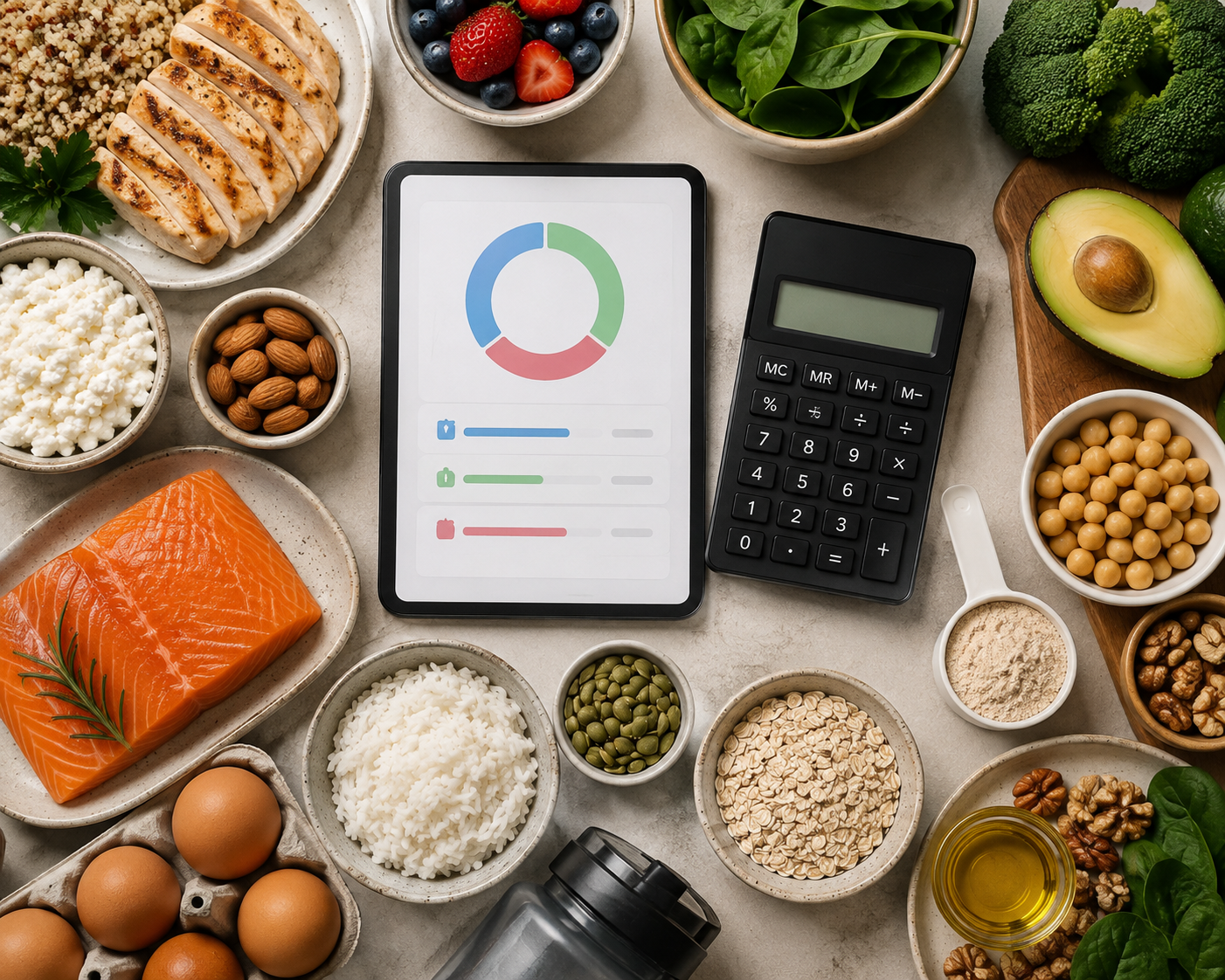
How to count macros for weight loss, you set a daily calorie target slightly below what your body burns, eat about 500 fewer than that, and then split what you eat into protein, carbs, and fat. Protein does most of the heavy lifting here, which is why most people start with a 30/40/30 split and keep the protein number high. That’s really it. The rest of this guide gets into the details, gives you a free calculator, and, because we’re a bariatric practice, covers what changes if you’ve had weight loss surgery or you’re taking a GLP-1.
What Are Macros, and Why Do They Matter?
Macros, short for macronutrients, are the three nutrients your body needs in large amounts: protein, carbohydrates, and fat. Each one carries calories. Protein and carbs have 4 calories per gram, and fat has 9 calories per gram. When people talk about how to count macros for weight loss, they really mean tracking the grams of each nutrient so the total adds up to a calorie level that helps you lose fat.
Plain calorie counting tells you how much you are eating. Macro counting tells you what you are eating. That difference matters. Two meals can have the same calories, but the one with more protein will keep you fuller, help preserve lean muscle, and make the fat loss feel less like deprivation. That is why so many people who plateau on standard diets switch to figuring out their macros instead.
Step 1: Find Out How Many Calories You Burn
Before you can determine your macros, you need to know your daily energy needs. This number is called your TDEE, or Total Daily Energy Expenditure. It is the amount of calories your body burns in a full day, including everything from breathing to walking to workouts.
Start with your resting needs using the Mifflin-St Jeor formula, which most dietitians rely on. Then multiply that by an activity factor:
- Sedentary (little exercise): BMR x 1.2
- Lightly active (1 to 3 days a week): BMR x 1.375
- Moderately active (3 to 5 days a week): BMR x 1.55
- Very active (6 to 7 days a week): BMR x 1.725
You do not need to do the math by hand. A free TDEE calculator will ask for your age, sex, height, weight, and activity level, then hand you the number in seconds. That number is your starting line.
Step 2: Set a Calorie Deficit That You Can Stick To
Weight loss comes down to one rule. You have to eat fewer calories than you burn. This gap is called a calorie deficit, and it is the engine behind every approach to losing weight, macros included.
A safe and sustainable deficit is around 500 calories below your TDEE per day, which adds up to roughly one pound of fat loss per week. If you prefer percentages, trimming 15% to 25% off your maintenance calories works well for most people. Resist the urge to slash too much. Crash deficits backfire because they tank your energy, spike your hunger, and burn away muscle along with fat. Slow and steady wins here, and it is far easier to keep the weight off when you do it without starving yourself.
Step 3: Calculate Your Macros
Now for the part everyone asks about. Once you have your target calories, here is how to calculate your macros for weight loss in a simple order:
Protein first:
Aim for about 0.7 to 1 gram of protein per pound of your goal body weight. Protein protects muscle during a deficit and keeps hunger in check, so it deserves top priority.
Fat next:
Set fat at roughly 0.3 to 0.4 grams per pound of body weight. You need enough fat for hormones and overall health, so do not cut it too low.
Carbs fill the rest:
Whatever calories are left after protein and fat get assigned to carbohydrates. Carbs fuel your workouts and your brain, so they are not the enemy.
Here is a quick example. Say a 200-pound person lands on 1,800 calories for fat loss:
- Protein: 160g (640 calories)
- Fat: 60g (540 calories)
- Carbs: 155g (620 calories)
That adds up to your 1,800-calorie target. These are starting numbers, not permanent rules. If you wonder how many macros you should be eating, this framework gives you a solid baseline that you fine-tune over a few weeks based on real results.
Try Our Free Macro Calculator
Skip the manual math. Enter your details below and get your daily calorie target and macro breakdown instantly.
Macro Calculator
Estimate your daily calories, protein, carbs, and fat based on your body and goals.
Please fill in your age, height, and weight to calculate your macros.
Ready for lasting results? Book a free consultation with our team.
This calculator provides general estimates for educational purposes only and is not medical advice. If you have had or are considering bariatric surgery, your nutrition needs are different. Always follow the plan provided by your surgeon and dietitian at BodEvolve.
How to Track Your Macros Each Day
Knowing your numbers is half the job. Tracking is the other half, and it is where most of the results come from. A food tracking app like MyFitnessPal or Cronometer does the heavy lifting. You log what you eat, scan barcodes, and the app totals your protein, carbs, and fat against your goals.
A few habits make tracking far more accurate:
- Use a kitchen food scale for at least the first month. Eyeballing portions is the most common reason people stall.
- Read nutrition labels and log serving sizes by weight, not by guess.
- Track everything, including cooking oils, sauces, drinks, and the bites you take while cooking.
- Prep meals ahead when you can, since repeating reliable meals makes hitting your macros almost automatic.
Consistency beats perfection. Hitting your protein goal and landing within 5 to 10 grams on carbs and fat is plenty good enough to keep losing weight steadily.
How to Work Out Your Macros for Fat Loss and Muscle Gain
If your goal is to lose fat while building or maintaining muscle, the macro setup is the same but carbs become your most flexible lever. On rest days, bring carbs down slightly and let fat fill the gap. On training days, bring carbs back up to fuel your session. This approach, called carb cycling, helps your body tap into stored fat without hurting workout performance.
For beginners starting out, skip carb cycling entirely for the first four to six weeks. Hit your protein target consistently, hold your deficit, and let the basics work before adding any complexity.
Counting Macros for Weight Loss for Women
Women often ask how to count macros for weight loss when their numbers look so different from a partner's or a friend's. The method is identical, but the inputs change. Women generally have lower calorie needs, so the calorie floor matters. Dropping below roughly 1,200 calories a day is rarely a good idea without medical supervision.
Protein still comes first, and keeping it high helps with the muscle preservation and appetite control that make a deficit livable. Hormonal shifts, including perimenopause and menopause, can slow metabolism and change how the body handles carbs, so many women do well leaning slightly higher on protein and slightly lower on refined carbs during those years. If your weight stops responding, that is a signal to recheck your TDEE rather than to cut calories drastically.
Common Macro Counting Mistakes to Avoid
A handful of mistakes trip up almost everyone learning how to figure out their macros for weight loss:
- Eating too little protein, which leaves you hungry and costs you muscle
- Guessing portion sizes instead of weighing food
- Forgetting liquid calories from coffee drinks, juice, and alcohol
- Setting the deficit too aggressively and burning out within two weeks
- Quitting after one bad day instead of getting back on track the next meal
Avoid these and you will be ahead of most people who try this on their own.
Macro Counting After Bariatric Surgery
For patients who have had gastric sleeve or gastric bypass surgery, macro counting shifts. Protein becomes the non-negotiable priority at 60 to 80 grams per day minimum, regardless of your calorie target. Carbs and fat get adjusted around that fixed protein floor. This approach protects lean mass during the rapid weight loss phase and supports long-term maintenance once you reach your goal weight.
When Counting Macros Is Not Enough
Macro counting is a powerful tool, and for many people it is all they need. But if you have struggled with significant or stubborn weight for years, tracking alone may not move the needle the way you hoped. Genetics, metabolism, and underlying medical conditions all play a role that a food scale cannot fix.
That is where professional support changes the picture. A structured medical weight management program pairs nutrition guidance with medications and clinical oversight for people who need more than diet changes. For those carrying a larger amount of excess weight, procedures like gastric sleeve surgery and gastric bypass deliver results that are difficult to reach through dieting alone. At BodEvolve, board-certified surgeons build a complete plan around your body and your goals, and macro counting often becomes part of the long-term maintenance that keeps the weight off after surgery.
If you are in the Dallas-Fort Worth area, you can meet our team at our Arlington, Richardson, Dallas, or Texarkana locations.
The Bottom Line
Learning how to count macros for weight loss is simpler than it looks once you break it into steps. Find your calories, set a reasonable deficit, split your protein, fat, and carbs, then track honestly and adjust over time. For many people, that is the missing piece that finally makes fat loss stick. And if your weight has not budged despite doing everything right, the experienced team at BodEvolve can help you find a path that works for your body. Book a consultation to take the next step.
Frequently Asked Questions
How do I calculate my macros for weight loss?
Start by finding your daily calorie needs, then subtract about 500 calories for a deficit. Set protein at 0.7 to 1g per pound of goal weight, fat at 0.3 to 0.4g per pound, and fill the rest with carbs. Track daily and adjust as needed.
What are the best macros for menopause?
There is no single perfect split, but many women in menopause do well with higher protein to protect muscle and slightly lower refined carbs. Keeping protein around 30% or more of calories supports satiety and metabolism during hormonal changes.
Do I need to count calories on Zepbound?
Counting is not required, since Zepbound reduces appetite on its own. Still, tracking protein helps protect muscle while you lose weight, and keeping a loose eye on calories prevents under-eating. Always follow your prescribing provider’s guidance.
Can I eat anything as long as I hit my macros?
Technically you can lose weight hitting your macros with almost any foods, but food quality still matters for energy, digestion, and health. Aim to fill most of your macros with whole, nutrient-dense foods and leave a little room for treats.
Can you lose weight by counting macros?
Yes, because counting macros is precision calorie counting, hitting your protein, carb, and fat targets keeps intake controlled while preserving muscle and curbing hunger. It only works within a calorie deficit, though, so hitting your macros while overeating won’t produce results.
