
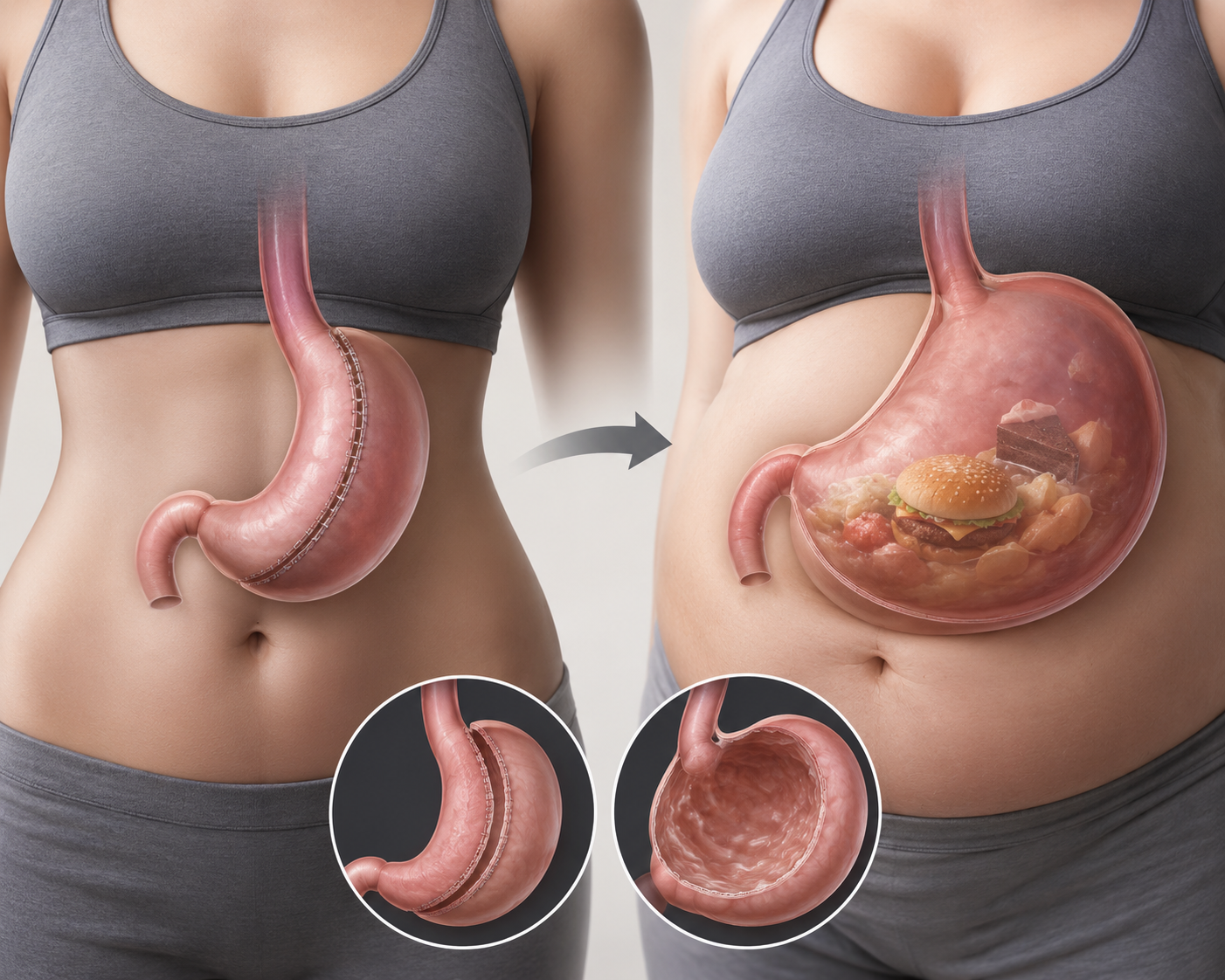
Can you stretch your stomach after gastric sleeve? The short answer is yes, but almost never in the way patients fear. A sleeve stomach naturally expands a little in the first year as swelling settles, and it can slowly enlarge over the years if certain eating habits creep back in. What it will not do is quietly return to its original size, no matter how many horror stories you read online. This is the piece most blogs get wrong, and it is the piece that keeps otherwise successful patients up at night.
At BodEvolve Bariatric Surgery Center in Texas, dr Frenzel and Dr. Brian Holt have this exact conversation with patients almost weekly. Someone had surgery a year ago, portions feel bigger than they used to, the scale is nudging upward, and panic sets in. This guide walks you through what is actually happening inside your sleeve, what the research says, and what to do if you think your sleeve has stretched.
Can Your Stomach Stretch After Gastric Sleeve? The Short Answer
Your sleeve stomach is created by removing about 75 to 80 percent of the original stomach, leaving behind a narrow banana-shaped tube. Immediately after a gastric sleeve procedure, that tube holds roughly 2 to 4 ounces of food or liquid. Over the first 12 months, natural post-surgical swelling reduces and the sleeve settles into a comfortable working capacity of around 4 to 6 ounces. That is expansion, not failure.
The question of whether your stomach can stretch after gastric sleeve becomes more serious when we are talking about years three, four, or five post-op. Studies published in Obesity Surgery have shown that sleeve volume can gradually increase by 25 to 50 percent over long time periods in some patients. That still leaves you with a stomach far smaller than the original organ, but it can be enough to allow regain if your habits have loosened alongside it.
After Gastric Sleeve Can Your Stomach Stretch From Normal Eating?
Not really, and this is the reassurance most patients need to hear. A single big meal, a holiday feast, or an occasional restaurant portion is not going to permanently enlarge your sleeve. Your stomach tissue is muscular and elastic. It stretches to accommodate what you eat and then returns close to its resting size, the same way it did before surgery.
What causes actual, lasting sleeve enlargement is chronic pattern behavior. Grazing all day, ignoring the full signal, eating past discomfort meal after meal, and drinking with meals for months on end. That combination is what slowly retrains the sleeve. One Thanksgiving dinner will not do it. Two years of quietly bumping up portion sizes absolutely can.
Can Water Stretch Your Stomach After Gastric Sleeve?
This is one of the most searched questions among sleeve patients, and the answer surprises most people. Water alone, sipped throughout the day the way you are supposed to, cannot stretch your sleeve. Water passes through the pyloric valve within minutes. It does not sit in the stomach long enough to apply the sustained pressure that would enlarge tissue.
The real risk with fluids is not water itself. It is carbonated drinks, which trap gas and apply outward pressure on your sleeve, and it is drinking with meals, which pushes solid food through your stomach too quickly and lets you eat more than your sleeve should hold. If you are hitting 64 ounces of plain water a day and not drinking during meals, you are doing exactly what your surgeon wants you to do.
Can You Stretch Your Stomach After Gastric Sleeve With Water Between Meals?
No. In fact, drinking water between meals is one of the healthiest habits a sleeve patient can build. It keeps you hydrated, curbs false hunger cues, prevents dumping style symptoms, and never risks stretching your sleeve. The 30 minutes before and 30 minutes after eating are the only windows you need to keep fluid-free.
If you are worried about water intake somehow undoing your surgery, put that fear down. Chronic dehydration is a far bigger risk for sleeve patients than any theoretical stretching from sipping water throughout the afternoon.
Can You Stretch Out Your Stomach After Gastric Sleeve? Warning Signs to Watch
There is a difference between wondering if you can stretch out your stomach after gastric sleeve and actually seeing signs that it is happening. The following patterns are the ones we look for at follow-up appointments:
- Your portions have quietly grown from 4 ounces to 8 or 10 ounces at most meals
- You can eat past the point of comfortable fullness without pain or restriction
- Hunger returns within one to two hours of eating
- The scale has stalled or reversed for three or more consecutive months
- Sliders like crackers, chips, and sweets go down easily and in large amounts
- You find yourself grazing rather than eating three defined meals
If two or more of these describe you, the sleeve is likely enlarged behaviorally, not surgically. That distinction matters because behavioral enlargement responds beautifully to a structured reset. Surgical failure is much rarer than the internet suggests.
Our team walks through this exact checklist in our weight loss stall after gastric sleeve guide, which covers what to do at the 3-month, 6-month, and 1-year stall points before anyone assumes surgery is to blame.
Can You Stretch Your Stomach Back Out After Gastric Sleeve on Purpose?
Some patients ask this fearing they will, others ask it because they wish they could eat more. Either way, the answer is that you cannot force your sleeve back to its original size. The removed portion of the stomach is gone permanently. What you can do, over years of consistent overeating, is stretch what remains by 25 to 50 percent. That is enough to blunt your results but not enough to give you back the stomach you had before surgery.
The takeaway: your sleeve is a one-way anatomical change with a small amount of behavioral give. Treat it well and it stays close to its designed size. Push it consistently and it grows to accommodate you, which is the opposite of what you paid for.
Can Your Stomach Stretch After a Gastric Sleeve More Than a Gastric Bypass?
Yes, slightly. A sleeve is a single tube of muscular stomach tissue, which means the entire structure can enlarge over time. A gastric bypass creates a very small pouch (about the size of an egg) that is disconnected from the rest of the stomach, so there is far less tissue that can stretch. This is one reason some patients who regain significant weight after a sleeve are eventually offered revision to bypass or SADI-S.
If you are years post-sleeve and stretching plus regain has become a serious problem, revision is worth discussing. It is not a failure conversation. It is a next-step conversation, and thousands of patients have it every year.
How to Prevent Sleeve Stretching (The Habits That Actually Matter)
Prevention is not glamorous, but it works. The patients we see maintain their results long term all follow the same core rules:
- Protein first, every single meal
- Solid food, not liquid calories, as the base of your diet
- Twenty chews per bite, minimum
- No drinking within 30 minutes before or after eating
- Three defined meals a day, no all-day grazing
- Stop eating at the first sign of comfortable fullness
- Zero carbonated drinks, permanently
- Track protein grams if the scale starts to move the wrong way
If you already know your habits have slipped and portions have crept up, a short structured reset can retrain your sleeve behaviorally without any additional surgery. Our gastric sleeve reset diet breakdown walks through the 5-day pouch reset that Dr. Frenzel recommends for exactly this situation.
When Revision Surgery Becomes the Right Conversation
If your sleeve has enlarged significantly, if you have regained more than 25 percent of the weight you lost, and if a structured reset plus nutrition support has not moved the needle after three to six months, revision surgery is a legitimate option. Common revisions from a stretched sleeve include re-sleeve, conversion to gastric bypass, and conversion to SADI-S.
Cost is often the first worry. The good news is that revision surgery is frequently covered by insurance when the initial procedure has documented failure and specific criteria are met. Read how to get insurance to cover revision bariatric surgery for the paperwork trail, documentation, and appeal strategies that get revision approved in Texas.
Talk to a Texas Bariatric Surgeon Who Will Actually Answer Your Questions
If you have read this far, you are probably worried about regain, portions, or whether something is going wrong with your sleeve. The best thing you can do is stop guessing and get evaluated. A quick consultation with an experienced bariatric surgeon will tell you whether your sleeve is behaviorally enlarged (fixable at home) or structurally enlarged (may need revision).
BodEvolve sees patients across Arlington, richardson, Dallas, and texarkana with nutrition support, revision consultations, and long-term care that keeps sleeve patients on track years after surgery. Reach out today and get a personalized consultation with a surgical team that has seen every version of this question.
